
Pulp Fiction, 1928 · page 139 of 160
Argosy All-Story Weekly, April 7, 1928 — page 139: what you’re looking at
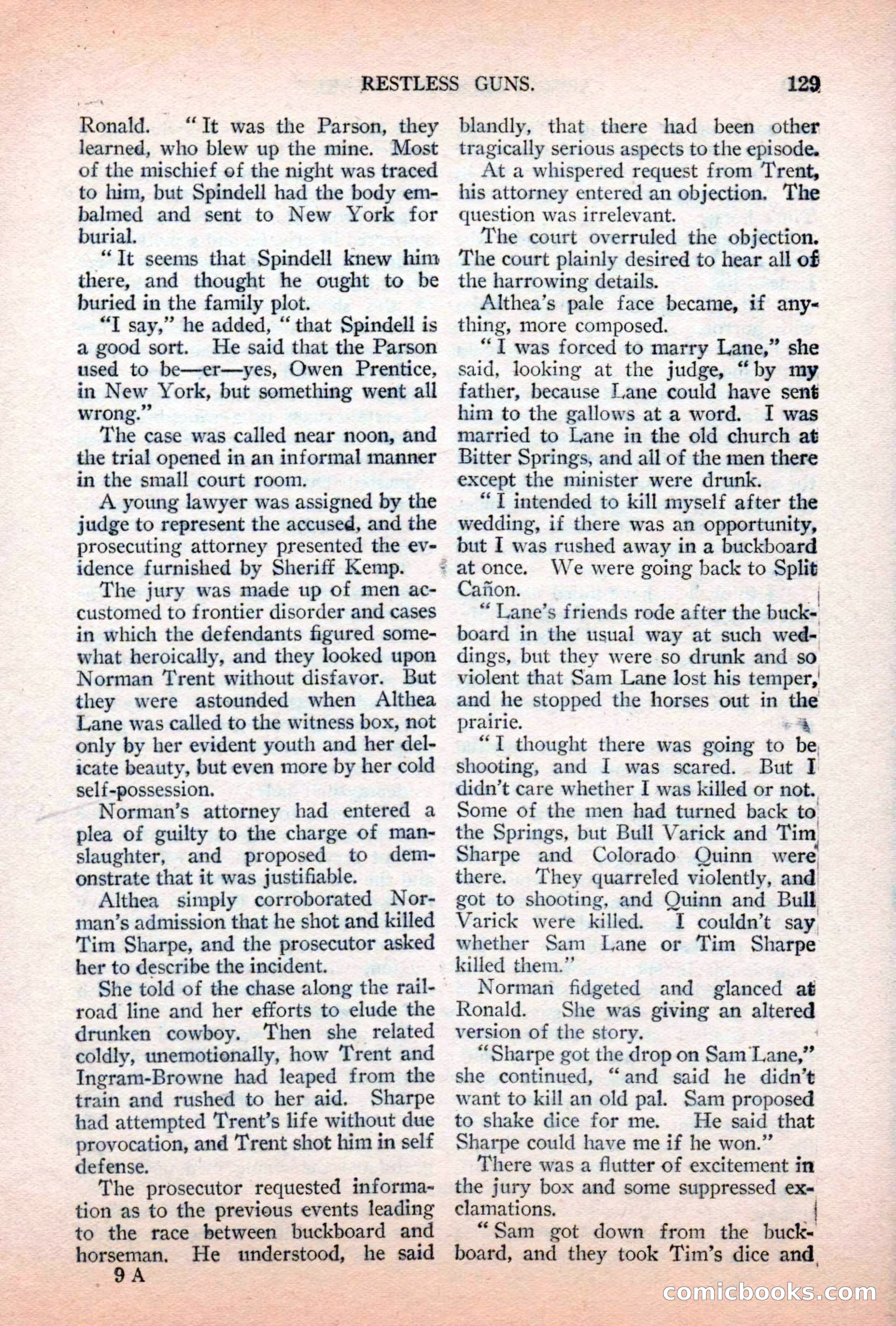
A restored page from Pulp Fiction, 1928. Page through the whole issue in the reader above.
📄 Transcribed text from this page (OCR, searchable)
Machine-transcribed from the original scan — historical spelling and the odd misread are preserved.
RESTLESS GUNS. Ronald. “It was the Parson, they learned, who blew up the mine. Most of the mischief of the night was traced to him, but Spindell had the body em- balmed and sent to New York for burial. | “It seems that Spindell knew hina there, and thought he ought to be buried in the family plot. “T say,” he added, “that Spindell is a good sort. He said that the Parson used to be—er—yes, Owen Prentice, in New York, but something went all wrong.” The case was called near noon, and the trial opened in an informal manner in the small court room. A young lawyer was assigned by the judge to represent the accused, and the prosecuting attorney presented the ev- idence furnished by Sheriff Kemp. The jury was made up of men ac- customed to frontier disorder and cases in which the defendants figured some- what heroically, and they looked upon Norman Trent without disfavor. But they were astounded when Althea Lane was called to the witness box, not only by her evident youth and her del- icate beauty, but even more by her cold self-possession. Norman’s attorney had entered a plea of guilty to the charge of man- slaughter, and proposed to dem- onstrate that it was justifiable. Althea simply corroborated Nor- man’s admission that he shot and killed Tim Sharpe, and the prosecutor asked her to describe the incident. She told of the chase along the rail- road line and her efforts to elude the drunken cowboy. ‘Then she related coldly, unemotienally, how Trent and Ingram-Browne had leaped from the train and rushed to her aid. Sharpe had attempted Trent’s life without due provocation, and Trent shot him in self defense. The prosecutor requested informa~ tion as to the previous events leading to the race between buckboard and a He understood, he said A = at once. 129 blandly, that there had been other tragically serious aspects to the episode. At a whispered request from Trent, his attorney entered an objection, The question was irrelevant. The court overruled the objection. The court plainly desired to hear all of the harrowing details. Althea’s pale face became, if any- thing, more composed. “I was forced to marry Lane,” she said, looking at the judge, “by my father, because Lane could have sent him to the gallows at a word. I was married to Lane in the old church at Bitter Springs, and all of the men there except the minister were drunk. “{ intended to kill myself after the wedding, if there was an opportunity, but I was rushed away in a buckboard We were going back to _ Cafion. “ Lane’s friends rode after the bucks board in the usual way at such wed- dings, but they were so drunk and so violent that Sam Lane lost his temper, and he stopped the horses out in the prairie. mA’ “T thought there was going to be, shooting, and I was scared. But I didn’t care whether I was killed or not. Some of the men had turned back to the Springs, but Bull Varick and Tim, Sharpe and Colorado Quinn were there. ‘They quarreled violently, and got to shooting, and Quinn and Bull Varick were killed. “I couldn’t say whether Sam Lane or Tim Sharpe killed them.”’ Norman fidgeted and glanced at Ronald. She was giving an altered version of the story. “Sharpe got the drop on Sam Lane,” she continued, “and said he didn’t want to kill an old pal. Sam proposed to shake dice for me. He said that Sharpe could have me if he won.” There was a flutter of excitement in the jury box and some suppressed ex- clamations, “Sam got down from the buck- board, and they took Tim’s dice and. Gomichbooks com