
Pulp Fiction, 1928 · page 22 of 160
Argosy All-Story Weekly, April 7, 1928 — page 22: what you’re looking at
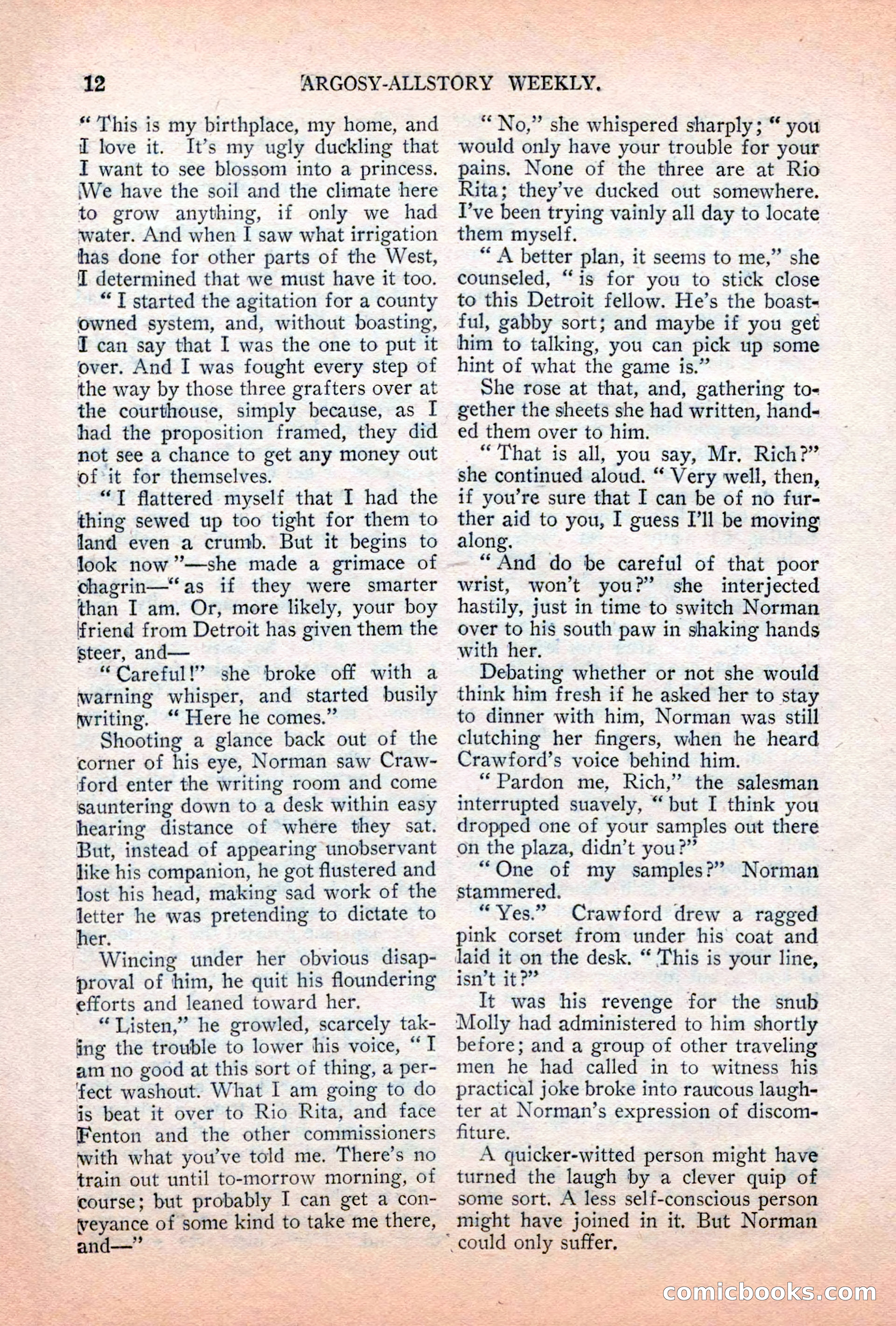
A restored page from Pulp Fiction, 1928. Page through the whole issue in the reader above.
📄 Transcribed text from this page (OCR, searchable)
Machine-transcribed from the original scan — historical spelling and the odd misread are preserved.
12 “ This is my birthplace, my home, and f love it. It’s my ugly duckling that ft want to see blossom into a princess. We have the soil and the climate here to grow anything, if only we had water. And when I saw what irrigation has done for other parts of the West, I determined that we must have it too. “T started the agitation for a county owned system, and, without boasting, TI can say that I was the one to put it over. And I was fought every step of the way by those three grafters over at the courthouse, simply because, as I had the proposition framed, they did not see a chance to get any money out of it for themselves. “T flattered myself that I had the thing sewed up too tight for them to land even a crumb. But it begins to look now ’—she made a grimace of chagrin—“‘as if they were smarter than I am. Or, more likely, your boy friend from Detroit has given them the steer, and— “Careful!” she broke off with a warning whisper, and started busily Writing, ‘“ Here he comes.” Shooting a glance back out of the corner of his eye, Norman saw Craw- ford enter the writing room and come sauntering down to a desk within easy hearing distance of where they sat. But, instead of appearing unobservant like his companion, he got flustered and lost his head, making sad work of the letter he was pretending to dictate to her. Wincing under her obvious disap- proval of him, he quit his floundering efforts and leaned toward her. “Tisten,” he growled, scarcely tak- ing the trouble to lower his voice, “I am no good at this sort of thing, a per- fect washout. What I am going to do is beat it over to Rio Rita, and face Fenton and the other commissioners with what you’ve told me. There’s no train out until to-morrow morning, of course; but probably I can get a con- veyance of some kind to take me there, and—” ARGOSY-ALLSTORY WEEKLY. “No,” she whispered sharply; “ you would only have your trouble for your pains. None of the three are at Rio Rita; they've ducked out somewhere. I’ve been trying vainly all day to locate them myself. “A better plan, it seems to me,” she counseled, “‘is for you to stick close to this Detroit fellow. He’s the boast- ful, gabby sort; and maybe if you get him to talking, you can pick up some hint of what the game is.” She rose at that, and, gathering to- gether the sheets she had written, hand- ed them over to him. “That is all, you say, Mr, Rich?” she continued aloud. “ Very well, then, if you’re sure that I can be of no fur- ther aid to you, I guess I'll be moving along, “And do be careful of that poor wrist, won't you?” she interjected hastily, just in time to switch Norman over to his south paw in shaking hands with her. Debating whether or not she would think him fresh if he asked her to stay to dinner with him, Norman was still clutching her fingers, when he heard Crawford’s voice behind him. “Pardon me, Rich,” the salesman interrupted suavely, “but I think you dropped one of your samples out there on the plaza, didn’t you?” “One of my samples?” Norman stammered. : “Yes.” Crawford drew a ragged pink corset from under his coat and laid it on the desk. “ ‘This is your line, isn’t it?” It was his revenge for the snub Molly had administered to him shortly before; and a group of other traveling men he had called in to witness his practical joke broke into raucous laugh- ter at Norman’s expression of discom- fiture. A quicker-witted person might have turned the laugh by a clever quip of some sort. A less self-conscious person might have joined in it. But Norman could only suffer. (E@) migbooks (EO)