
Pulp Fiction, 1928 · page 23 of 160
Argosy All-Story Weekly, April 7, 1928 — page 23: what you’re looking at
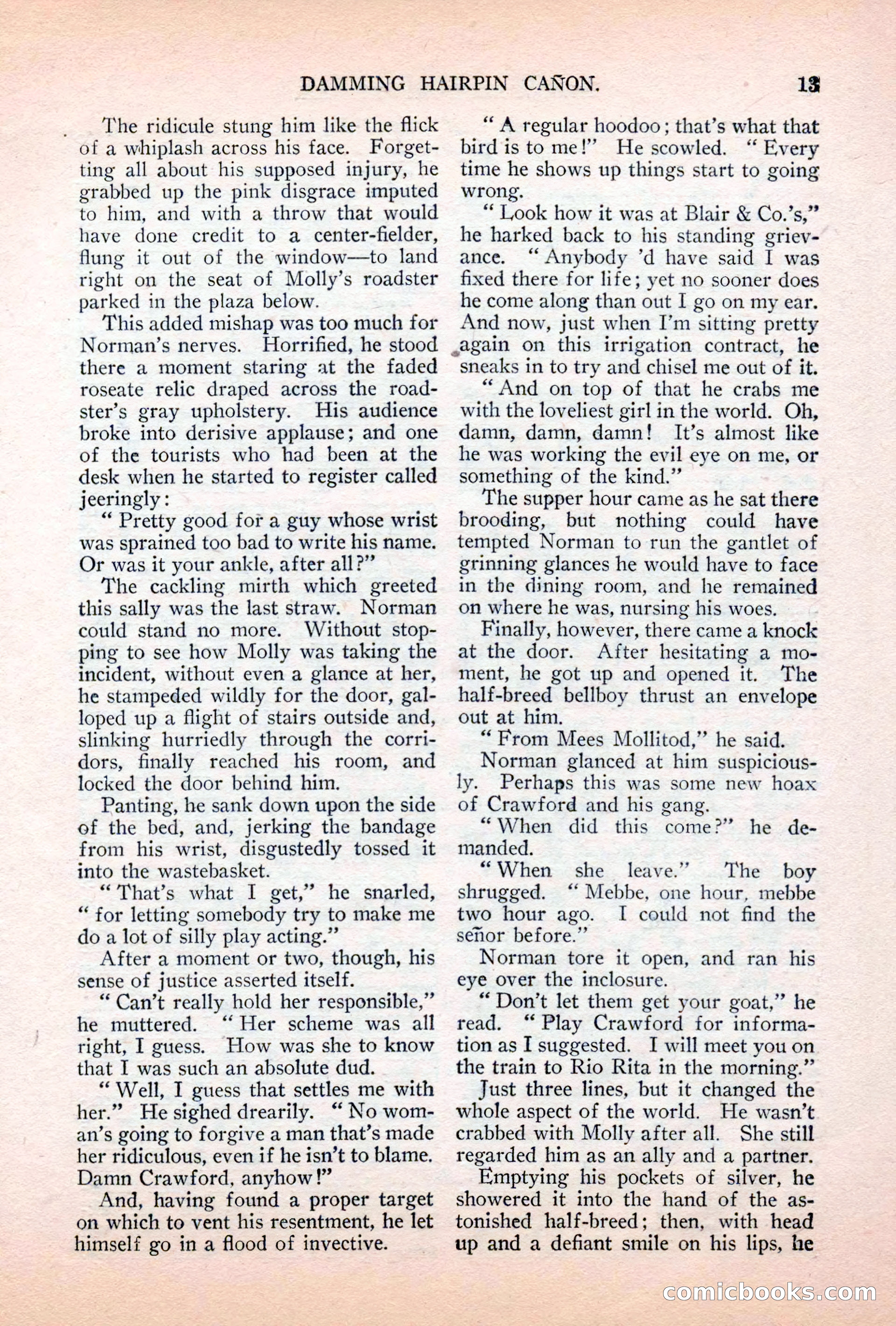
A restored page from Pulp Fiction, 1928. Page through the whole issue in the reader above.
📄 Transcribed text from this page (OCR, searchable)
Machine-transcribed from the original scan — historical spelling and the odd misread are preserved.
DAMMING HAIRPIN CANON, The ridicule stung him like the flick of a whiplash across his face. Forget- ting all about his supposed injury, he grabbed up the pink disgrace imputed to him, and with a throw that would have done credit to a center-fielder, flung it out of the window—to land right on the seat of Molly’s roadster parked in the plaza below. This added mishap was too much for Norman’s nerves. Horrified, he stood there a moment staring at the faded roseate relic draped across the road- ster’s gray upholstery. His audience broke into derisive applause; and one of the tourists who had been at the desk when he started to register called jeeringly: “ Pretty good for a guy whose wrist was sprained too bad to write his name. Or was it your ankle, after all?” The cackling mirth which greeted this sally was the last straw. Norman could stand no more. Without stop- ping to see how Molly was taking the incident, without even a glance at her, he stampeded wildly for the door, gal- loped up a flight of stairs outside and, slinking hurriedly through the corri- dors, finally reached his room, and locked the door behind him. Panting, he sank down upon the side of the bed, and, jerking the bandage from his wrist, disgustedly tossed it into the wastebasket. “That’s what I get,” he snarled, “ for letting somebody try to make me do a lot of silly play acting.” After a moment or two, though, his sense of justice asserted itself. “ Can’t really hold her responsible,” he muttered. ‘“‘ Her scheme was all right, I guess. How was she to know that I was such an absolute dud. “ Well, I guess that settles me with her.” He sighed drearily. “ No wom- an’s going to forgive a man that’s made her ridiculous, even if he isn’t to blame. Damn Crawford, anyhow!” And, having found a proper target on which to vent his resentment, he let himself go in a flood of invective. 13 “A regular hoodoo; that’s what that bird is to me!” He scowled. “ Every time he shows up things start to going wrong. ** Look how it was at Blair & Co.’s,” he harked back to his standing griev- ance. “ Anybody ’d have said I was fixed there for life; yet no sooner does he come along than out I go on my ear. And now, just when I’m sitting pretty .again on this irrigation contract, he sneaks in to try and chisel me out of it. “And on top of that he crabs me with the loveliest girl in the world. Oh, damn, damn, damn! It’s almost like he was working the evil eye on me, or something of the kind.” The supper hour came as he sat there brooding, but nothing could have tempted Norman to run the gantlet of grinning glances he would have to face in the dining room, and he remained on where he was, nursing his woes. Finally, however, there came a knock at the door. After hesitating a mo- ment, he got up and opened it. The half-breed bellboy thrust an envelope out at him. “From Mees Mollitod,” he said. Norman glanced at him suspicious- ly. Perhaps this was some new hoax of Crawford and his gang. “When did this come?” manded. “ When shrugged. two hour ago. senor before.” Norman tore it open, and ran his eye over the inclosure. “Don’t let them get your goat,” he read. “ Play Crawford for informa- tion as I suggested. I will meet you on the train to Rio Rita in the morning.” Just three lines, but it changed the whole aspect of the world. He wasn’t crabbed with Molly after all. She still regarded him as an ally and a partner. Emptying his pockets of silver, he showered it into the hand of the as- tonished half-breed; then, with head up and a defiant smile on his lips, he he de- she leave.” The boy *“Mebbe, one hour, mebbe I could not find the EOPMICE MOO KS (E@)