
Pulp Fiction, 1928 · page 24 of 152
Argosy All-Story Weekly, April 14, 1928 — page 24: what you’re looking at
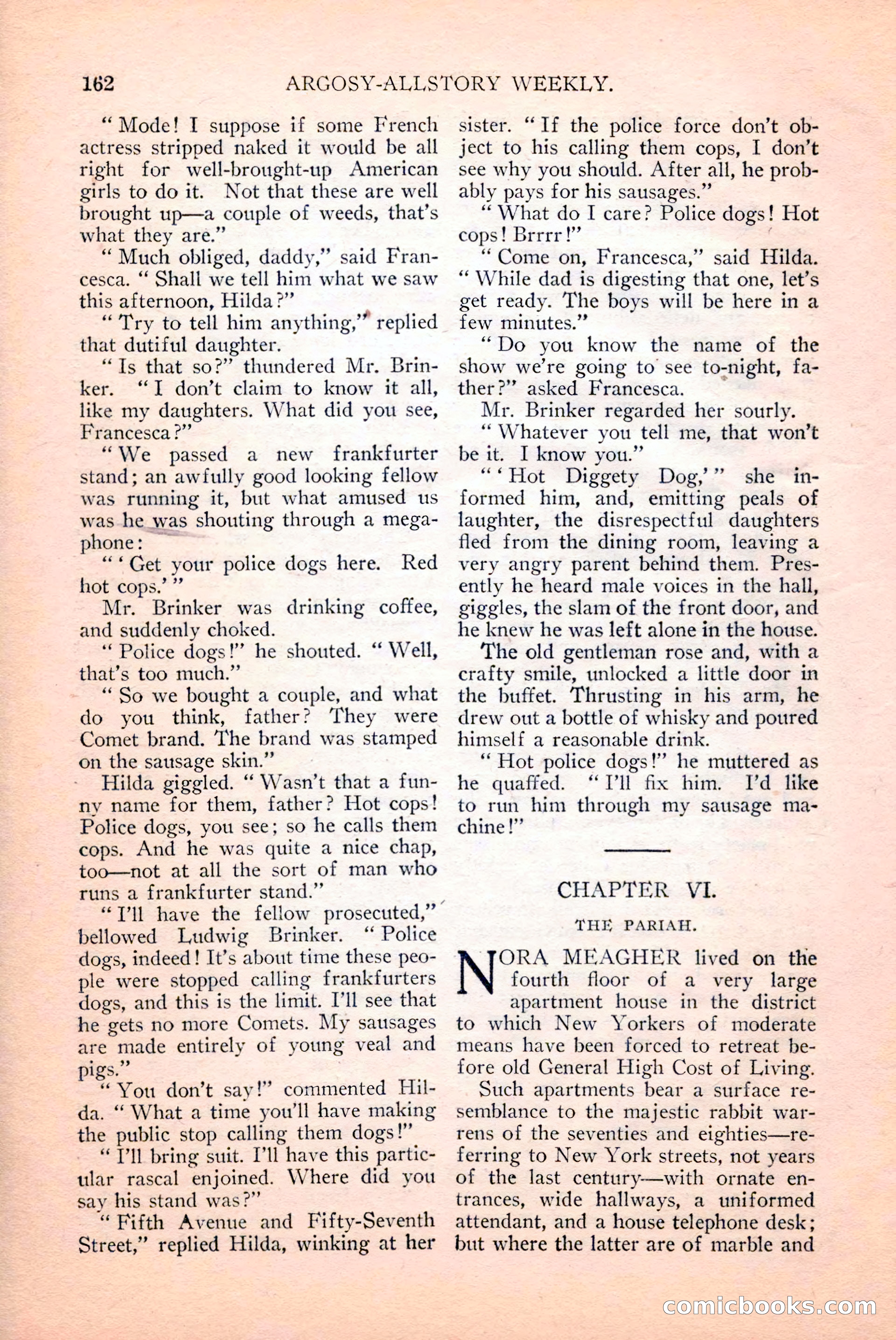
A restored page from Pulp Fiction, 1928. Page through the whole issue in the reader above.
📄 Transcribed text from this page (OCR, searchable)
Machine-transcribed from the original scan — historical spelling and the odd misread are preserved.
162 “Mode! I suppose if some French actress stripped naked it would be all right for well-brought-up American girls to do it. Not that these are well brought up—a couple of weeds, that’s what they are.” “ Much obliged, daddy,” said Fran- cesca. “ Shall we tell him what we saw this afternoon, Hilda °” “Try to tell him anything,” replied that dutiful daughter. “Ts that so?” thundered Mr. Brin- ker. ‘‘I don’t claim to know it all, like my daughters. What did you see, Francesca?” “We passed a new frankfurter stand; an awfully good looking fellow was running it, but what amused us was he was shouting through a mega- phone: — “*Get your police dogs here. Red hot cops.’ ” Mr. Brinker was drinking coffee, and suddenly choked. ‘Police dogs!’ he shouted. “ Well, that’s too much.” ‘““So we bought a couple, and what do you think, father? They were Comet brand. The brand was stamped on the sausage skin.” Hilda giggled. “ Wasn’t that a fun- ny name for them, father? Hot cops! Police dogs, you see; so he calls them cops. And he was quite a nice chap, too—not at all the sort of man who runs a frankfurter stand.” “T’ll have the fellow prosecuted,” bellowed Ludwig Brinker. “ Police dogs, indeed! It’s about time these peo- ple were stopped calling frankfurters dogs, and this is the limit. P’Il see that he gets no more Comets. My sausages are made entirely of young veal and pigs.” : “You don’t say!” commented Hil- da. “ What a time you'll have making the public stop calling them dogs!” “T'll bring suit. I'll have this partic- ular rascal enjoined. Where did you say his stand was?” “Fifth Avenue and Fifty-Seventh Street,” replied Hilda, winking at her ARGOSY-ALLSTORY WEEKLY. sister. “If the police force don’t ob- ject to his calling them cops, I don’t see why you should. After all, he prob- ably pays for his sausages.” “What do I care? Police dogs! Hot cops! Brrrr!”’ ‘Come on, Francesca,” said Hilda. “ While dad is digesting that one, let’s get ready. The boys will be here in a few minutes.” “Do you know the name of the show we’re going to see to-night, fa- ther?” asked Francesca. Mr. Brinker regarded her sourly. “Whatever you tell me, that won’t be it. I know you.” “*“Hot Diggety Dog,’” she in- formed him, and, emitting peals of laughter, the disrespectful daughters fled from the dining room, leaving a very angry parent behind them. Pres- ently he heard male voices in the hall, giggles, the slam of the front door, and he knew he was left alone in the house. The old gentleman rose and, with a crafty smile, unlocked a little door in the buffet. Thrusting in his arm, he drew out a bottle of whisky and poured himself a reasonable drink. “Hot police dogs!” he muttered as he quaffed. “Tl fix him. I’d like to run him through my sausage ma- chine!” CHAPTER VI. THE PARIAH. ORA MEAGHER lived on the fourth floor of a very large apartment house in the district to which New Yorkers of moderate means have been forced to retreat be- fore old General High Cost of Living. Such apartments bear a surface re- semblance to the majestic rabbit war- rens of the seventies and eighties—re- ferring to New York streets, not years of the last century—with ornate en- trances, wide hallways, a uniformed attendant, and a house telephone desk; but where the latter are of marble and Go VOOKS mie (F@)