
Pulp Fiction, 1928 · page 25 of 152
Argosy All-Story Weekly, April 14, 1928 — page 25: what you’re looking at
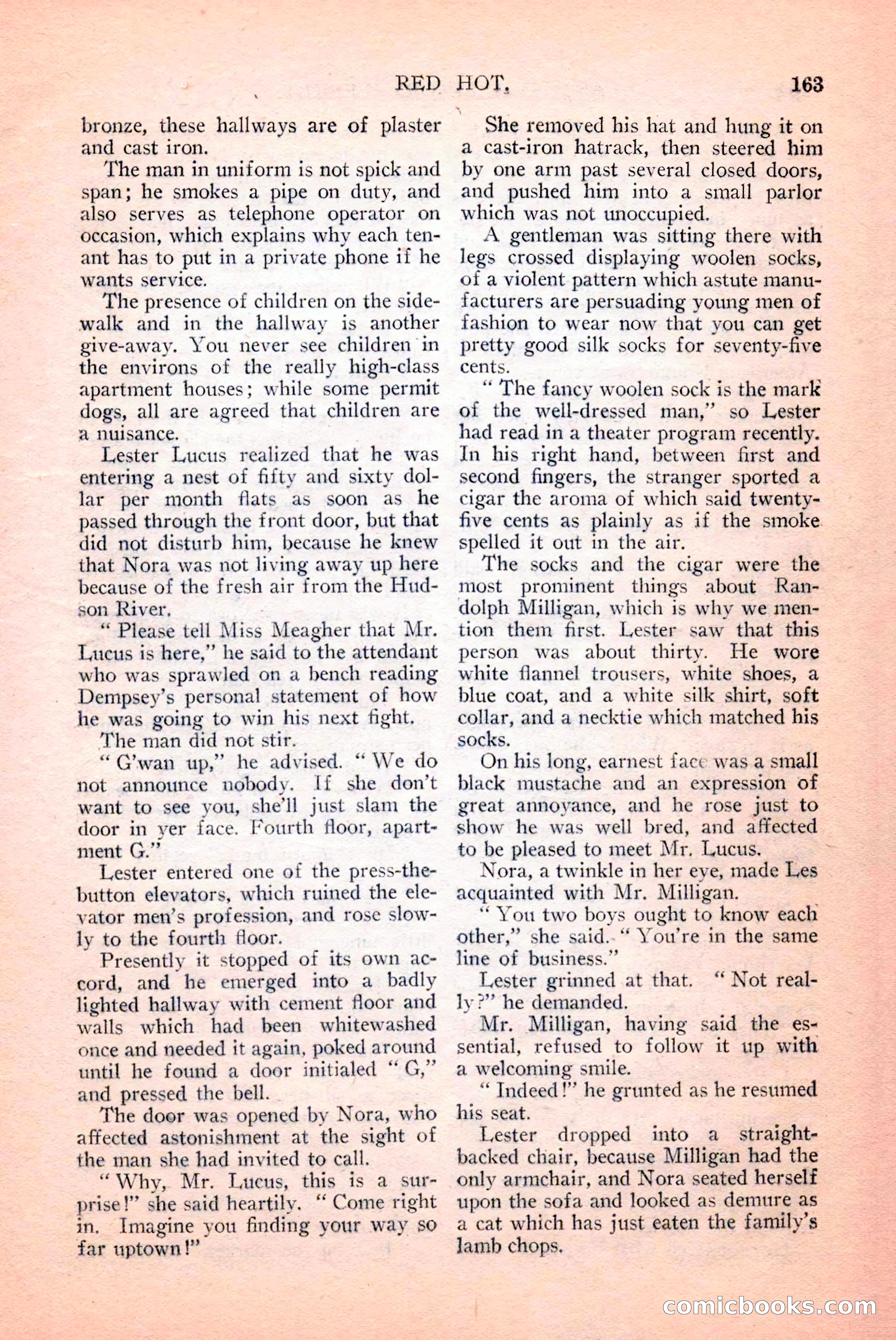
A restored page from Pulp Fiction, 1928. Page through the whole issue in the reader above.
📄 Transcribed text from this page (OCR, searchable)
Machine-transcribed from the original scan — historical spelling and the odd misread are preserved.
RED bronze, these hallways are of plaster ; and cast iron. The man in uniform is not spick and span; he smokes a pipe on duty, and also serves as telephone operator on occasion, which explains why each ten- ant has to put in a private phone if he wants service. The presence of children on the side- walk and in the hallway is another give-away. You never see children in the environs of the really high-class apartment houses; while some permit dogs, all are agreed that children are a nuisance. Lester Lucus realized that he was entering a nest of fifty and sixty dol- lar per month flats as soon as he passed through the front door, but that did not disturb him, because he knew that Nora was not living away up here because of the fresh air from the Hud- son River, “ Please tell Miss Meagher that Mr. Laicus is here,” he said to the attendant who was sprawled on a bench reading Dempsey’s personal statement of how he was going to win his next fight, The man did not stir. “Gwan up,” he advised. “We do not announce nobody. If she don’t want to see you, she'll just slam the door in yer face. Fourth floor, apart- ment G.” Lester entered one of the press-the- button elevators, which ruined the ele- vator men’s profession, and rose slow- ly to the fourth floor. Presently it stopped of its own ac- cord, and he emerged into a badly lighted hallway with cement floor and walls which had been whitewashed once and needed it again, poked around until he found a door initialed ‘“ G,” and pressed the bell. The door was opened by Nora, who affected astonishment at the sight of the man she had invited to call. “Why, Mr. Lacus, this is a sur- prise!” she said heartily. “ Come right in. Imagine you finding your way so far uptown!” HOT, 163 She removed his hat and hung it on a cast-iron hatrack, then steered him by one arm past several closed doors, and pushed him into a small parlor which was not unoccupied. A gentleman was sitting there with legs crossed displaying woolen socks, of a violent pattern which astute manu- facturers are persuading young men of fashion to wear now that you can get pretty good silk socks for seventy-five cents. “The fancy woolen sock is the mark of the well-dressed man,’ so Lester had read in a theater program recently. In his right hand, between first and second fingers, the stranger sported a cigar the aroma of which said twenty- five cents as plainly as if the smoke. spelled it out in the air. The socks and the cigar were the most prominent things about Ran- dolph Milligan, which is why we men- tion them first. Lester saw that this person was about thirty. He wore white flannel trousers, white shoes, a blue coat, and a white silk shirt, soft collar, and a necktie which matched his socks. On his long, earnest face was a small black mustache and an expression of great annoyance, and he rose just to show he was well bred, and affected to be pleased to meet Mr, Lucus. Nora, a twinkle in her eye, made Les acquainted with Mr. Milligan. ‘You two boys ought to know each other,” she said..‘ You’re in the same line of business.” Lester grinned at that. ly?” he demanded. Mr. Milligan, having said the es- sential, refused to follow it up with a welcoming smile. “ Indeed!’ he grunted as he resumed his seat. Lester dropped backed chair, because Milligan had the only armchair, and Nora seated herself upon the sofa and looked as demure as a cat which has just eaten the family’s lamb chops. * Not real- (C@) vDOOK into a_ straight- (E)