
Pulp Fiction, 1928 · page 41 of 156
Argosy All-Story Weekly, May 5, 1928 — page 41: what you’re looking at
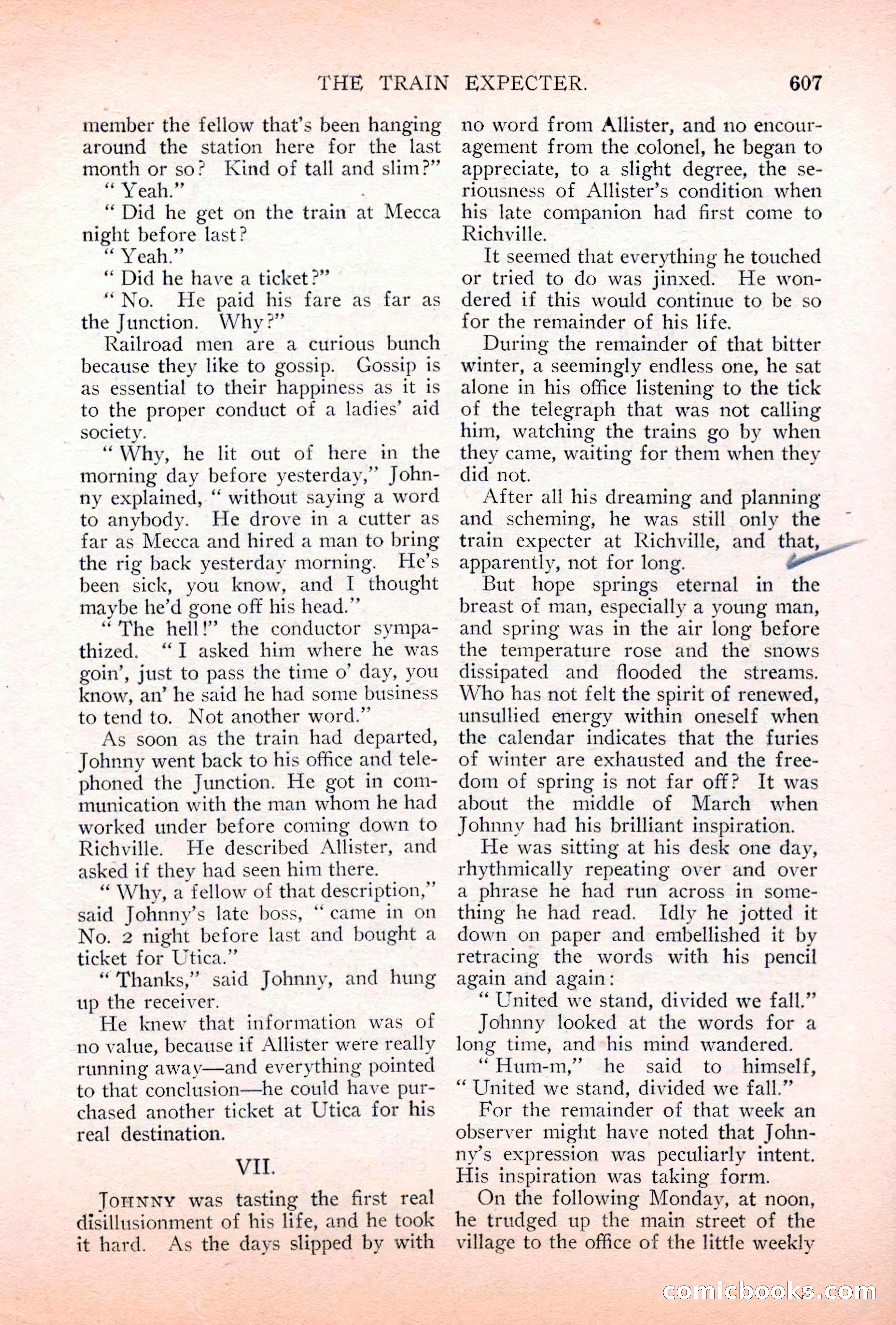
A restored page from Pulp Fiction, 1928. Page through the whole issue in the reader above.
📄 Transcribed text from this page (OCR, searchable)
Machine-transcribed from the original scan — historical spelling and the odd misread are preserved.
THE TRAIN EXPECTER. member the fellow that’s been hanging around the station here for the last month or so? Kind of tall and slim?” ree , “Did he get on the train at Mecca night before last? Yeah,” “ Did he have a ticket?” ‘“No. He paid his fare as far as the Junction. Why?” Railroad men are a curious bunch because they like to gossip. Gossip 1s as essential to their happiness as it 1s to the proper conduct of a ladies’ aid society. ‘Why, he lit out of here in the morning day before yesterday,” John- ny explained, “ without saying a word to anybody. He drove in a cutter as far as Mecca and hired a man to bring the rig back yesterday morning. He's been sick, you know, and I thought maybe he’d gone off his head.” “The hell!” the conductor sympa- thized. “I asked him where he was goin’, just to pass the time o’ day, you know, an’ he said he had some business to tend to. Not another word.” As soon as the train had departed, Johnny went back to his office and tele- phoned the Junction. He got in com- munication with the man whom he had worked under before coming down to Richville. He described Allister, and asked if they had seen him there. “ Why, a fellow of that description,” said Johnny’s late boss, “came in on No. 2 night before last and bought a ticket for Utica.” “Thanks,” said Johnny, and hung up the receiver. He knew that information was of no value, because if Allister were really running away—and everything pointed to that conclusion—he could have pur- chased another ticket at Utica for his real destination. VIL. JOHNNY was tasting the first real disillusionment of his life, and he took it hard. As the days slipped by with 607 no word from Allister, and no encour- agement from the colonel, he began to appreciate, to a slight degree, the se- riousness of Allister’s condition when his late companion had first come to Richville. It seemed that everything he touched or tried to do was jinxed. He won- dered if this would continue to be so for the remainder of his life. During the remainder of that bitter winter, a seemingly endless one, he sat alone in his office listening to the tick of the telegraph that was not calling him, watching the trains go by when they came, waiting for them when they did not. After all his dreaming and planning and scheming, he was still only the train expecter at Richville, and se apparently, not for long. But hope springs eternal in the breast of man, especially a young man, and spring was in the air long before the temperature rose and the snows dissipated and flooded the streams. Who has not felt the spirit of renewed, unsullied energy within oneself when the calendar indicates that the furies of winter are exhausted and the free- dom of spring is not far off? It was about the middle of March when Johnny had his brilliant inspiration. He was sitting at his desk one day, rhythmically repeating over and over a phrase he had run across in some- thing he had read. Idly he jotted it down on paper and embellished it by retracing the words with his pencil again and again: “ United we stand, divided we fall.” Johnny looked at the words for a long time, and his mind wandered. “Hum-m,” he said to himself, * United we stand, divided we fall.” For the remainder of that week an observer might have noted that John- ny’s expression was peculiarly intent. His inspiration was taking form. On the following Monday, at noon, he trudged up the main street of the village to the office of the little weekly EOMICGLOOOKS (C@)