
Pulp Fiction, 1928 · page 43 of 156
Argosy All-Story Weekly, May 5, 1928 — page 43: what you’re looking at
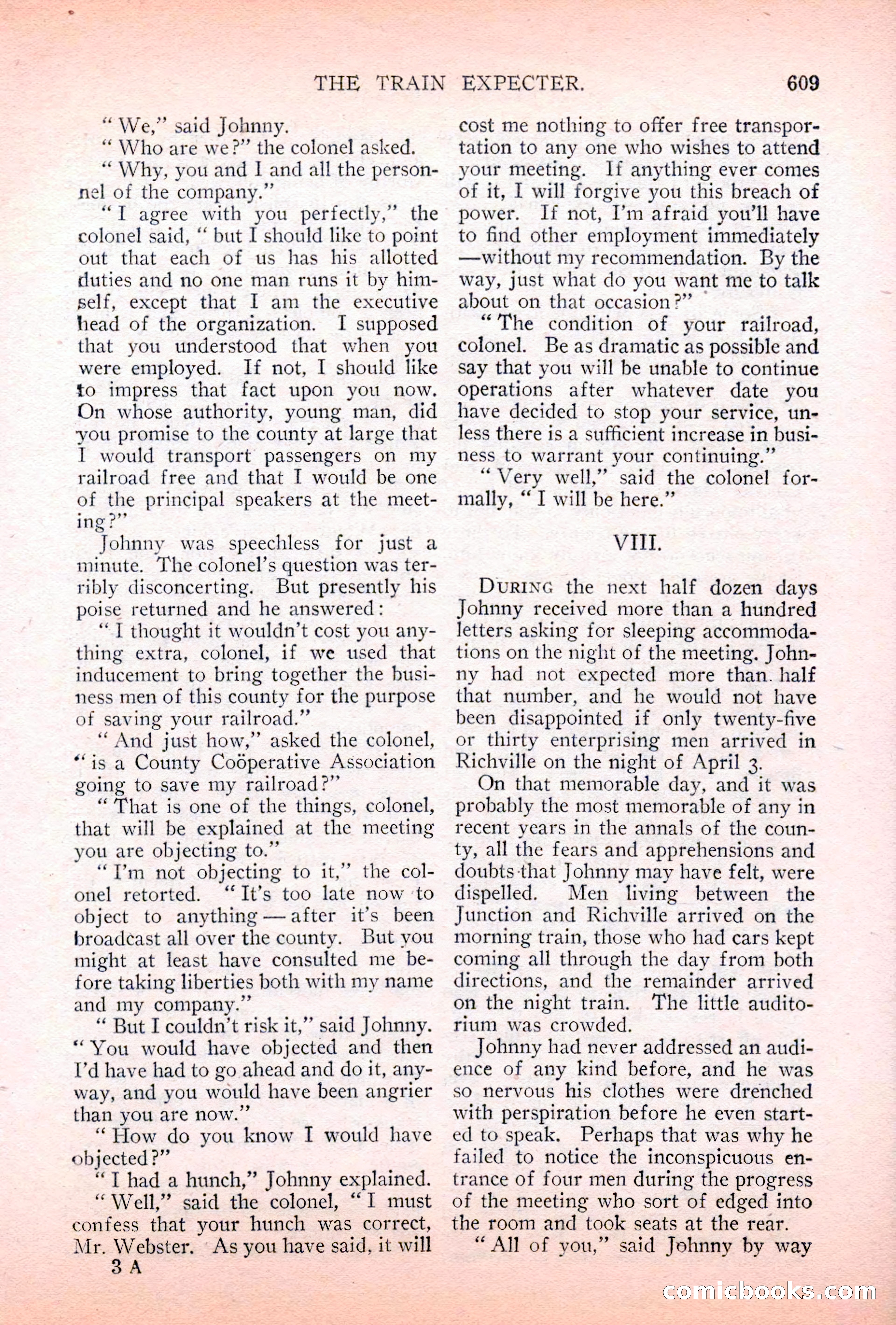
A restored page from Pulp Fiction, 1928. Page through the whole issue in the reader above.
📄 Transcribed text from this page (OCR, searchable)
Machine-transcribed from the original scan — historical spelling and the odd misread are preserved.
THE TRAIN EXPECTER. “We,” said Johnny. “Who are we?” the colonel asked. “Why, you and I and all the person- nel of the company.” “T agree with you perfectly,” the colonel said, “ but I should like to point out that each of us has his allotted duties and no one man runs it by him- self, except that I am the executive head of the organization. I supposed that you understood that when you were employed. If not, I should like to impress that fact upon you now. On whose authority, young man, did ‘you promise to the county at large that I would transport passengers on my railroad free and that I would be one of the principal speakers at the meet- ing?” Johnny was speechless for just a minute. The colonel’s question was ter- ribly disconcerting. But presently his poise returned and he answered: “| thought it wouldn’t cost you any- thing extra, colonel, if we used that inducement to bring together the busi- ness men of this county for the purpose of saving your railroad.” ‘And just how,” asked the colonel, ‘‘is a County Cooperative Association going to save my railroad?” “That is one of the things, colonel, that will be explained at the meeting you are objecting to.” ‘“T’m not objecting to it,’’ the col- onel retorted. “It’s too late now ‘to object to anything —after it’s been broadcast all over the county. But you might at least have consulted me be- fore taking liberties both with my name and my company.” ‘“ But I couldn’t risk it,” said Johnny. “You would have objected and then I’d have had to go ahead and do it, any- way, and you would have been angrier than you are now.” “How do you know I would have objected ?” “T had a hunch,” Johnny explained. “Well,” said the colonel, “I must confess that your hunch was correct, Mr. Webster. As you have said, it will 3A 609 cost me nothing to offer free transpor- tation to any one who wishes to attend your meeting. If anything ever comes of it, I will forgive you this breach of power. If not, I’m afraid you'll have to find other employment immediately —without my recommendation. By the way, just what do you want me to talk about on that occasion?” “The condition of your railroad, colonel. Beas dramatic as possible and say that you will be unable to continue operations after whatever date you have decided to stop your service, un- less there is a sufficient increase in busi- ness to warrant your continuing.” “Very well,” said the colonel for- mally, “ I will be here.” VII. DuRING the next half dozen days Johnny received more than a hundred letters asking for sleeping accommoda- tions on the night of the meeting. John- ny had not expected more than. half that number, and he would not have been disappointed if only twenty-five or thirty enterprising men arrived in Richville on the night of April 3. On that memorable day, and it was probably the most memorable of any in recent years in the annals of the coun- ty, all the fears and apprehensions and doubts that Johnny may have felt, were dispelled. Men living between the Junction and Richville arrived on the morning train, those who had cars kept coming all through the day from both directions, and the remainder arrived on the night train. The little audito- rium was crowded. Johnny had never addressed an audi- ence of any kind before, and he was so nervous his clothes were drenched with perspiration before he even start- ed to speak. Perhaps that was why he failed to notice the inconspicuous en- trance of four men during the progress of the meeting who sort of edged into the room and took seats at the rear. “All of you,” said Johnny by way COMIC OOO KS (E@