
Pulp Fiction, 1928 · page 56 of 156
Argosy All-Story Weekly, May 5, 1928 — page 56: what you’re looking at
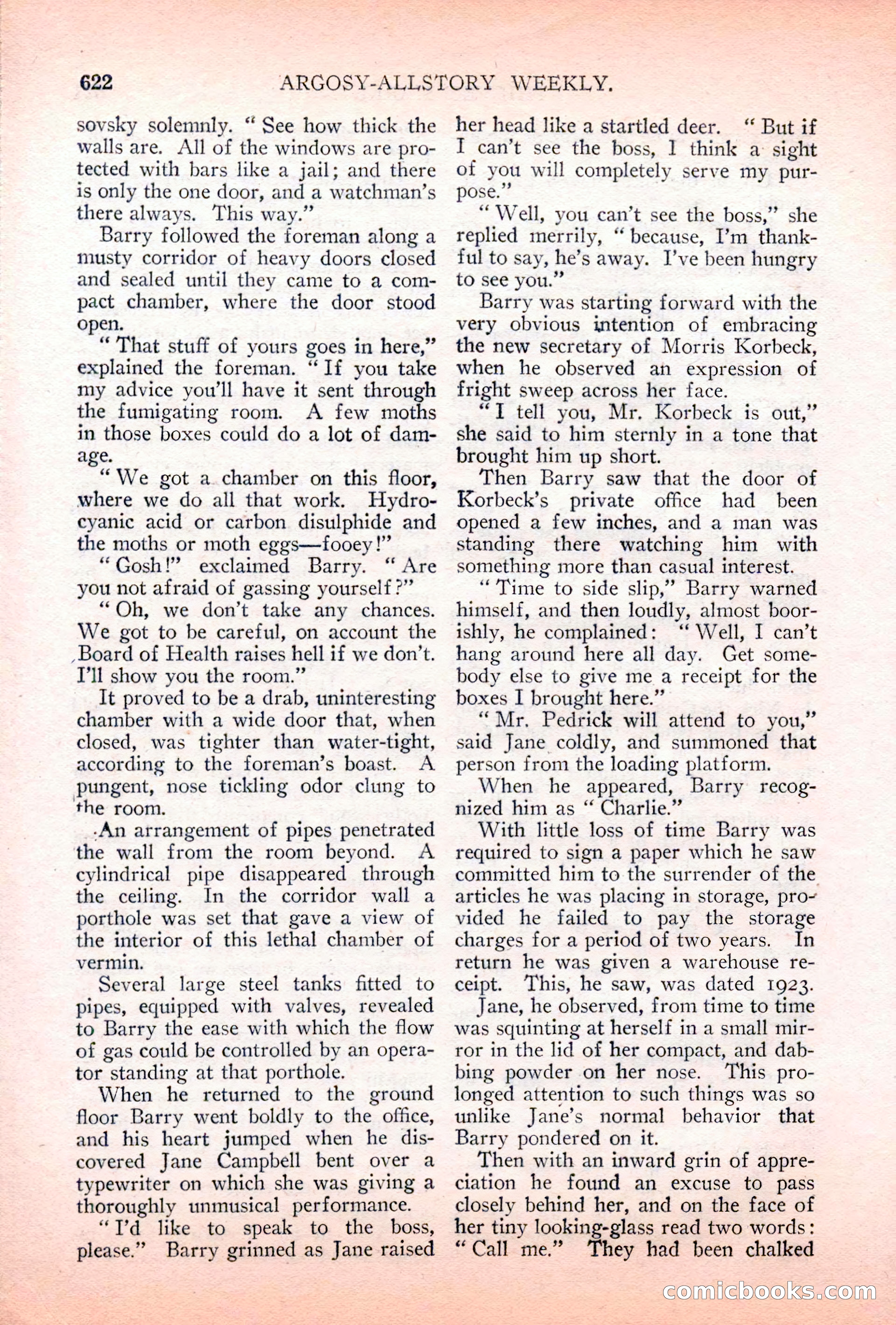
A restored page from Pulp Fiction, 1928. Page through the whole issue in the reader above.
📄 Transcribed text from this page (OCR, searchable)
Machine-transcribed from the original scan — historical spelling and the odd misread are preserved.
622 sovsky solemnly. “ See how thick the walls are. All of the windows are pro- tected with bars like a jail; and there is only the one door, and a watchman’s there always. This way.” Barry followed the foreman along a musty corridor of heavy doors closed and sealed until they came to a com- pact chamber, where the door stood open. “That stuff of yours goes in here,” explained the foreman. “If you take my advice you'll have it sent through the fumigating room. A few moths in those boxes could do a lot of dam- age. “We got a chamber on this floor, where we do all that work. Hydro- cyanic acid or carbon disulphide and the moths or moth eggs—fooey!” “Gosh!” exclaimed Barry. “ Are you not afraid of gassing yourself?” “Oh, we don’t take any chances. We got to be careful, on account the _Board of Health raises hell if we don’t. I’ll show you the room.” It proved to be a drab, uninteresting chamber with a wide door that, when closed, was tighter than water-tight, according to the foreman’s boast. A pungent, nose tickling odor clung to the room. -An arrangement of pipes penetrated the wall from the room beyond. A cylindrical pipe disappeared through the ceiling. In the corridor wall a porthole was set that gave a view of the interior of this lethal chamber of vermin. Several large steel tanks fitted to pipes, equipped with valves, revealed to Barry the ease with which the flow of gas could be controlled by an opera- tor standing at that porthole. When he returned to the ground floor Barry went boldly to the office, and his heart jumped when he dis- covered Jane Campbell bent over a typewriter on which she was giving a thoroughly unmusical performance. “T’d like to speak to the boss, please.” Barry grinned as Jane raised ARGOSY-ALLSTORY WEEKLY. her head like a startled deer. ‘“ But if I can’t see the boss, I think a: sight of you will completely serve my pur- pose.” “Well, you can’t see the boss,” she replied merrily, “ because, I’m thank- ful to say, he’s away. I’ve been hungry to see you.” Barry was starting forward with the very obvious intention of embracing the new secretary of Morris Korbeck, when he observed an expression of fright sweep across her face. “TI tell you, Mr. Korbeck is out,” she said to him sternly in a tone that brought him up short. Then Barry saw that the door of Korbeck’s private office had been opened a few inches, and a man was standing there watching him with something more than casual interest. “Time to side slip,” Barry warned himself, and then loudly, almost boor- ishly, he complained: ‘‘ Well, I can’t hang around here all day. Get some- body else to give me a receipt for the boxes I brought here.” “Mr. Pedrick will attend to you,” said Jane coldly, and summoned that person from the loading platform. When he appeared, Barry recog- nized him as “ Charlie.” With little loss of time Barry was required to sign a paper which he saw committed him to the surrender of the articles he was placing in storage, pro- vided he failed to pay the storage charges for a period of two years. In return he was given a warehouse re- ceipt. This, he saw, was dated 1923. Jane, he observed, from time to time was squinting at herself in a small mir- ror in the lid of her compact, and dab- bing powder on her nose. This pro- longed attention to such things was so unlike Jane’s normal behavior that Barry pondered on it. Then with an inward grin of appre- ciation he found an excuse to pass closely behind her, and on the face of her tiny looking-glass read two words: “Call me.” They had been chalked n”OOLKS (EOL MCE (E@)