
Pulp Fiction, 1928 · page 57 of 156
Argosy All-Story Weekly, May 5, 1928 — page 57: what you’re looking at
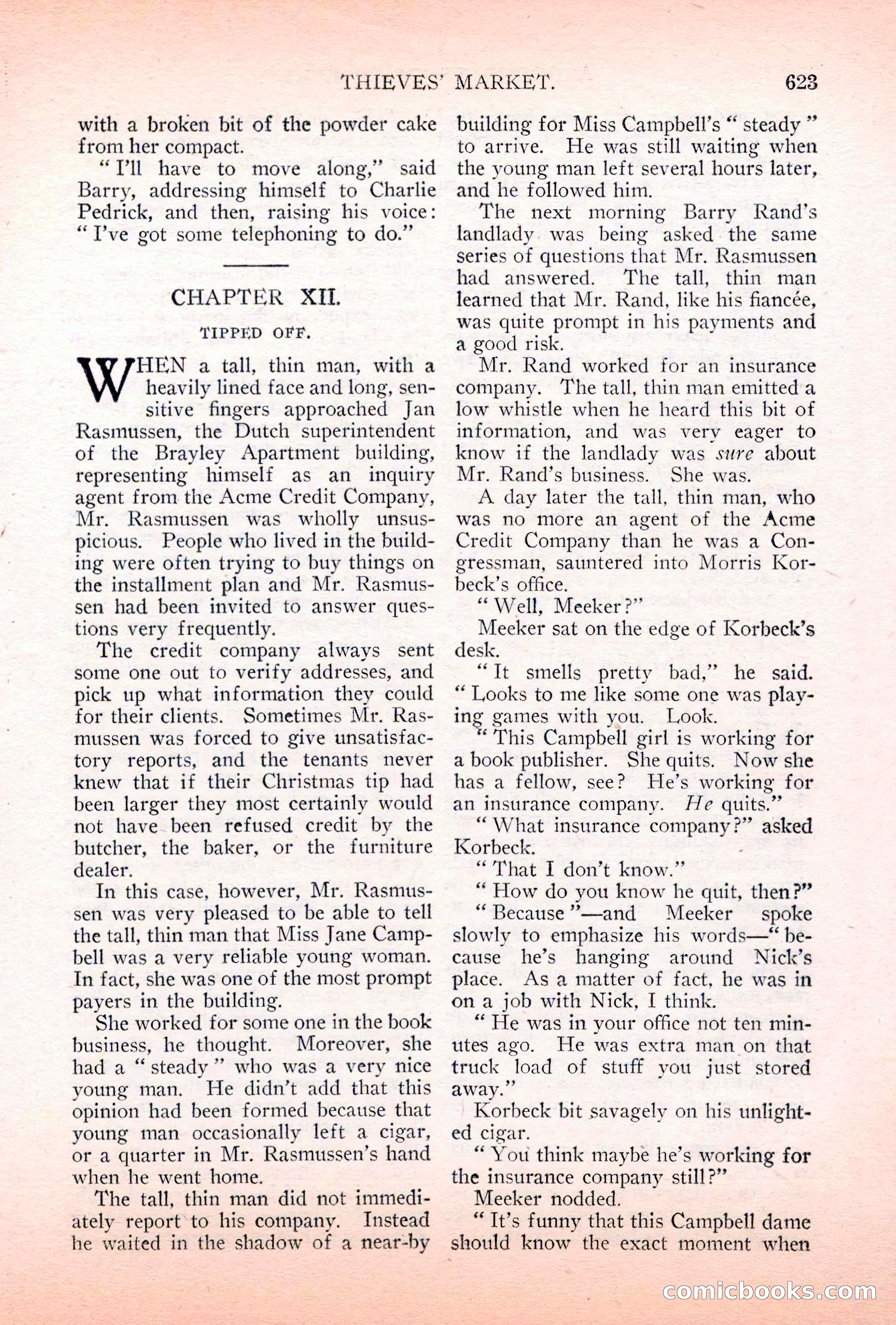
A restored page from Pulp Fiction, 1928. Page through the whole issue in the reader above.
📄 Transcribed text from this page (OCR, searchable)
Machine-transcribed from the original scan — historical spelling and the odd misread are preserved.
THIEVES’ with a broken bit of the powder cake from her compact. “Til have to move along,” said Barry, addressing himself to Charlie Pedrick, and then, raising his voice: “Tve got some telephoning to do.” CHAPTER XII TIPPED OFF. HEN a tall, thin man, with a heavily lined face and long, sen- sitive fingers approached Jan Rasmussen, the Dutch superintendent of the Brayley Apartment building, representing himself as an inquiry agent from the Acme Credit Company, Mr. Rasmussen was wholly unsus- picious. People who lived in the build- ing were often trying to buy things on the installment plan and Mr. Rasmus- sen had been invited to answer ques- tions very frequently. The credit company always sent some one out to verify addresses, and pick up what information they could for their clients. Sometimes Mr. Ras- mtssen was forced to give unsatisfac- tory reports, and the tenants never knew that if their Christmas tip had been larger they most certainly would not have been refused credit by the butcher, the baker, or the furniture dealer. In this case, however, Mr. Rasmus- sen was very pleased to be able to tell the tall, thin man that Miss Jane Camp- bell was a very reliable young woman. In fact, she was one of the most prompt payers in the building. She worked for some one in the book business, he thought. Moreover, she had a “steady” who was a very nice young man. He didn’t add that this opinion had been formed because that young man occasionally left a cigar, or a quarter in Mr. Rasmussen’s hand when he went home. The tall, thin man did not immedi- ately report to his company. Instead he waited in the shadow of a near-by MARKET. 623 building for Miss Campbell’s “ steady ” to arrive. He was still waiting when the young man left several hours later, and he followed him. The next morning Barry Rand’s landlady. was being asked the same series of questions that Mr. Rasmussen had answered. The tall, thin man learned that Mr. Rand, like his fiancee, was quite prompt in his payments and a good risk. Mr. Rand worked for an insurance company. The tall, thin man emitted a low whistle when he heard this bit of information, and was very eager to know if the landlady was sure about Mr. Rand’s business. She was. A. day later the tall, thin man, who was no more an agent of the Acme Credit Company than he was a Con- eressman, sauntered into Morris Kor- beck’s office. “Well, Meeker?” Meeker sat on the edge of Korbeck’s desk. “It smells pretty bad,” he said. “Looks to me like some one was play- ing games with you. Look. ‘This Campbell girl is working for a book publisher. She quits. Now she has a fellow, see? He’s working for an insurance company. He quits.” “What insurance company?” asked Korbeck. , “That I don’t know.” “How do you know he quit, then?” “Because ”’>—and Meeker spoke slowly to emphasize his words—* be- cause he’s hanging around Nick’s place. As a matter of fact, he was in on a job with Nick, [ think. “He was in your office not ten min- utes ago. He was extra man on that truck load of stuff you just stored away.” Korbeck bit savagely on his unlight- ed cigar. “You think maybe he’s working for the insurance company still?” Meeker nodded. “It’s funny that this Campbell dame should know the exact moment when Gomichbooks (E@)