
Pulp Fiction, 1928 · page 6 of 150
Argosy All-Story Weekly, July 7, 1928 — page 6: what you’re looking at
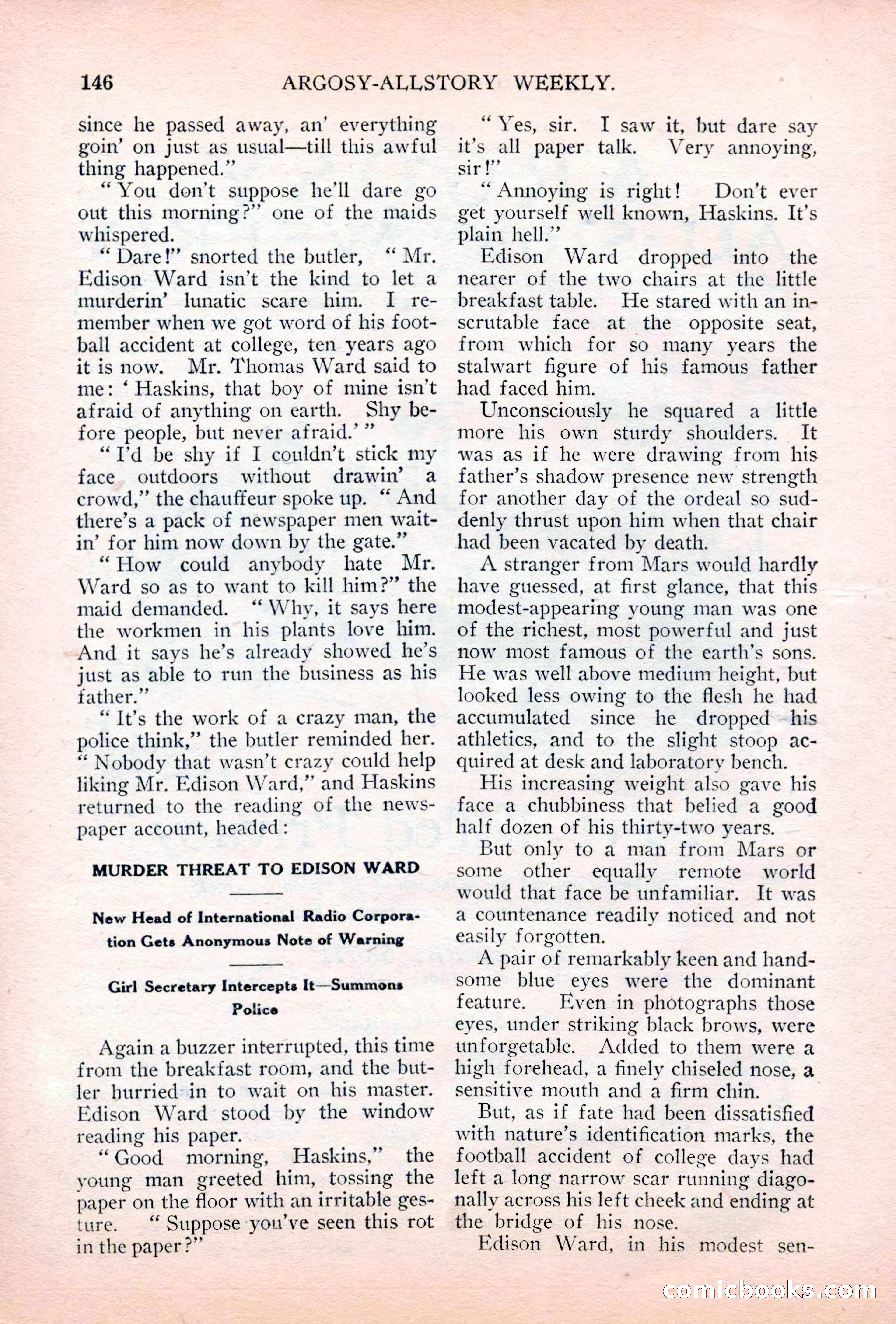
A restored page from Pulp Fiction, 1928. Page through the whole issue in the reader above.
📄 Transcribed text from this page (OCR, searchable)
Machine-transcribed from the original scan — historical spelling and the odd misread are preserved.
146 since he passed away, an’ everything goin’ on just as usual—till this awful thing happened.” “You don’t suppose he'll dare go out this morning?’’’ one of the maids whispered. “Dare!” snorted the butler, “ Mr. Edison Ward isn’t the kind to let a murderin’ lunatic scare him. I re- member when we got word of his foot- ball accident at college, ten years ago itis now. Mr. Thomas Ward said to me: ‘ Haskins, that boy of mine isn’t afraid of anything on earth. Shy be- fore people, but never afraid.’ ” “T’'d be shy if I conldn’t stick my face outdoors without drawin’ a crowd,” the chauffeur spoke up. “ And there’s a pack of newspaper men wait- in’ for him now down by the gate.” “How could anybody hate Mr. Ward so as to want to kill him?” the maid demanded. “ Why, it says here the workmen in his plants love him. And it says he’s already showed he’s just as able to run the business as his father.” “It’s the work of a crazy man, the police think,” the butler reminded her. “ Nobody that wasn’t crazy could help liking Mr. Edison Ward,” and Haskins returned to the reading of the news- paper account, headed: MURDER THREAT TO EDISON WARD New Head of International Radio Corpora- tion Gets Anonymous Note of Warning Girl Secretary Intercepts It—Summons Police Again a buzzer interrupted, this time from the breakfast room, and the but- ler burried in to wait on his master. Edison Ward stood by the window reading his paper. “Good morning, Haskins,” the young man greeted him, tossing the paper on the floor with an irritable ges- ture. “ Suppose you've seen this rot in the paper?” ARGOSY-ALLSTORY WEEKLY. “Yes, sir. I saw-it, but dare say it’s all paper talk. Very annoying, sir!” “Annoying is right! Don’t ever get yourself well known, Haskins. It’s plain hell.”’ Edison Ward dropped into the nearer of the two chairs at the little breakfast table. He stared with an in- scrutable face at the opposite seat, from which for so many years the stalwart figure of his famous father had faced him. Unconsciously he squared a little more his own sturdy shoulders. It was as if he were drawing from his father’s shadow presence new strength for another day of the ordeal so sud- denly thrust upon him when that chair had been vacated by death. A stranger from Mars would hardly have guessed, at first glance, that this modest-appearing young man was one of the richest, most powerful and just now most famous of the earth’s sons. He was well above medium height, but looked less owing to the flesh he had accumulated since he dropped ~ his athletics, and to the slight stoop ac- quired at desk and laboratory bench. His increasing weight also gave his face a chubbiness that belied a good half dozen of his thirty-two years. But only to a man from Mars or some other equally remote world would that face be unfamiliar. It was a countenance readily noticed and not easily forgotten. A pair of remarkably keen and hand- some blue eyes were the dominant feature. Even in photographs those eyes, under striking black brows, were unforgetable. Added to them were a high forehead, a finely chiseled nose, a sensitive mouth and a firm chin. But, as if fate had been dissatisfied with nature’s identification marks, the football accident of college days had left a long narrow scar running diago- nally across his left cheek and ending at the bridge of his nose. FEidison Ward, in his modest sen- EORMICLOOOKS (F@)