
Pulp Fiction, 1920 · page 213 of 232
Argosy All-Story Weekly, Vol. 123, No. 3 — page 213: what you’re looking at
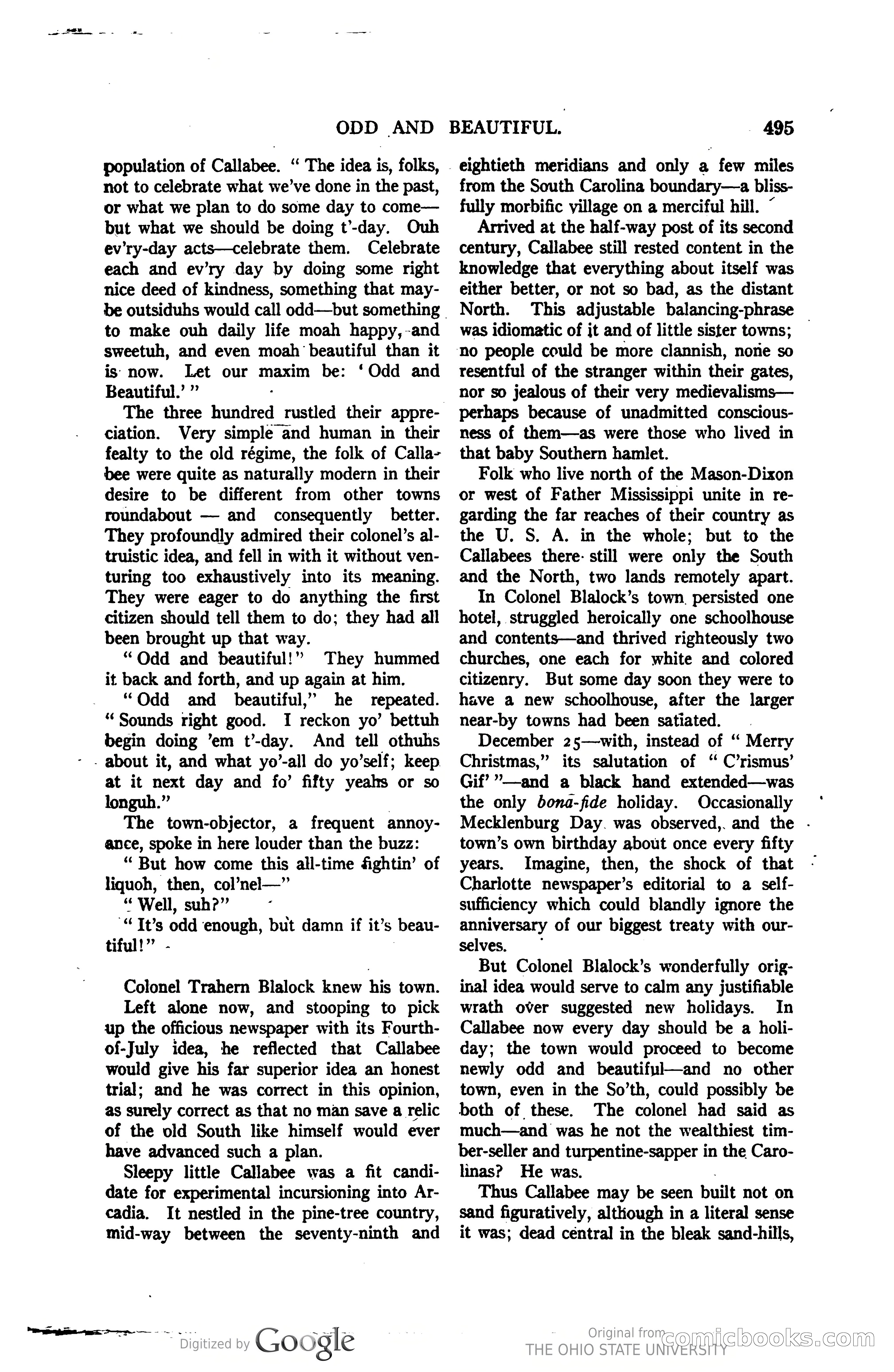
A restored page from Pulp Fiction, 1920. Page through the whole issue in the reader above.
📄 Transcribed text from this page (OCR, searchable)
Machine-transcribed from the original scan — historical spelling and the odd misread are preserved.
ODD AND BEAUTIFUL. population of Callabee. ‘‘ The idea is, folks, not to celebrate what we’ve done in the past, or what we plan to do some day to come— but what we should be doing t’-day. Ouh ev’ry-day acts—celebrate them. Celebrate each and ev’ry day by doing some right nice deed of kindness, something that may- be outsiduhs would call odd—but something | to make ouh daily life moah happy,-and sweetuh, and even moah beautiful than it is now. Let our maxim be: ‘Odd and Beautiful.’ ” The three hundred rustled their appre- ciation. Very simple and human in their fealty to the old régime, the folk of Calla- bee were quite as naturally modern in their desire to be different from other towns roundabout — and consequently _ better. They profoundly admired their colonel’s al- truistic idea, and fell in with it without ven- turing too exhaustively into its meaning. They were eager to do anything the first citizen should tell them to do; they had all been brought up that way. “Odd and beautiful!” They hummed it back and forth, and up again at him. “Odd and beautiful,” he repeated. ‘‘ Sounds right good. I reckon yo’ bettuh begin doing ’em t’-day. And tell othuhs - . about it, and what yo’-all do yo’self; keep _ tn ens eae a at it next day and fo’ fifty yeahs or so longuh.”’ | The town-objector, a frequent annoy- ance, spoke in here louder than the buzz: “ But how come this all-time fightin’ of liquoh, then, col’nel—” “Well, suh?” ““Tt’s odd enough, but damn if it’s beau- tiful!” - | Colonel Trahern Blalock knew his town. Left alone now, and stooping to pick up the officious newspaper with its Fourth- of-July idea, he reflected that Callabee would give his far superior idea an honest trial; and he was correct in this opinion, as surely correct as that no man save a relic of the old South like himself would ever have advanced such a plan. Sleepy little Callabee was a fit candi- date for experimental incursioning into Ar- cadia. It nestled in the pine-tree country, mid-way between the seventy-ninth and ~"™ Digitized by CO ogle — 495 eightieth meridians and only a few miles from the South Carolina boundary—a bliss- fully morbific village on a merciful hill. ~ Arrived at the half-way post of its second century, Callabee still rested content in the knowledge that everything about itself was either better, or not so bad, as the distant North. This adjustable balancing-phrase _ was idiomatic of jt and of little sister towns; no people could be more clannish, norie so resentful of the stranger within their gates, nor so jealous of their very medievalisms— perhaps because of unadmitted conscious- ness of them—as were those who lived in that baby Southern hamlet. Folk who live north of the Mason-Dixon or west of Father Mississippi unite in re- garding the far reaches of their country as the U. S. A. in the whole; but to the Callabees there- still were only the South and the North, two lands remotely apart. In Colonel Blalock’s town. persisted one hotel, struggled heroically one schoolhouse and contents—and thrived righteously two churches, one each for white and colored citizenry. But some day soon they were to have a new schoolhouse, after the larger near-by towns had been satiated. December 25—with, instead of “ Merry Christmas,” its salutation of ‘ C’rismus’ Gif’”’—and a black hand extended—was the only bona-fide holiday. Occasionally Mecklenburg Day. was observed,. and the . town’s own birthday about once every fifty years. Imagine, then, the shock of that Charlotte newspaper’s editorial to a self- sufficiency which could blandly ignore the anniversary of our biggest treaty with our- selves. But Colonel Blalock’s wonderfully orig- inal idea would serve to calm any justifiable wrath over suggested new holidays. In Callabee now every day should be a holi- cay; the town would proceed to become newly odd and beautiful—and no other town, even in the So’th, could possibly be both of these. The colonel had said as much—and was he not the wealthiest tim- ber-seller and turpentine-sapper in the Caro- linas? He was. Thus Callabee may be seen built not on sand figuratively, although in a literal sense it was; dead central in the bleak sand-hills, Original rome One HOO) SD a) SS CO