
Pulp Fiction, 1920 · page 214 of 232
Argosy All-Story Weekly, Vol. 123, No. 3 — page 214: what you’re looking at
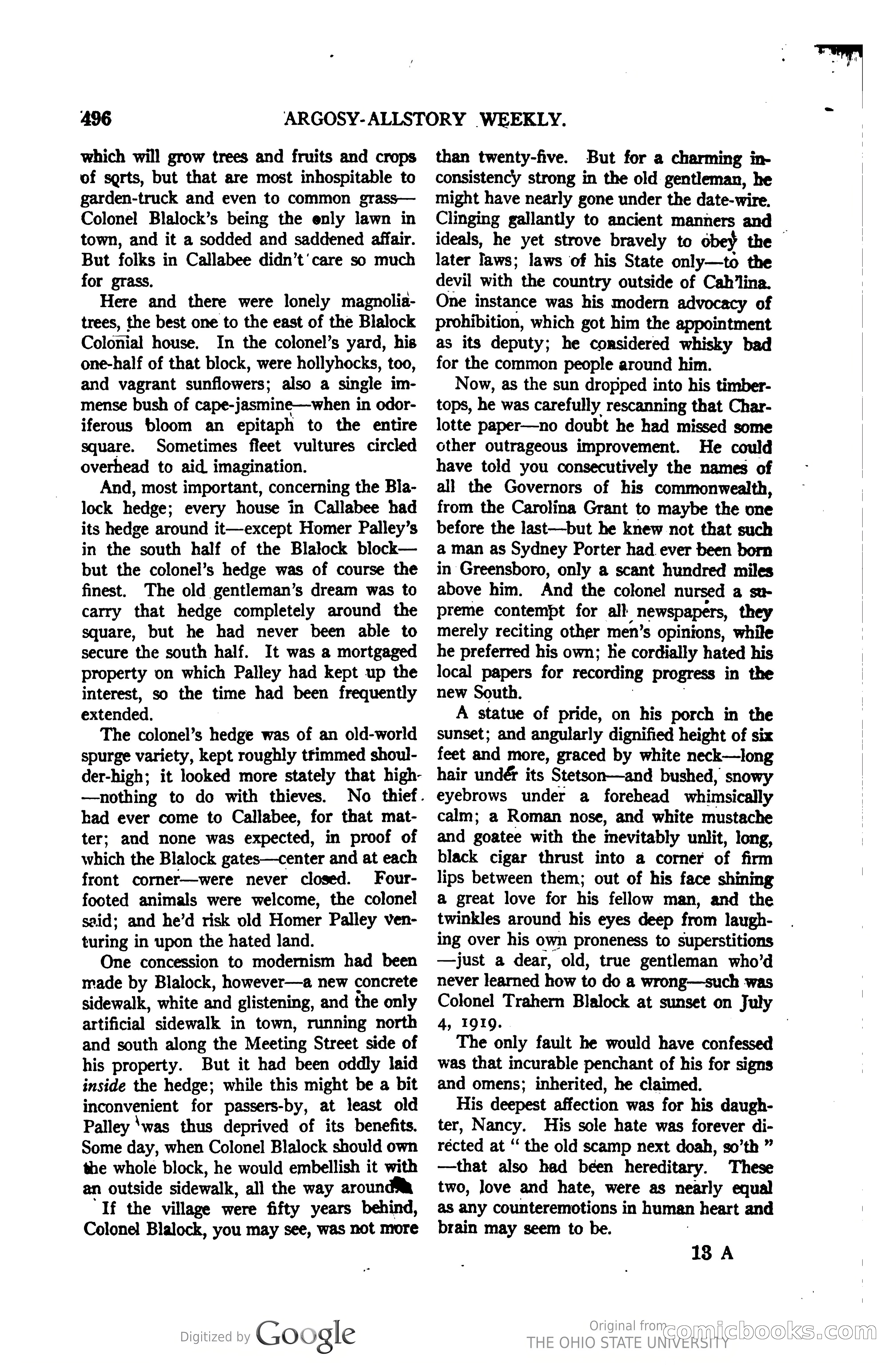
A restored page from Pulp Fiction, 1920. Page through the whole issue in the reader above.
📄 Transcribed text from this page (OCR, searchable)
Machine-transcribed from the original scan — historical spelling and the odd misread are preserved.
496 which will grow trees and fruits and crops of sorts, but that are most inhospitable to garden-truck and even to common grass— Colonel Blalock’s being the enly lawn in town, and it a sodded and saddened affair. But folks in Callabee didn’t'care so much for grass. Here and there were lonely magnolia- trees, the best one to the east of the Blalock Colonial house. In the colonel’s yard, his one-half of that block, were hollyhocks, too, and vagrant sunflowers; also a single im- mense bush of cape-jasmine—when in odor- iferous bloom an epitaph to the entire square. Sometimes ffeet vultures circled overhead to aid imagination. And, most important, concerning the Bla- lock hedge; every house in Callabee had its hedge around it—except Homer Palley’s in the south half of the Blalock block— but the colonel’s hedge was of course the finest. The old gentleman’s dream was to carry that hedge completely around the square, but he had never been able to secure the south half. It was a mortgaged property on which Palley had kept up the interest, so the time had been frequently extended. | The colonel’s hedge was of an old-world spurge variety, kept roughly trimmed shoul- der-high; it looked more stately that high- —nothing to do with thieves. No thief. had ever come to Callabee, for that mat- ter; and none was expected, in proof of which the Blalock gates—center and at each front corner—were never closed. Four- footed animals were welcome, the colonel said; and he’d risk old Homer Palley ven- turing in upon the hated land. One concession to modernism had been made by Blalock, however—a new concrete sidewalk, white and glistening, and the only artificial sidewalk in town, running north and south along the Meeting Street side of his property. But it had been oddly laid inside the hedge; while this might be a bit inconvenient for passers-by, at least old Palley ‘was thus deprived of its benefits. Some day, when Colonel Blalock should own the whole block, he would embellish it with an outside sidewalk, all the way aroun If the village were fifty years behind, Colonel Blalock, you may see, was not more ARGOSY-ALLSTORY WEEKLY. than twenty-five. But for a charming in- consistency strong in the old gentleman, he might have nearly gone under the date-wire Clinging gallantly to ancient manners and ideals, he yet strove bravely to obey the | later laws; laws of his State only—to the devil with the country outside of Cah’lina. One instance was his modern advocacy of prohibition, which got him the appointment as its deputy; he considered whisky bad for the common people around him. Now, as the sun dropped into his timber- tops, he was carefully rescanning that Char- lotte paper—no doubt he had missed some other outrageous improvement. He could have told you consecutively the names of all the Governors of his commonwealth, from the Carolina Grant to maybe the one before the last—but he knew not that such a man as Sydney Porter had ever been born in Greensboro, only a scant hundred miles above him. And the colonel nursed a su- preme contempt for all _ Newspapers, they merely reciting other men’s opinions, while he preferred his own; he cordially hated his local papers for recording progress in the new South. A statue of pride, on his porch in the sunset; and angularly dignified height of six feet and more, graced by white neck—long hair undér its Stetson—and bushed, snowy eyebrows under a forehead whimsically calm; a Roman nose, and white mustache and goatee with the inevitably unlit, long, black cigar thrust into a corner of firm lips between them; out of his face shining a great love for his fellow man, and the twinkles around his eyes deep from laugh- ing over his own proneness to superstitions —Jjust a dear, old, true gentleman who’d never learned how to do a wrong—such was Colonel Trahern Blalock at sunset on July 4, 1919. The only fault he would have confessed was that incurable penchant of his for signs and omens; inherited, he claimed. His deepest affection was for his daugh- ter, Nancy. His sole hate was forever di- récted at “‘ the old scamp next doah, so’th ” —that also had been hereditary. These two, love and hate, were as nearly equal as any counteremotions in human heart and brain may seem to be. 18 A =D) Original fron GC THE OHIO STATE UNWEREHY DOO S CO