
Pulp Fiction, 1920 · page 220 of 232
Argosy All-Story Weekly, Vol. 123, No. 3 — page 220: what you’re looking at
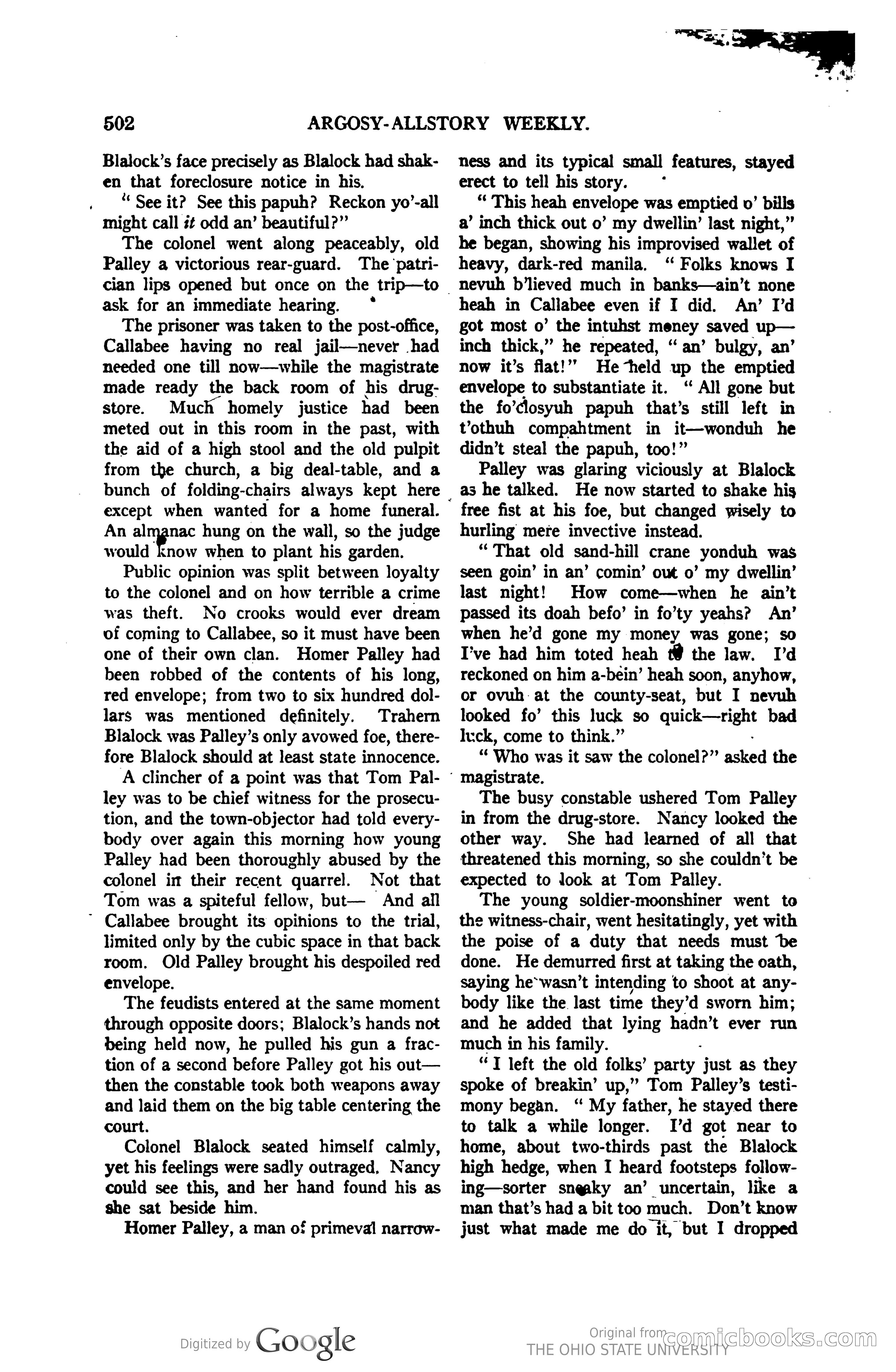
A restored page from Pulp Fiction, 1920. Page through the whole issue in the reader above.
📄 Transcribed text from this page (OCR, searchable)
Machine-transcribed from the original scan — historical spelling and the odd misread are preserved.
502 Blalock’s face precisely as Blalock had shak- en that foreclosure notice in his. “See it? See this papuh? Reckon yo’-all might call #¢ odd an’ beautiful?” The colonel went along peaceably, old Palley a victorious rear-guard. The patri- cian lips opened but once on the trip—to | e ask for an immediate hearing. The prisoner was taken to the post-office, Callabee having no real jail—never had needed one till now—while the magistrate made ready the back room of his drug- store. Much homely justice had been meted out in this room in the past, with the aid of a high stool and the old pulpit from the church, a big deal-table, and a bunch of folding-chairs always kept here _ except when wanted for a home funeral. An almanac hung on the wall, so the judge would know when to plant his garden. Public opinion was split between loyalty to the colonel and on how terrible a crime was theft. No crooks would ever dream of coming to Callabee, so it must have been one of their own clan. Homer Palley had been robbed of the contents of his long, red envelope; from two to six hundred dol- lars was mentioned definitely. Trahern Blalock was Palley’s only avowed foe, there- fore Blalock should at least state innocence. A clincher of a point was that Tom Pal- ley was to be chief witness for the prosecu- tion, and the town-objector had told every- body over again this morning how young Palley had been thoroughly abused by the colonel im their recent quarrel. Not that Tom was a spiteful fellow, but— And all ~ Callabee brought its opihions to the trial, limited only by the cubic space in that back room. Old Palley brought his despoiled red envelope. The feudists entered at the same moment through opposite doors; Blalock’s hands not being held now, he pulled his gun a frac- tion of a second before Palley got his out— then the constable took both weapons away and laid them on the big table centering the court. Colonel Blalock seated himself calmly, yet his feelings were sadly outraged, Nancy could see this, and her hand found his as she sat beside him. Homer Palley, a man of primeval narrow- Digitized by (Go ogle ARGOSY-ALLSTORY WEEKLY. ness and its typical small features, stayed erect to tell his story. “ This heah envelope was emptied 0’ bills a’ inch thick out 0’ my dwellin’ last night,” he began, showing his improvised wallet of heavy, dark-red manila. “ Folks knows I nevuh b’lieved much in banks—ain’t none heah in Callabee even if I did. An’ I’d got most o’ the intuhst meney saved up— inch thick,” he repeated, “ an’ bulgy, an now it’s flat!’”’ He-held up the emptied envelope to substantiate it. “ All gone but the fo’closyuh papuh that’s still left in t’othuh compahtment in it—wonduh he didn’t steal the papuh, too!” Palley was glaring viciously at Blalock as he talked. He now started to shake his free fist at his foe, but changed wisely to hurling mere invective instead. “That old sand-hill crane yonduh was seen goin’ in an’ comin’ out o’ my dwellin’ last night! How come—when he ain’t passed its doah befo’ in fo’ty yeahs? An’ when he’d gone my money was gone; so I've had him toted heah t@ the law. I’d reckoned on him a-bein’ heah soon, anyhow, or ovuh at the county-seat, but I nevuh looked fo’ this luck so quick-—tight bad Iuck, come to think.” “é Who was it saw the colonel?” asked the " magistrate. The busy constable ushered Tom Palley in from the drug-store. Nancy looked the other way. She had learned of all that threatened this morning, so she couldn’t be expected to look at Tom Palley. The young soldier-moonshiner went to the witness-chair, went hesitatingly, yet with the poise of a duty that needs must be done. He demurred first at taking the oath, saying he*wasn’t intending to shoot at any- body like the. last time they’d sworn him; and he added that lying hadn’t ever run much in his family. “T left the old folks’ party just as they spoke of breakin’ up,” Tom Palley’s testi- mony began. ‘“ My father, he stayed there to talk a while longer. I’d got near to home, about two-thirds past the Blalock high hedge, when I heard footsteps follow- ing—sorter sneaky an’ uncertain, like a man that’s had a bit too much. Don’t know just what made me do it, but I dropped SS CO THE O 10 S TATE Wn