
Pulp Fiction, 1920 · page 221 of 232
Argosy All-Story Weekly, Vol. 123, No. 3 — page 221: what you’re looking at
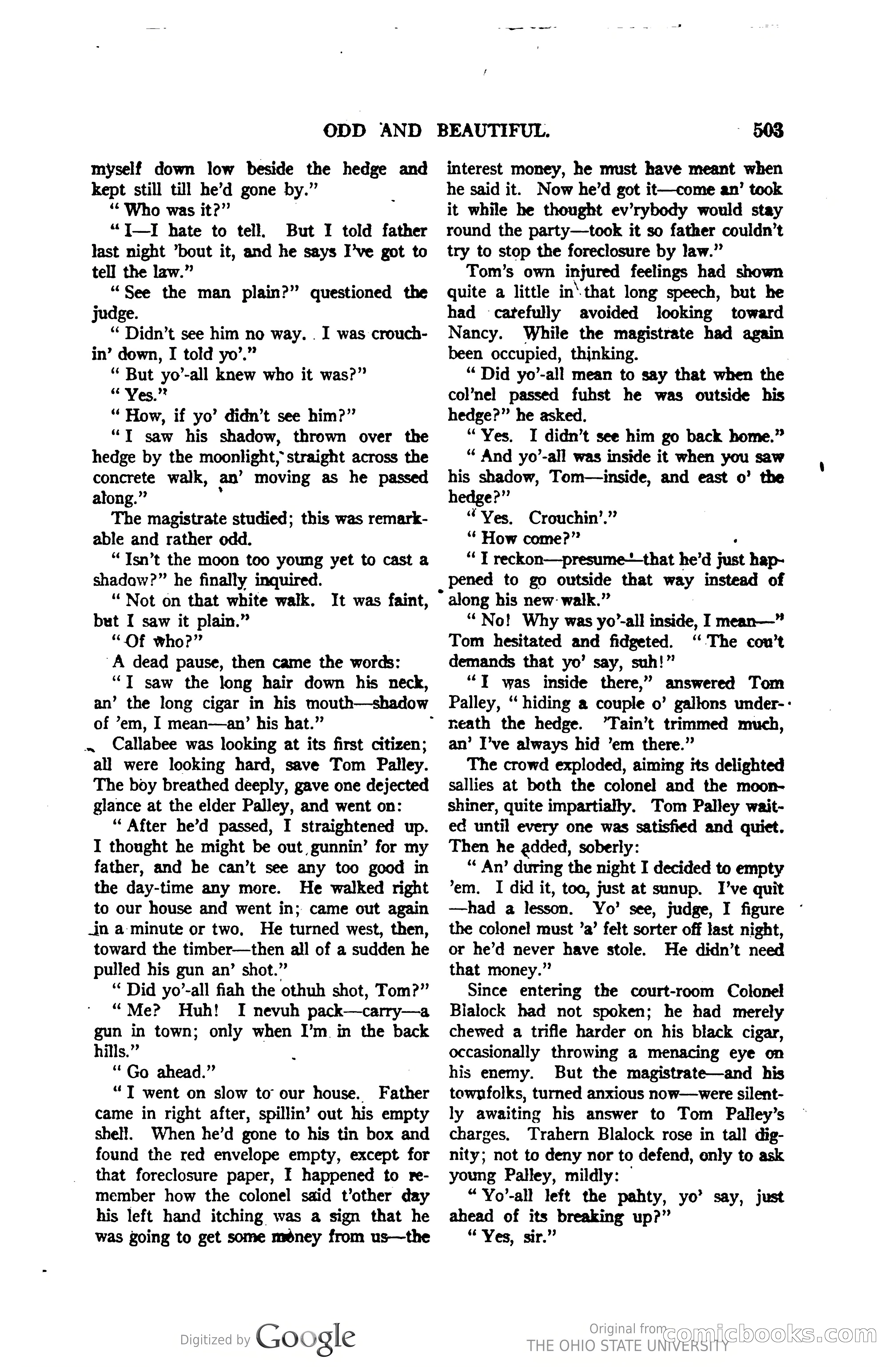
A restored page from Pulp Fiction, 1920. Page through the whole issue in the reader above.
📄 Transcribed text from this page (OCR, searchable)
Machine-transcribed from the original scan — historical spelling and the odd misread are preserved.
ODD AND BEAUTIFUL. myself down low beside the hedge and kept still till he’d gone by.” ‘‘'Who was it?” ““I—I hate to tell. But I told father last night "bout it, and he says I’ve got to tell the law.” “See the man plain?” questioned the judge. ‘“‘ Didn’t see him no way. . I was crouch- in’ down, I told yo’.” ‘“ But yo’-all knew who it was?” 6é Yes. DB ‘“‘ How, if yo’ didn’t see him?” “TI saw his shadow, thrown over the hedge by the moonlight, straight across the concrete walk, an’ moving as he passed along.” The magistrate studied; this was remark- able and rather odd. ““Isn’t the moon too young yet to cast a shadow?” he finally inquired. “Not on that white walk. It was faint, but I saw it plain.” “Of who?” | “A dead pause, then came the words: ‘“T saw the long hair down his neck, an’ the long cigar in his mouth—shadow of ’em, I mean—an’ his hat.” ~ Callabee was looking at its first citizen; all were looking hard, save Tom Palley. The boy breathed deeply, gave one dejected glance at the elder Palley, and went on: ‘“‘ After he’d passed, I straightened up. I thought he might be out gunnin’ for my father, and he can’t see any too good in the day-time any more. He walked right to our house and went in; came out again In a minute or two, He turned west, then, toward the timber—then all of a sudden he pulled his gun an’ shot.” “ Did yo’-all fiah the othuh shot, Tom?” “Me? Huh! I nevuh pack—carry—a gun in town; only when I’m im the back hills.” ‘Go ahead.” : ‘“‘T went on slow to our house. Father came in right after, spillin’ out his empty shell. When he’d gone to his tin box and found the red envelope empty, except for that foreclosure paper, I happened to re- member how the colonel said t’other day his left hand itching was a sign that he was going to get some méney from us—the — BOS interest money, he must have meant when he said it. Now he’d got it—come an’ took it while he thought ev’rybody would stay round the party—took it so father couldn’t try to stop the foreclosure by law.” Tom’s own injured feelings had shown quite a little in\that long speech, but he had catefully avoided looking toward Nancy. While the magistrate had again been occupied, thinking. ““ Did yo’-all mean to say that when the col’nel passed fuhst he was outside his hedge?” he asked. “Yes. I didn’t see him go back home.” “ And yo’-all was inside it when you saw his shadow, Tom—inside, and east o’ the hedge?” “Yes. Crouchin’.” “ How come?” “ T reckon—presumethat he’d just hap~ _ pened to go outside that way instead of along his new: walk.” “No! Why was yo’-all inside, I mean—” Tom hesitated and fidgeted. ‘The cou’t demands that yo’ say, suh!” ‘““T was inside there,” answered Tom Palley, ‘“‘ hiding a couple o’ gallons under-: " neath the hedge. ’‘Tain’t trimmed much, an’ I’ve always hid ’em there.” The crowd exploded, aiming its delighted sallies at both the colonel and the moon- shiner, quite impartially. Tom Palley wait- ed until every one was satisfied and quiet. Then he added, soberly: “ An’ during the night I decided to empty em. I did it, too, just at sunup. I’ve quit —had a lesson. Yo’ see, judge, I figure ~ the colonel must ’a’ felt sorter off last night, or he’d never have stole. He didn’t need that money.” Since entering the court-room Colonel Bialock had not spoken; he had merely chewed a trifle harder on his black cigar, occasionally throwing a menacing eye on his enemy. But the magistrate—and his townfolks, turned anxious now—were silent- ly awaiting his answer to Tom Palley’s charges. Trahern Blalock rose in tall dig- nity; not to deny nor to defend, only to ask young Palley, mildly: | “Yo’-all left the pahty, yo’ say, just ahead of its breaking up?” “Yes, sir.” Ori gin inal frc KEG (0) TA) G >TATE UNTVERSITY SD) THE OHIO SS CO