
Pulp Fiction, 1920 · page 192 of 200
Argosy All-Story Weekly, Vol. 123, No. 4 — page 192: what you’re looking at
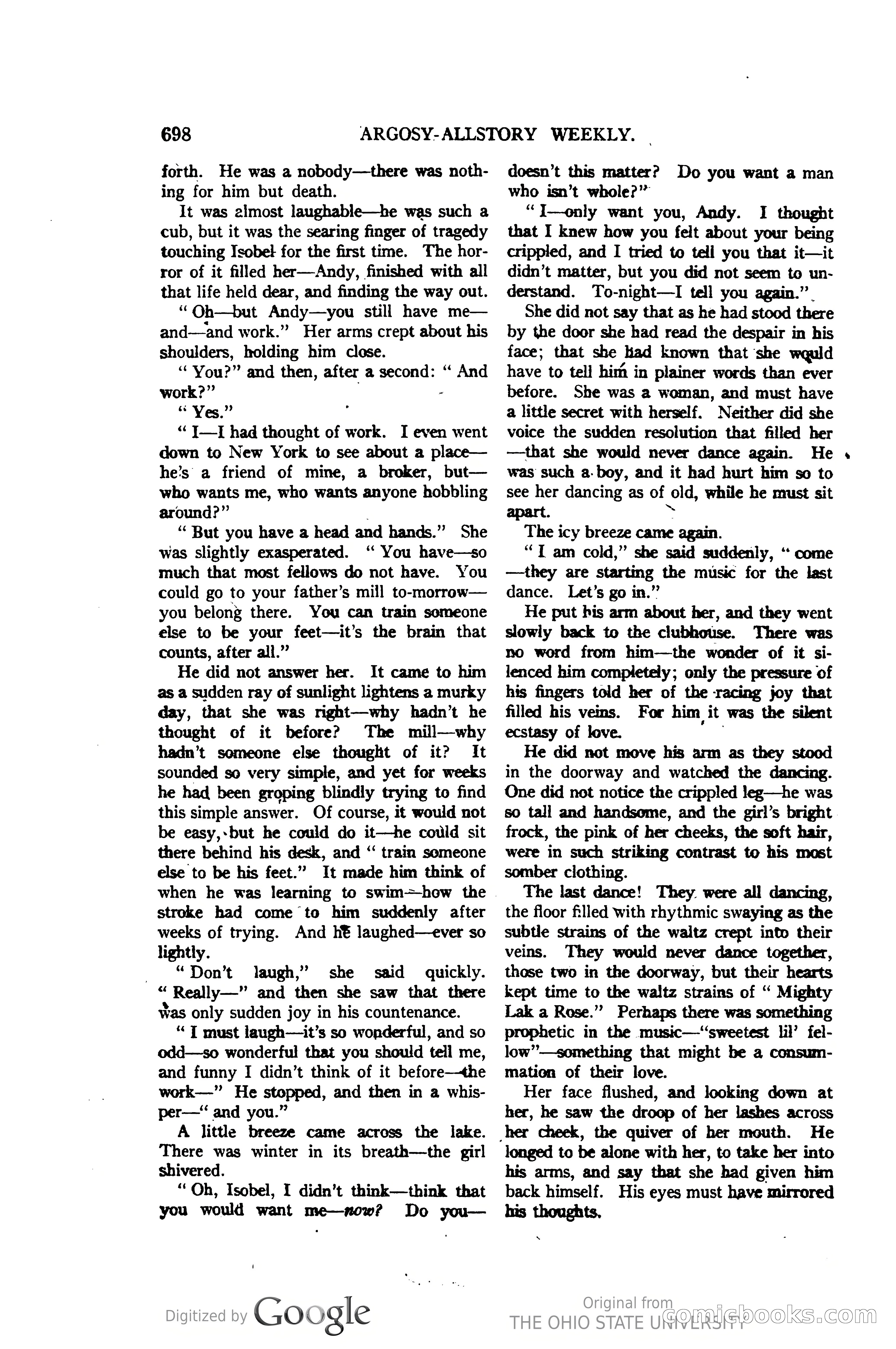
A restored page from Pulp Fiction, 1920. Page through the whole issue in the reader above.
📄 Transcribed text from this page (OCR, searchable)
Machine-transcribed from the original scan — historical spelling and the odd misread are preserved.
698 forth. He was a nobody—there was noth- ing for him but death. It was elmost laughable—he was such a cub, but it was the searing finger of tragedy touching Ysobel for the first time. The hor- ror of it filled her—Andy, finished with all that life held dear, and finding the way out. “ Oh—but Andy—you still have me— and—and work.” Her arms crept about his shoulders, holding him close. “You?” and then, after a second: “ And work?” . - Ge Yes.”’ . ““T—I had thought of work. I even went down to New York to see about a place— he’s a friend of mine, a broker, but— who wants me, who wants anyone hobbling around?”’ ‘“‘'But you have a head and hands.” She was slightly exasperated. ‘‘ You have—so much that most fellows do not have. You could go to your father’s mill to-morrew— you belong there. You can train someone else to be your feet—it’s the brain that counts, after all.”’ He did not answer her. It came to him as a sudden ray of sunlight lightens a murky day, that she was right—why hadn’t he thought of it before? The mill—why hadn’t someone else thought of it? It sounded so very simple, and yet for weeks he had been groping blindly trying to find this simple answer. Of course, it would not be easy,:but he could do it—he could sit there behind his desk, and “ train someone else to be his feet.” It made him think of when he was learning to swim-—how the | stroke had come to him suddenly after weeks of trying. And ht laughed—ever so lightly. “YDon’t laugh,” she said quickly. “ Really—” and then she saw that there was only sudden joy in his countenance. “‘ T must laugh—it’s so wonderful, and so odd—so wonderful that you should tell me, and funny I didn’t think of it before—¢he work—”’ He stopped, and then in a whis- per—‘ and you.” A little breeze came across the lake. There was winter in its breath—the girl shivered. “Qh, Isobel, I didn’t think—think that you would want me—now? Do you— N ARGOSY-ALLSTORY WEEKLY. | doesn’t this matter? Do you want a man who isn’t whole?” “I—only want you, Andy. I thought that I knew how you felt about your being crippled, and I tried to teli you that it—it didn’t matter, but you did not seem to un- derstand. To-night—I tell you again.’ She did not say that as he had stood there by the door she had read the despair in his face; that she had known that she wquld have to tell him in plainer words than ever before. She was a woman, and must have a little secret with herself. Neither did she voice the sudden resolution that filled her —that she would never dance again. He was such a-boy, and it had hurt him so to see her dancing as of old, while he must sit The icy breeze came again. ““T am cold,” she said suddenly, ‘‘ come —they are starting the music for the last dance. Let’s go in.” He put his arm about her, and they went slowly back to the clubhouse. There was no word from him—the wonder of it si- lenced him completely; only the pressure of his fingers told her of the racing joy that filled his veins. For him it was the silent ecstasy of love. He did not move his arm as they stood in the doorway and watched the dancing. One did not notice the crippled leg—he was so tall and handsome, and the girl’s bright. frock, the pink of her cheeks, the soft hair, were in such striking contrast to his most somber clothing. The last dance! They. were all dancing, the floor filled with rhythmic swaying as the subtle strains of the waltz crept into their veins. They would never dance together, those two in the doorway, but their hearts kept time to the waltz strains of “ Mighty Lak a Rose.” Perhaps there was something prophetic in the music—‘“sweetest lil’ fel- low”—something that might be a consum- mation of their love. Her face flushed, and looking down at her, he saw the droop of her lashes across her cheek, the quiver of her mouth. He longed to be alone with her, to take her into his arms, and say that she had given him back himself. His eyes must have mirrored his thoughts, Urigina On a