
Pulp Fiction, 1919 · page 22 of 196
Argosy and Railroad Man's Magazine, Vol. 107 No. 3 — page 22: what you’re looking at
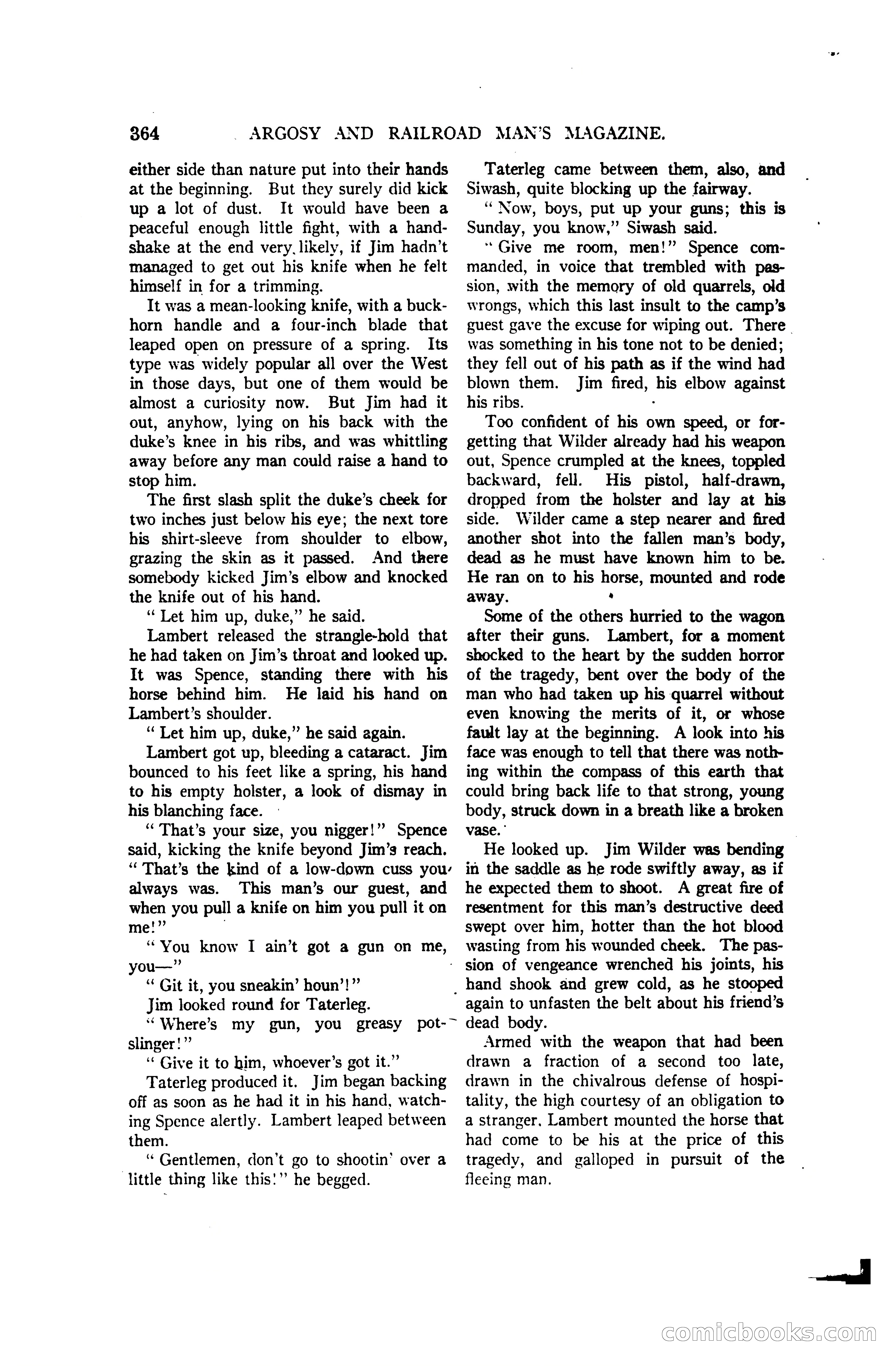
A restored page from Pulp Fiction, 1919. Page through the whole issue in the reader above.
📄 Transcribed text from this page (OCR, searchable)
Machine-transcribed from the original scan — historical spelling and the odd misread are preserved.
364 either side than nature put into their hands at the beginning. But they surely did kick up a lot of dust. It would have been a peaceful enough little fight, with a hand- shake at the end very. likely, if Jim hadn’t managed to get out his knife when he felt himself in for a trimming. It was a mean-looking knife, with a buck- horn handle and a four-inch blade that leaped open on pressure of a spring. Its type was widely popular all over the West in those days, but one of them would be almost a curiosity now. But Jim had it out, anyhow, lying on his back with the duke’s knee in his ribs, and was whittling away before any man could raise a hand to stop him. The first slash split the duke’s cheek for two inches just below his eye; the next tore his shirt-sleeve from shoulder to elbow, grazing the skin as it passed. And there somebody kicked Jim’s elbow and knocked the knife out of his hand. “Let him up, duke,” he said. Lambert released the strangle-hold that he had taken on Jim’s throat and looked up. It was Spence, standing there with his horse behind him. He laid his hand on Lambert’s shoulder. ‘“‘ Let him up, duke,” he said again. Lambert got up, bleeding a cataract. Jim bounced to his feet like a spring, his hand to his empty holster, a look of dismay in his blanching face. ‘“‘That’s your size, you nigger!” Spence said, kicking the knife beyond Jim’s reach. ““ That’s the kind of a low-down cuss you’ always was. This man’s our guest, and when you pull a knife on him you pull it on me!” | “You know I ain’t got a gun on me, “‘ Git it, you sneakin’ houn’!”’ Jim looked round for Taterleg. ‘““'Where’s my gun, you greasy pot-~ 99 slinger! ‘“ Give it to him, whoever’s got it.” Taterleg produced it. Jim began backing off as soon as he had it in his hand, watch- ing Spence alertly. Lambert leaped between them. ‘Gentlemen, don’t go to shootin’ over a little thing like this:” he begged. _ ARGOSY AND RAILROAD MAN’S MAGAZINE. Taterleg came between them, also, and Siwash, quite blocking up the fairway. ‘“Now, boys, put up your guns; this is Sunday, you know,” Siwash said. ‘Give me room, men!” Spence com- manded, in voice that trembled with pas- sion, with the memory of old quarrels, old wrongs, which this last insult to the camp’s guest gave the excuse for wiping out. There was something in his tone not to be denied; they fell out of his path as if the wind had blown them. Jim fired, his elbow against his ribs. Too confident of his own speed, or for- getting that Wilder already had his weapon out, Spence crumpled at the knees, toppled backward, fell. His pistol, half-drawn, dropped from the holster and lay at his side. Wilder came a step nearer and fired another shot into the fallen man’s body, dead as he must have known him to be. He ran on to his horse, mounted and rode away. ’ Some of the others hurried to the wagon after their guns. Lambert, for a moment shocked to the heart by the sudden horror of the tragedy, bent over the body of the man who had taken up his quarrel without even knowing the merits of it, or whose fault lay at the beginning. A look into his face was enough to tell that there was noth- ing within the compass of this earth that could bring back life to that strong, young body, struck down in a breath like a broken vase. He looked up. Jim Wilder was bending — in the saddle as he rode swiftly away, as if he expected them to shoot. A great fire of resentment for this man’s destructive deed swept over him, hotter than the hot blood wasting from his wounded cheek. The pas- sion of vengeance wrenched his joints, his _hand shook and grew cold, as he stooped again to unfasten the belt about his friend’s dead body. Armed with the weapon that had been drawn a fraction of a second too late, drawn in the chivalrous defense of hospi- tality, the high courtesy of an obligation to a stranger. Lambert mounted the horse that had come to be his at the price of this tragedy, and galloped in pursuit of the fleeing man. NOO > Co S Co mM