
Pulp Fiction, 1919 · page 23 of 196
Argosy and Railroad Man's Magazine, Vol. 107 No. 3 — page 23: what you’re looking at
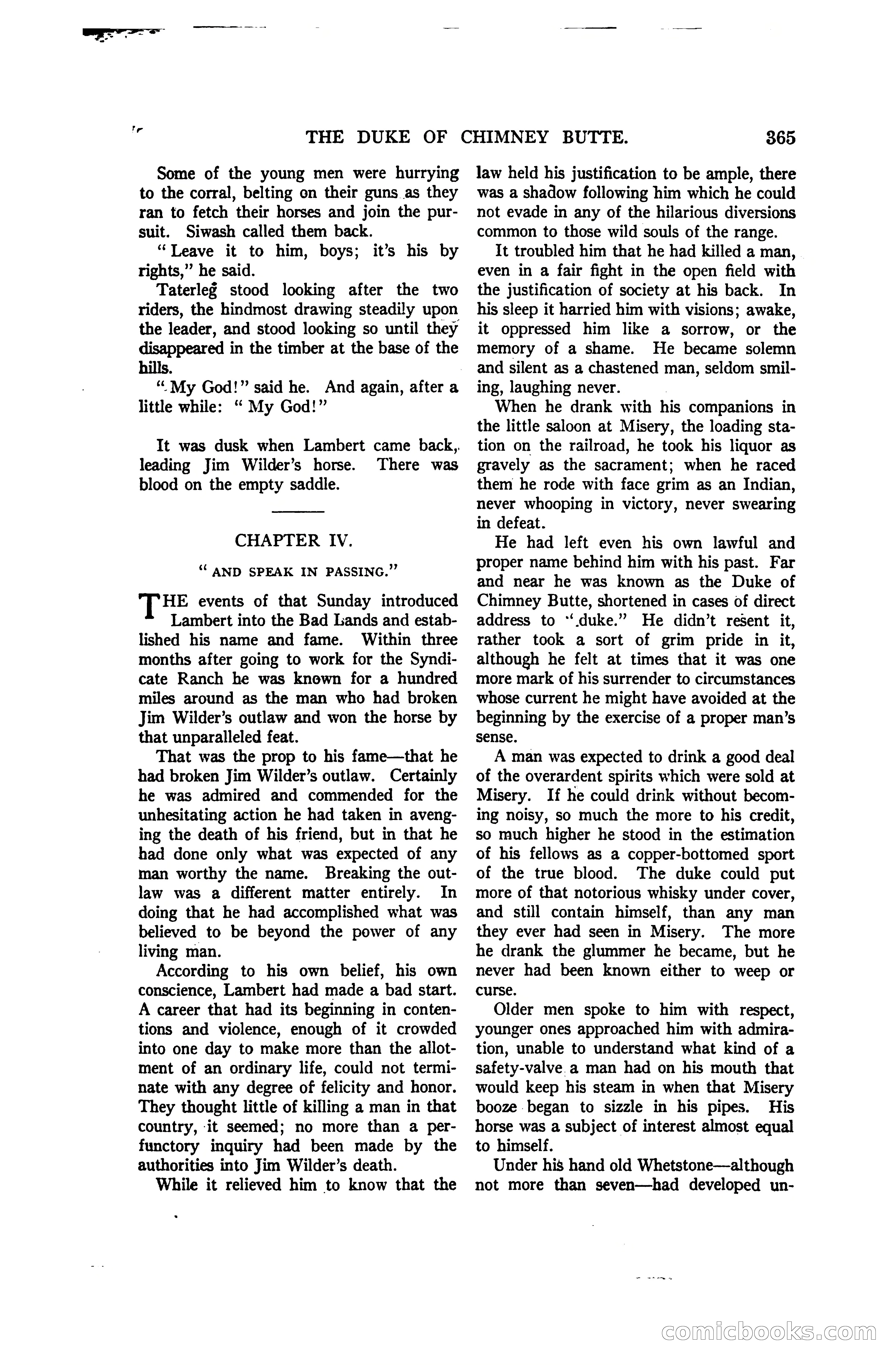
A restored page from Pulp Fiction, 1919. Page through the whole issue in the reader above.
📄 Transcribed text from this page (OCR, searchable)
Machine-transcribed from the original scan — historical spelling and the odd misread are preserved.
Some of the young men were hurrying to the corral, belting on their guns as they ran to fetch their horses and join the pur- suit. Siwash called them back. “Leave it to him, boys; it’s his by rights,” he said. Taterleg stood looking after the two riders, the hindmost drawing steadily upon the leader, and stood looking so until they disappeared in the timber at the base of the hills ““My God!” said he. And again, after a little while: “ My God!” It was dusk when Lambert came back,. leading Jim Wilder’s horse. There was blood on the empty saddle. CHAPTER IV. ‘““ AND SPEAK IN PASSING.”’ THE events of that Sunday introduced Lambert into the Bad Lands and estab- lished his name and fame. Within three months after going to work for the Syndi- cate Ranch he was known for a hundred miles around as the man who had broken Jim Wilder’s outlaw and won the horse by that unparalleled feat. That was the prop to his fame—that he had broken Jim Wilder’s outlaw. Certainly he was admired and commended for the unhesitating action he had taken in aveng- ing the death of his friend, but in that he had done only what was expected of any man worthy the name. Breaking the out- law was a different matter entirely. In doing that he had accomplished what was believed to be beyond the power of any living man. According to his own belief, his own conscience, Lambert had made a bad start. A career that had its beginning in conten- tions and violence, enough of it crowded into one day to make more than the allot- ment of an ordinary life, could not termi- nate with any degree of felicity and honor. They thought little of killing a man in that country, it seemed; no more than a per- functory inquiry had been made by the authorities into Jim Wilder’s death. While it relieved him to know that the THE DUKE OF CHIMNEY BUTTE. 365 law held his justification to be ample, there was a shadow following him which he could not evade in any of the hilarious diversions common to those wild souls of the range. It troubled him that he had killed a man, even in a fair fight in the open field with the justification of society at his back. In his sleep it harried him with visions; awake, it oppressed him like a sorrow, or the memory of a shame. He became solemn and silent as a chastened man, seldom smil- Ing, laughing never. When he drank with his companions in the little saloon at Misery, the loading sta- tion on the railroad, he took his liquor as gravely as the sacrament; when he raced them he rode with face grim as an Indian, never whooping in victory, never swearing in defeat. He had left even his own lawful and proper name behind him with his past. Far and near he was known as the Duke of Chimney Butte, shortened in cases of direct address to “duke.” He didn’t resent it, rather took a sort of grim pride in it, although he felt at times that it was one more mark of his surrender to circumstances whose current he might have avoided at the beginning by the exercise of a proper man’s sense. A man was expected to drink a good deal of the overardent spirits which were sold at Misery. If he could drink without becom- ing noisy, so much the more to his credit, so much higher he stood in the estimation of his fellows as a copper-bottomed sport of the true blood. The duke could put more of that notorious whisky under cover, and still contain himself, than any man they ever had seen in Misery. The more he drank the glummer he became, but he never had been known either to weep or curse. Older men spoke to him with respect, younger ones approached him with admira- tion, unable to understand what kind of a safety-valve.a man had on his mouth that would keep his steam in when that Misery booze began to sizzle in his pipes. His horse was a subject of interest almost equal to himself. Under his hand old Whetstone—although not more than seven—had developed un- ELOOO (C(O) S (C(O) mM