
Pulp Fiction, 1891 · page 8 of 16
The Argosy, Vol. XI No. 20 — page 8: what you’re looking at
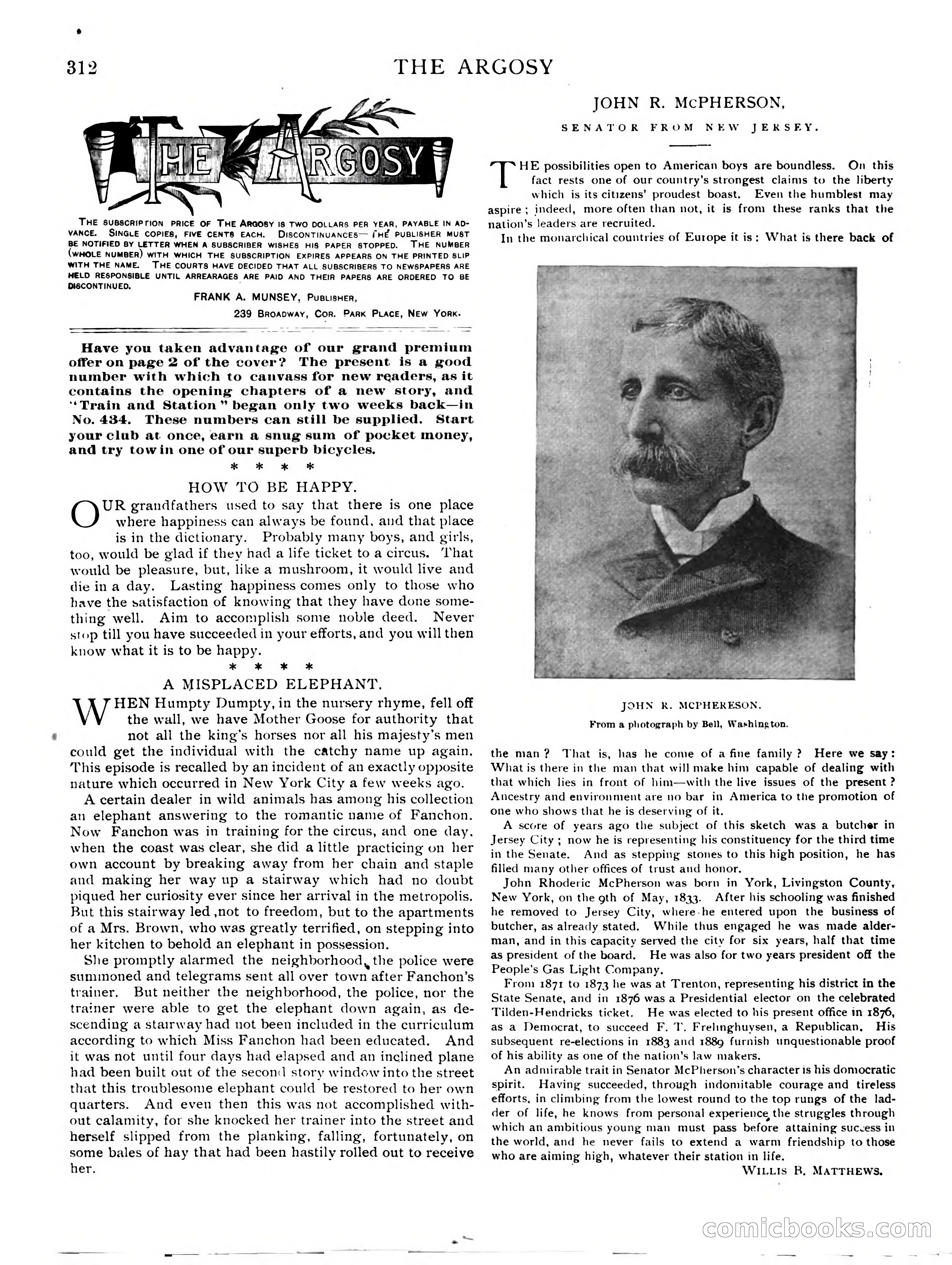
A restored page from Pulp Fiction, 1891. Page through the whole issue in the reader above.
📄 Transcribed text from this page (OCR, searchable)
Machine-transcribed from the original scan — historical spelling and the odd misread are preserved.
THE SUBSCRIPTION PRICE OF THE ARGOSY IS TWO DOLLARS PER YEAR, PAYABLE IN AD- VANCE. SINGLE COPIES, FIVE CENTS EACH. DISCONTINUANCES— [HE PUBLISHER MUST BE NOTIFIED BY LETTER WHEN A SUBSCRIBER WISHES HIS PAPER STOPPED. THE NUMBER (WHOLE NUMBER) WITH WHICH THE SUBSCRIPTION EXPIRES APPEARS ON THE PRINTED SLIP WITH THE NAME. THE COURTS HAVE DECIDED THAT ALL SUBSCRIBERS TO NEWSPAPERS ARE HELO RESPONSIBLE UNTIL ARREARAGES ARE PAID ANDO THEIR PAPERS ARE ORDERED TO BE DISCONTINUED. : FRANK A. MUNSEY, Pustisner, 239 BRoApway, Cor. PARK PLACE, NEW YORK. Have you taken advantage of our grand premium offer on page 2 of the cover? The present is a good number with which to canvass for new readers, as it contains the opening chapters of a new story, and “Train and Station” began only two weeks back—in No. 434. These numbers can still be supplied. Start your club at once, earn a snug sum of pocket money, and try towin one of our superb bicycles. * * * HOW TO BE HAPPY. UR grandfathers used to say that there is one place where happiness can always be found, and that place is in the dictionary. Probably many boys, and girls, too, would be glad if they had a life ticket to acircus. ‘That would be pleasure, but, like a mushroom, it would live and die ina day. Lasting happiness comes only to those who have the satisfaction of knowing that they have done some- thing well. Aim to accomplish some noble deed. Never stop till you have succeeded in your efforts, and you will then know what it is to be happy. * * * x A MISPLACED ELEPHANT. HEN Humpty Dumpty, in the nursery rhyme, fell off the wall, we have Mother Goose for authority that not all the king’s horses nor all his majesty’s men could get the individual with the catchy name up again. This episode is recalled by an incident of an exactly opposite nature which occurred in New York City a few weeks ago. A certain dealer in wild animals has among his collection an elephant answering to the romantic name of Fanchon. Now Fanchon was in training for the circus, and one day, when the coast was clear, she did a little practicing on her own account by breaking away from her chain and staple and making her way up a stairway which had no doubt piqued her curiosity ever since her arrival in the metropolis. But this stairway led not to freedom, but to the apartments of a Mrs. Brown, who was greatly terrified, on stepping into her kitchen to behold an elephant in possession. She promptly alarmed the neighborhood, the police were suminoned and telegrams sent all over town after Fanchon’s trainer. But neither the neighborhood, the police, nor the trainer were able to get the elephant down again, as de- scending a stairway had not been included in the curriculum according to which Miss Fanchon had been educated. And it was not until four days had elapsed and an inclined plane had been built out of the second story window into the street that this troublesome elephant could be restored to her own quarters. And even then this was not accomplished with- out calamity, for she knocked her trainer into the street and herself slipped from the planking, falling, fortunately, on some bales of hay that had been hastilv rolled out to receive her. THE ARGOSY JOHN R. McPHERSON, SENATOR FROM NEW JEKSFEFY. HE possibilities open to American boys are boundless. On this sii fact rests one of our country’s strongest claims to the liberty which is its citizens’ proudest boast. Even the humblest may aspire; indeed, more often than not, it is from these ranks that the nation’s leaders are recruited. In the monarchical countries of Europe it is: What is there back of + ~ , - ~~ a . 7s my Cae rd F * ? wks ~ cme al + a set 7 . 297.5 JOHN R. MCPHERESON. From a photograph by Bell, Washing ton. the man? That is, has he come of a fine family ? Here we say: What is there in the man that will make him capable of dealing with that which lies in front of him—with the live issues of the present ? Ancestry and environment are no bar in America to the promotion of one who shows that he is deserving of it. A score of years ago the subject of this sketch was a butcher in Jersey City ; now he is representing his constituency for the third time in the Senate. And as stepping stones to this high position, he has filled many other offices of trust and honor. John Rhoderic McPherson was born in York, Livingston County, New York, on the gth of May, 1833. After his schooling was finished he removed to Jersey City, where-he entered upon the business of butcher, as already stated. While thus engaged he was made alder- man, and in this capacity served the city for six years, half that time as president of the board. He was also for two years president off the People's Gas Light Company, From 1871 to 1873 he was at Trenton, representing his district in the State Senate, and in 1876 was a Presidential elector on the celebrated Tilden-Hendricks ticket. He was elected to his present office in 1876, as a Democrat, to succeed F. T. Frelinghuysen, a Republican, His subsequent re-elections in 1883 and 1889 furnish unquestionable proof of his ability as one of the nation’s law makers. An adniirable trait in Senator McPherson's character is his domocratic spirit. Having succeeded, through indomitable courage and tireless efforts, in climbing from the lowest round to the top rungs of the lad- der of life, he knows from personal experience the struggles through which an ambitious young man must pass before attaining success in the world, and he never fails to extend a warm friendship to those who are aiming high, whatever their station in life. , WILLIS B, MATTHEWS. comic ooolks (CO)