
Pulp Fiction, 1891 · page 9 of 16
The Argosy, Vol. XI No. 20 — page 9: what you’re looking at
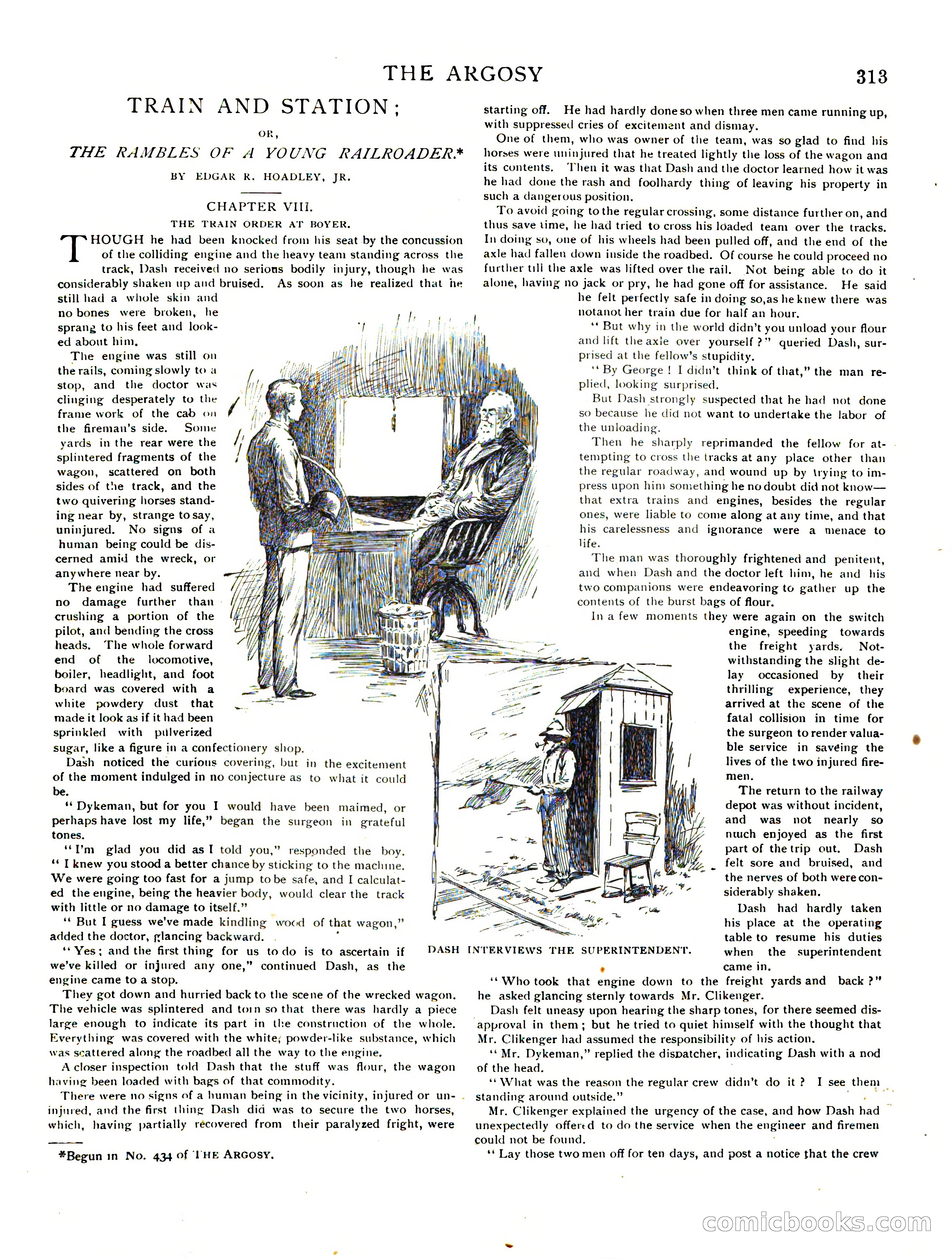
A restored page from Pulp Fiction, 1891. Page through the whole issue in the reader above.
📄 Transcribed text from this page (OCR, searchable)
Machine-transcribed from the original scan — historical spelling and the odd misread are preserved.
THE ARGOSY TRAIN AND STATION; THE RAMBLES OF A YOUNG RAILROADER* BY EDGAR R. HOADLEY, JR. CHAPTER VIII. THE TRAIN ORDER AT BOYER. HOUGH he had been knocked from his seat by the concussion of the colliding engine and the heavy team standing across the track, Dash received no serious bodily injury, though he was considerably shaken up and bruised. As soon as he realized that he still had a whole skin and no bones were broken, he sprang to his feet and look- ed about him, The engine was still on the rails, coming slowly to a / stop, and the doctor was fly ¢ clinging desperately to the { Ke a / nh) | frame work of the cab on the fireman's side. Some yards in the rear were the splintered fragments of the ; wagon, scattered on both sides of the track, and the two quivering horses stand- ing near by, strange tosay, uninjured. No signs of a human being could be dis- cerned amid the wreck, or any where near by. The engine had suffered no damage further than » crushing a portion of the pilot, and bending the cross heads. The whole forward end of the locomotive, boiler, headlight, and foot board was covered with a white powdery dust that made it look as if it had been sprinkled with pulverized sugar, like a figure in a confectionery shop. Dash noticed the curious covering, but in the excitement of the moment indulged in no conjecture as to what it could be. ** Dykeman, but for you I would have been maimed, or perhaps have lost my life,” began the surgeon in grateful tones. ‘‘I’m glad you did asI told you,” responded the boy. ‘* T knew you stood a better chance by sticking to the machine. We were going too fast for a jump tobe safe, and I calculat- ed the engine, being the heavier body, would clear the track with little or no damage to itself.” ‘* But I guess we've made kindling wocd of that wagon,” added the doctor, glancing backward. , ‘* Yes; and the first thing for us todo is to ascertain if we’ve killed or injured any one,” continued Dash, as the engine came to a stop. They got down and hurried back to the scene of the wrecked wagon. The vehicle was splintered and toin so that there was hardly a piece large enough to indicate its part in the construction of the whole. Everything was covered with the white; powder-like substance, which was scattered along the roadbed all the way to the engine. A closer inspection told Dash that the stuff was flour, the wagon having been loaded with bags of that commodity. There were no signs of a human being in the vicinity, injured or un- injured, and the first thing Dash did was to secure the two horses, which, having partially recovered from their paralyzed fright, were *Begun in No. 434 of 1HE ARGOSY, eal Phila DASH INTERVIEWS THE SUPERINTENDENT. 313 starting off. He had hardly doneso when three men came running up, with suppressed cries of excitement and dismay. One of them, who was owner of the team, was so glad to find his horses were uninjured that he treated lightly the loss of the wagon ana its contents. Then it was that Dash and the doctor learned how it was he had done the rash and foolhardy thing of leaving his property in such a dangerous position. To avoid going tothe regular crossing, some distance further on, and thus save time, he had tried to cross his loaded team over the tracks. In doing so, one of his wheels had been pulled off, and the end of the axle had fallen down inside the roadbed. Of course he could proceed no further tll the axle was lifted over the rail. Not being able to do it alone, having no jack or pry, he had gone off for assistance. He said he felt perfectly safe in doing so,as he knew there was notanot her train due for half an hour. ‘* But why in the world didn’t you unload your flour and lift the axie over yourself ?‘’ queried Dash, sur- prised at the fellow’s stupidity. ‘* By George ! I didn’t think of that,” the man re- plied, looking surprised. But Dash strongly suspected that he had not done so because he did not want to undertake the labor of the unloading. tempting to cross the tracks at any place other than the regular roadway, and wound up by trying to im- press upon him something he no doubt did not know— that extra trains and engines, besides the regular ones, were liable to come along at any time, and that his carelessness and ignorance were a menace to Y. life. {y//: The man was thoroughly frightened and penitent, f/f. / and when Dash and the doctor left him, he and_ his Mf two companions were endeavoring to gather up the contents of the burst bags of flour. In a few moments they were again on the switch engine, speeding towards the freight yards. Not- withstanding the slight de- lay occasioned by their thrilling experience, they arrived at the scene of the fatal collision in time for the surgeon to render valua- ble service in savéing the lives of the two injured fire- men. The return to the railway depot was without incident, and was not nearly so nwch enjoyed as the first part of thetrip out. Dash felt sore and bruised, and the nerves of both were con- siderably shaken. Dash had hardly taken his place at the operating table to resume his duties when the superintendent ’ came in. ‘“Who took that engine down to the freight yards and _ back ?” he asked glancing sternly towards Mr. Clikenger. Dash felt uneasy upon hearing the sharp tones, for there seemed dis- ‘approval in them; but he tried to quiet himself with the thought that Mr. Clikenger had assumed the responsibility of his action. ‘*Mr. Dykeman,” replied the dispatcher, indicating Dash with a nod of the head. ‘‘ What was the reason the regular crew didn’t do it? I see them — standing around outside.” ‘ Mr. Clikenger explained the urgency of the case, and how Dash had unexpectedly offered to do the service when the engineer and firemen could not be found. , ‘* Lay those twomen off for ten days, and post a notice that the crew Then he sharply reprimanded the fellow for at- . MICGOOOKS @ CO (CO)