
Pulp Fiction, 1920 · page 133 of 208
Argosy All-Story Weekly — "The Purple Limited" — page 133: what you’re looking at
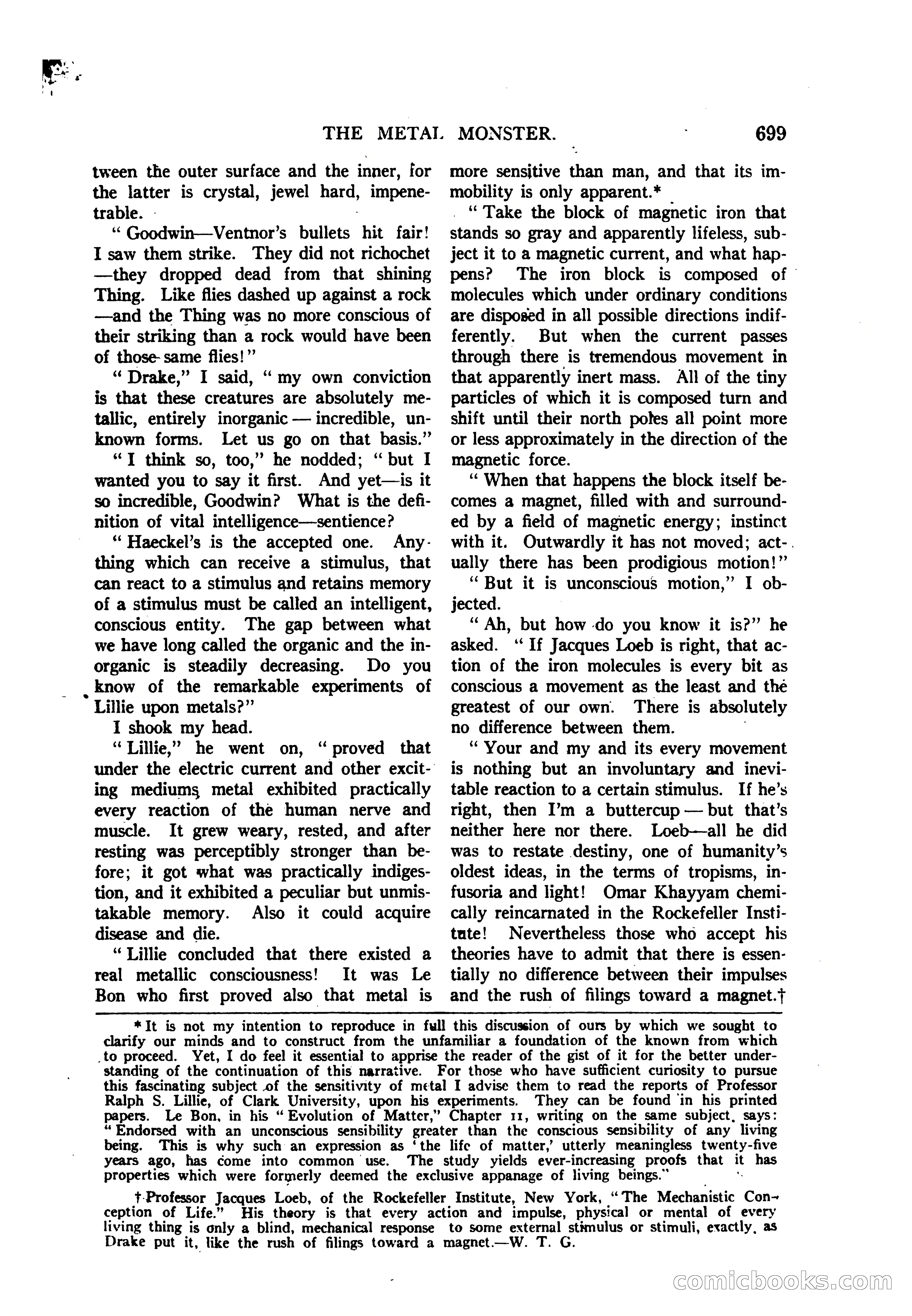
A restored page from Pulp Fiction, 1920. Page through the whole issue in the reader above.
📄 Transcribed text from this page (OCR, searchable)
Machine-transcribed from the original scan — historical spelling and the odd misread are preserved.
THE METAI MONSTER. tween the outer surface and the inner, for the latter is crystal, jewel hard, impene- trable. ‘“‘ Goodwin—Ventnor’s bullets hit fair! I saw them strike. They did not richochet —they dropped dead from that shining Thing. Like flies dashed up against a rock —and the Thing was no more conscious of their striking than a rock would have been of those- same flies!” “ Drake,” I said, ‘my own conviction is that these creatures are absolutely me- tallic, entirely inorganic — incredible, un- known forms. Let us go on that basis.”’ “I think so, too,’’ he nodded; “ but I wanted you to say it first. And yet—is it so incredible, Goodwin? What is the defi- nition of vital intelligence—sentience? ‘“* Haeckel’s is the accepted one. Any- thing which can receive a stimulus, that can react to a stimulus and retains memory of a stimulus must be called an intelligent, conscious entity. The gap between what we have long called the organic and the in- organic is steadily decreasing. Do you , Know of the remarkable experiments of Lillie upon metals?” I shook my head. “ Lillie””’ he went on, “ proved that under the electric current and other excit- ing mediums metal exhibited practically every reaction of the human nerve and muscle. It grew weary, rested, and after resting was perceptibly stronger than be- fore; it got what was practically indiges- tion, and it exhibited a peculiar but unmis- takable memory. Also it could acquire disease and die. “Lillie concluded that there existed a real metallic consciousness! It was Le Bon who first proved also that metal is 699 more sensjtive than man, and that its im- mobility is only apparent.* | ‘Take the block of magnetic iron that stands so gray and apparently lifeless, sub- ject it to a magnetic current, and what hap- pens? molecules which under ordinary conditions are disposed in all possible directions indif- ferently. But when the current passes through there is tremendous movement in that apparently inert mass. All of the tiny particles of which it is composed turn and shift until their north potes all point more or less approximately in the direction of the magnetic force. ‘‘' When that happens the block itself be- comes a magnet, filled with and surround- ed by a field of magnetic energy; instinct with it. ually there has been prodigious motion!” ‘But it is unconscious motion,” I ob- jected. “Ah, but how do you know it is?” he asked. ‘‘ If Jacques Loeb is right, that ac- tion of the iron molecules is every bit as conscious a movement as the least and the greatest of our own. There is absolutely no difference between them. “Your and my and its every movement is nothing but an involuntary and inevi- table reaction to a certain stimulus. If he’s right, then I’m a buttercup — but that’s neither here nor there. Loeb—all he did was to restate destiny, one of humanity’s oldest ideas, in the terms of tropisms, in- fusoria and light! Omar Khayyam chemi- cally reincarnated in the Rockefeller Insti- tute! Nevertheless those who accept his theories have to admit that there is essen- tially no difference between their impulses and the rush of filings toward a magnet.j *It is not my intention to reproduce in full this discussion of ours by which we sought to clarify our minds and to construct from the unfamiliar a foundation of the known from which .to proceed. Yet, I do feel it essential to apprise the reader of the gist of it for the better under- standing of the continuation of this narrative. For those who have sufficient curiosity to pursue this fascinating subject of the sensitivity of metal I advise them to read the reports of Professor Ralph S. Lillie, of Clark University, upon his experiments. Chapter 11, writing on the same subject, says: papers. Le Bon, in his “ Evolution of Matter,” They can be found in his printed “Endorsed with an unconscious sensibility greater than the conscious sensibility of any living being. This is why such an expression as ‘the life of matter,’ utterly meaningless twenty-five years ago, has come into common use. The study yields ever-increasing proofs that it has properties which were formerly deemed the exclusive appanage of living beings.” +-Professor Jacques Loeb, of the Rockefeller Institute, New York, “The Mechanistic Con-~ ception of Life.” His theory is that every action and impulse, physical or mental of every living thing is only a blind, mechanical response to some external stimulus or stimuli, exactly, as Drake put it, like the rush of filings toward a magnet.—W. T. G. The iron block is composed of Outwardly it has not moved; act-. (C(O) nn) (C 6)(0)O) S (C(O)