
Pulp Fiction, 1920 · page 134 of 208
Argosy All-Story Weekly — "The Purple Limited" — page 134: what you’re looking at
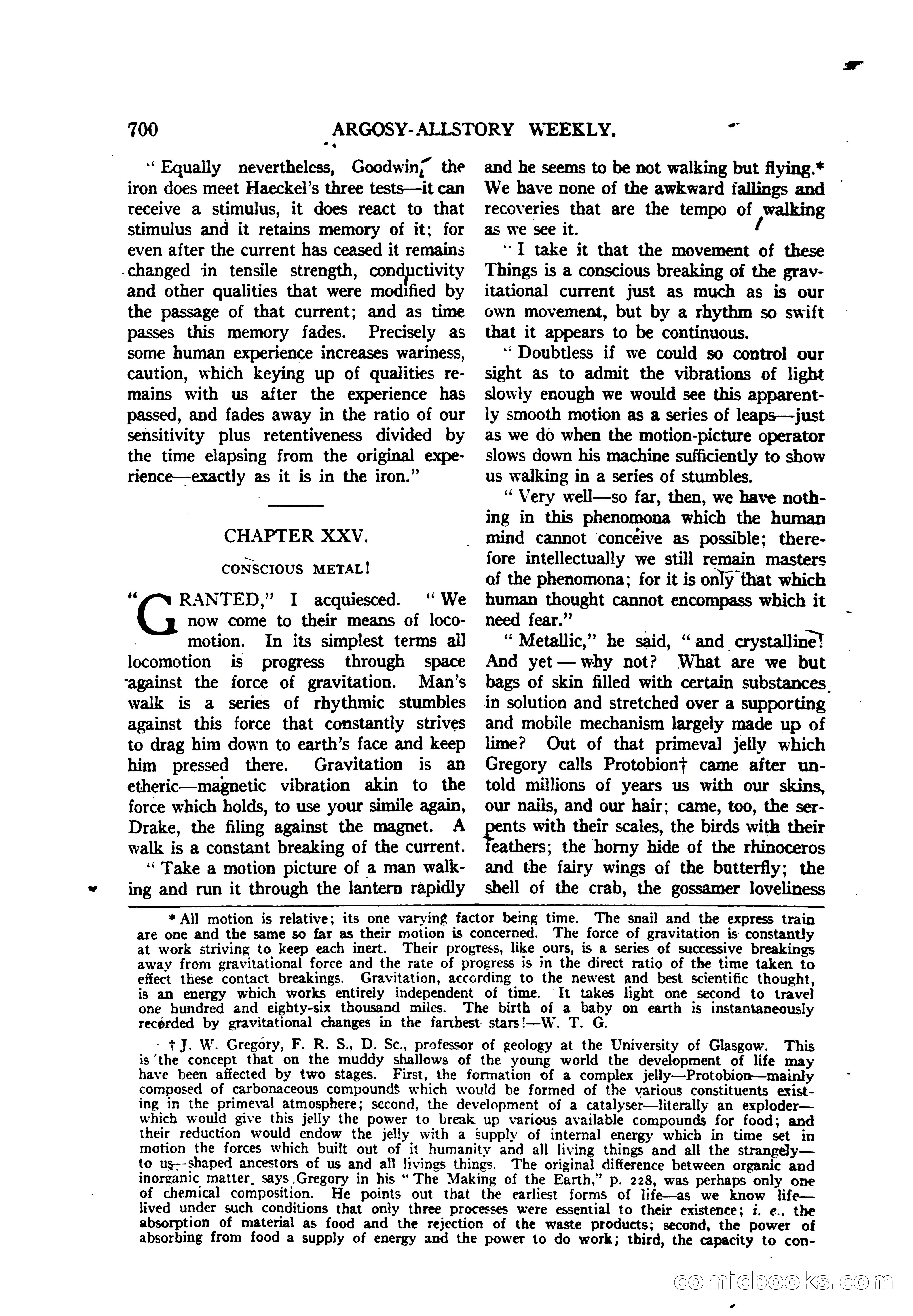
A restored page from Pulp Fiction, 1920. Page through the whole issue in the reader above.
📄 Transcribed text from this page (OCR, searchable)
Machine-transcribed from the original scan — historical spelling and the odd misread are preserved.
700 “ Equally nevertheless, Goodwin; the iron does meet Haeckel’s three tests—it can receive a stimulus, it does react to that stimulus and it retains memory of it; for even after the current has ceased it remains .changed in tensile strength, conductivity and other qualities that were modified by the passage of that current; and as time passes this memory fades. Precisely as some human experience increases wariness, caution, which keying up of qualities re- mains with us after the experience has passed, and fades away in the ratio of our sensitivity plus retentiveness divided by the time elapsing from the original expe- rience—exactly as it is in the iron.” CHAPTER XXV. CONSCIOUS METAL! “e RANTED,” I acquiesced. ‘‘ We now come to their means of loco- motion. In its simplest terms all locomotion is progress through space ‘against the force of gravitation. Man’s walk is a series of rhythmic stumbles against this force that constantly strives to drag him down to earth’s face and keep him pressed there. Gravitation is an etheric—magnetic vibration akin to the force which holds, to use your simile again, Drake, the filing against the magnet. A walk is a constant breaking of the current. ‘Take a motion picture of a man walk- ing and run it through the lantern rapidly * All motion is relative; its one varying factor being time. ARGOSY-ALLSTORY WEEKLY. and he seems to be not walking but flying.* We have none of the awkward fallings and recoveries that are the tempo of walking as we see it. f ‘IT take it that the movement of these Things is a conscious breaking of the grav- itational current just as much as is our own movement, but by a rhythm so swift. that it appears to be continuous. ‘Doubtless if we could so control our sight as to admit the vibrations of light slowly enough we would see this apparent- ly smooth motion as a series of leaps—just as we do when the motion-picture operator slows down his machine sufficiently to show us walking in a series of stumbles. ‘Very well—so far, then, we have noth- ing in this phenomona which the human mind cannot conceive as possible; there- fore intellectually we still remain masters of the phenomona; for it is only that which human thought cannot encompass which it need fear.” “ Metallic,” he said, “and crystalline! And yet— why not? What are we but bags of skin filled with certain substances in solution and stretched over a supporting and mobile mechanism largely made up of lime? Out of that primeval jelly which Gregory calls Protobiont came after un- told millions of years us with our skins, our nails, and our hair; came, too, the ser- pents with their scales, the birds with their feathers; the horny hide of the rhinoceros and the fairy wings of the butterfly; the shell of the crab, the gossamer loveliness The snail and the express train are one and the same so far as their motion is concerned. The force of gravitation is constantly at work striving to keep each inert. Their progress, like ours, is a series of successive breakings away from gravitational force and the rate of progress is in the direct ratio of the time taken to effect these contact breakings. Gravitation, according to the newest and best scientific thought, is an energy which works entirely independent of time. It takes light one second to travel one hundred and eighty-six thousand miles. The birth of a baby on earth is instantaneously recérded by gravitational changes in the farthest. stars!—W. T. G. : + J. W. Gregory, F. R. S., D. Sc., professor of geology at the University of Glasgow. This is ‘the concept that on the muddy shallows of the young world the development of life may have been affected by two stages. First, the formation of a complex jelly—Protobion—mainly composed of carbonaceous compound’ which would be formed of the various constituents exist- ing in the primeval atmosphere; second, the development of a catalyser—literally an exploder— which would give this jelly the power to break up various available compounds for food; and their reduction would endow the jelly with a Supply of internal energy which in time set in motion the forces which built out of it humanity and all living things and all the strangely— to us--shaped ancestors of us and all livings things. The original difference between organic and inorganic matter, says Gregory in his “The Making of the Earth,” p. 228, was perhaps only one of chemical composition. He points out that the earliest forms of life—as we know life— lived under such conditions that only three processes were essential to their existence; i. e.. the absorption of material as food and the rejection of the waste products; second, the power of absorbing from food a supply of energy and the power to do work; third, the capacity to con- (C 6)(0)©) sal (C(O) S (C(O) o