
Pulp Fiction, 1920 · page 186 of 208
Argosy All-Story Weekly — "The Purple Limited" — page 186: what you’re looking at
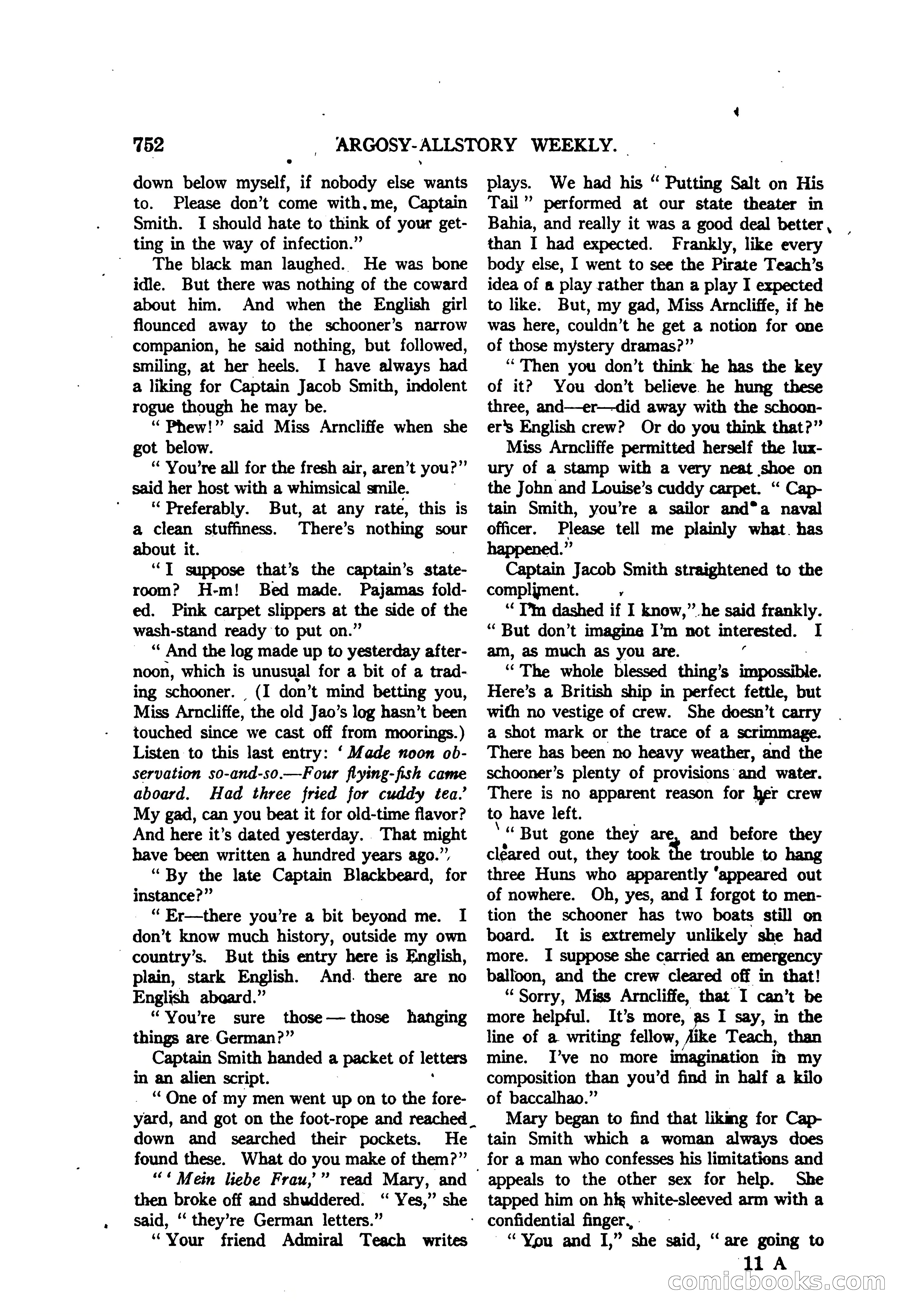
A restored page from Pulp Fiction, 1920. Page through the whole issue in the reader above.
📄 Transcribed text from this page (OCR, searchable)
Machine-transcribed from the original scan — historical spelling and the odd misread are preserved.
752 _ ARGOSY-ALLSTORY WEEKLY. down below myself, if nobody else wants to. Please don’t come with,me, Captain Smith. I should hate to think of your get- ting in the way of infection.” ' The black man laughed. He was bone idle. But there was nothing of the coward about him. And when the English girl flounced away to the schooner’s narrow companion, he said nothing, but followed, smiling, at her heels. I have always had a liking for Captain Jacob Smith, indolent rogue though he may be. “Phew!” said Miss Arncliffe when she got below. “You're all for the fresh air, aren’t you?” said her host with a whimsical smile. : ' Preferably. But, at any rate, this is a clean stuffiness. There’s nothing sour about it. ‘““T suppose that’s the captain’s state- room? H-m! Bed made. Pajamas fold- ed. Pink carpet slippers at the side of the wash-stand ready to put on.” ‘* And the log made up to yesterday after- noon, which is unusual for a bit of a trad- ing schooner. (I don’t mind betting you, Miss Arncliffe, the old Jao’s log hasn’t been touched since we cast off from moorings.) Listen to this last entry: ‘ Made noon ob- servation so-and-so.—Four flying-fish came aboard. Had three fried for cuddy tea.’ My gad, can you beat it for old-time flavor? And here it’s dated yesterday. That might have been written a hundred years ago.” “By the late Captain Blackbeard, for instance?” _ “ Er—there you’re a bit beyond me. I don’t know much history, outside my own - country’s. But this entry here is English, plain, stark English. And. there are no English aboard.” “You're sure those— those hahging things are German?” Captain Smith handed a packet of letters in an alien script. . “Qne of my men went up on to the fore- yard, and got on the foot-rope and reached _ down and searched their pockets. He found these. What do you make of them?” “* Mein liebe Frau,” read Mary, and then broke off and shuddered. ‘ Yes,” she said, “‘ they’re German letters.” “Your friend Admiral Teach writes plays. We had his “ Putting Salt on His Tail” performed at our state theater in Bahia, and really it was a good deal better , than I had expected. Frankly, like every body else, I went to see the Pirate Teach’s idea of a play rather than a play I expected to like. But, my gad, Miss Arncliffe, if he was here, couldn’t he get a notion for one of those mystery dramas?”’ “Then you don’t think he has the key of it? You don’t believe. he hung these three, and—er—-did away with the schoon- er’s English crew? Or do you think that?” Miss Arncliffe permitted herself the lux- ury of a stamp with a very neat shoe on the John and Louise’s cuddy carpet. ‘‘ Cap- tain Smith, you’re a sailor and*a naval officer. Please tell me plainly what. has Captain Jacob Smith straightened to the complyment. y ‘“ Tm dashed if I know,” he said frankly. “But don’t imagine I’m not interested. I am, as much as you are. ‘“‘ The whole blessed thing’s impasaibie Here’s a British ship in perfect fettle, but with no vestige of crew. She doesn’t carry a shot mark or the trace of a scrimmage. There has been no heavy weather, and the schooner’s plenty of provisions and water. There is no apparent reason for her crew to have left. ‘« But gone they are, and before they cleared out, they took the trouble to hang three Huns who apparently ‘appeared out of nowhere. Oh, yes, and I forgot to men- tion the schooner has two boats still on board. It is extremely unlikely she had more. I suppose she carried an emergency balloon, and the crew cleared off in that! 7 Sorry, Miss Arncliffe, that I can’t be more helpful. It’s more, as I say, in the line of a writing fellow, ike Teach, than mine. I’ve no more imagination in my composition than you’d find in half a kilo of baccalhao.”’ | Mary began to find that liking for Cap- tain Smith which a woman always does _ for a man who confesses his limitations and appeals to the other sex for help. She tapped him on hig white-sleeved arm with a confidential finger, - “You and I,” she said, “are going to TA (C(O) nn) (C 6)(0)©) KS (CO in