
Pulp Fiction, 1920 · page 187 of 208
Argosy All-Story Weekly — "The Purple Limited" — page 187: what you’re looking at
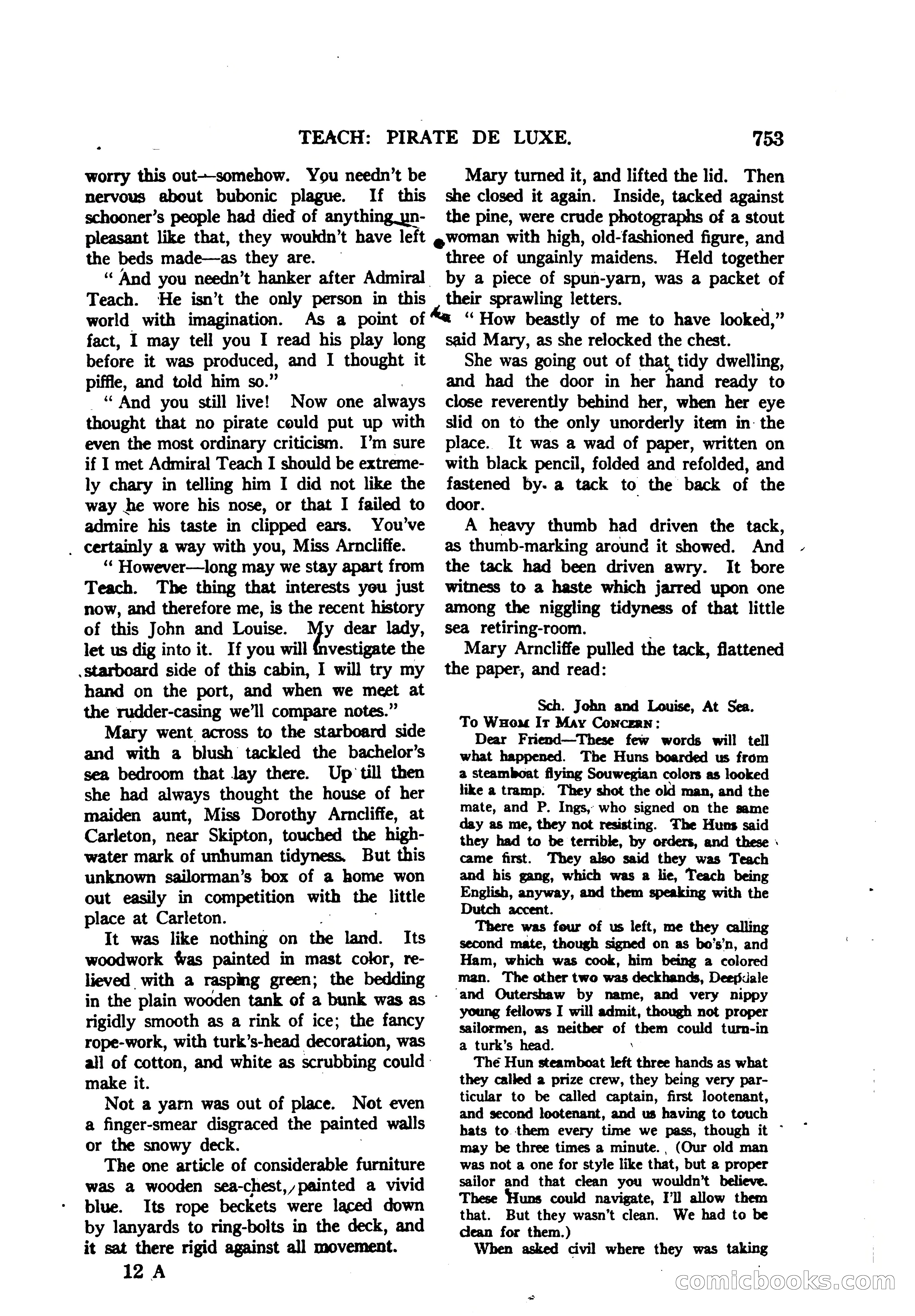
A restored page from Pulp Fiction, 1920. Page through the whole issue in the reader above.
📄 Transcribed text from this page (OCR, searchable)
Machine-transcribed from the original scan — historical spelling and the odd misread are preserved.
TEACH: PIRATE DE LUXE. worry this out--somehow. You needn’t be nervous about bubonic plague. If this schooner’s people had died of anything _un- 153 Mary turned it, and lifted the lid. Then She closed it again. Inside, tacked against the pine, were crude photographs of a stout pleasant like that, they woukdn’t have left gwoman with high, old-fashioned figure, and the beds made—as they are. — “ And you needn’t hanker after Admiral Teach. He isn’t the only person in this world with imagination. As a point of fact, I may tell you I read his play long before it was produced, and I thought it piffle, and told him so.” | _“ And you still live! Now one always thought that no pirate could put up with even the most ordinary criticism. I’m sure if I met Admiral Teach I should be extreme- ly chary in telling him I did not like the way he wore his nose, or that I failed to admire his taste in clipped ears. You've _ certainly a way with you, Miss Arncliffe. ‘“‘ However—long may we stay apart from Teach. The thing that interests you just now, and therefore me, is the recent history of this John and Louise. y dear lady, let us dig into it. If you will {nvestigate the .starboard side of this cabin, I will try my hand on the port, and when we meet at the rudder-casing we’ll compare notes.” Mary went across to the starboard side and with a blush tackled the bachelor’s sea bedroom that lay there. Up till then she had always thought the house of her maiden aunt, Miss Dorothy Arncliffe, at Carleton, near Skipton, touched the high- water mark of unhuman tidyness. But this unknown sailorman’s box of a home won out easily in competition with the little place at Carleton. It was like nothing on the land. Its woodwork vas painted in mast color, re- lieved with a rasping green; the bedding in the plain wooden tank of a bunk was as - rigidly smooth as a rink of ice; the fancy rope-work, with turk’s-head decoration, was all of cotton, and white as scrubbing could | make it. Not a yarn was out of place. Not even a finger-smear disgraced the painted walls or the snowy deck. The one article of considerable furniture was a wooden sea-chest,,painted a vivid blue. Its rope beckets were laced down by lanyards to ring-bolts in the deck, and it sat there rigid against all movement. IZA three of ungainly maidens. Held together by a piece of spun-yarn, was a packet of their sprawling letters. “How beastly of me to have looked,” said Mary, as she relocked the chest. She was going out of that tidy dwelling, and had the door in her hand ready to close reverently behind her, when her eye slid on to the only unorderly item in: the place. It was a wad of paper, written on with black pencil, folded and refolded, and fastened by. a tack to the back of the door. A heavy thumb had driven the tack, as thumb-marking around it showed. And the tack had been driven awry. It bore witness to a haste which jarred upon one among the niggling tidyness of that little sea retiring-room. Mary Arncliffe pulled the tack, flattened the paper, and read: Sch. John and Louise, At Sea. To WHom It May Concean: Dear Friend—These few words will tell what happened. The Huns boarded us from a steamboat flying Souwegian colors as looked like a tramp: They shot the old man, and the mate, and P. Ings, who signed on the same day as me, they not resisting. The Huns said they had to be terrible, by orders, and these : came first. They also said they was Teach and his gang, which was a lie, Teach being English, anyway, and them speaking with the Dutch accent. There was four of us left, me they calling second mate, though signed on as bo’'s’n, and Ham, which was cook, him being a colored man. The other two was deckhands, Deesiiale ‘and Outershaw by name, and very nippy young fellows I will admit, though not proper sailormen, as neither of them could turn-in a turk’s head. ’ The Hun steamboat left three hands as what they called a prize crew, they being very par- ticular to be called captain, first lootenant, and second lootenant, and us having to touch hats to. them every time we pass, though it ~ may be three times a minute. (Our old man was not a one for style like that, but a proper sailor and that clean you wouldn't believe. These Huns could navigate, I'll allow them that. But they wasn’t clean. We had to be Clean for them.) When asked civil where they was taking mG (C(O) TOG S