
Pulp Fiction, 1920 · page 194 of 208
Argosy All-Story Weekly — "The Purple Limited" — page 194: what you’re looking at
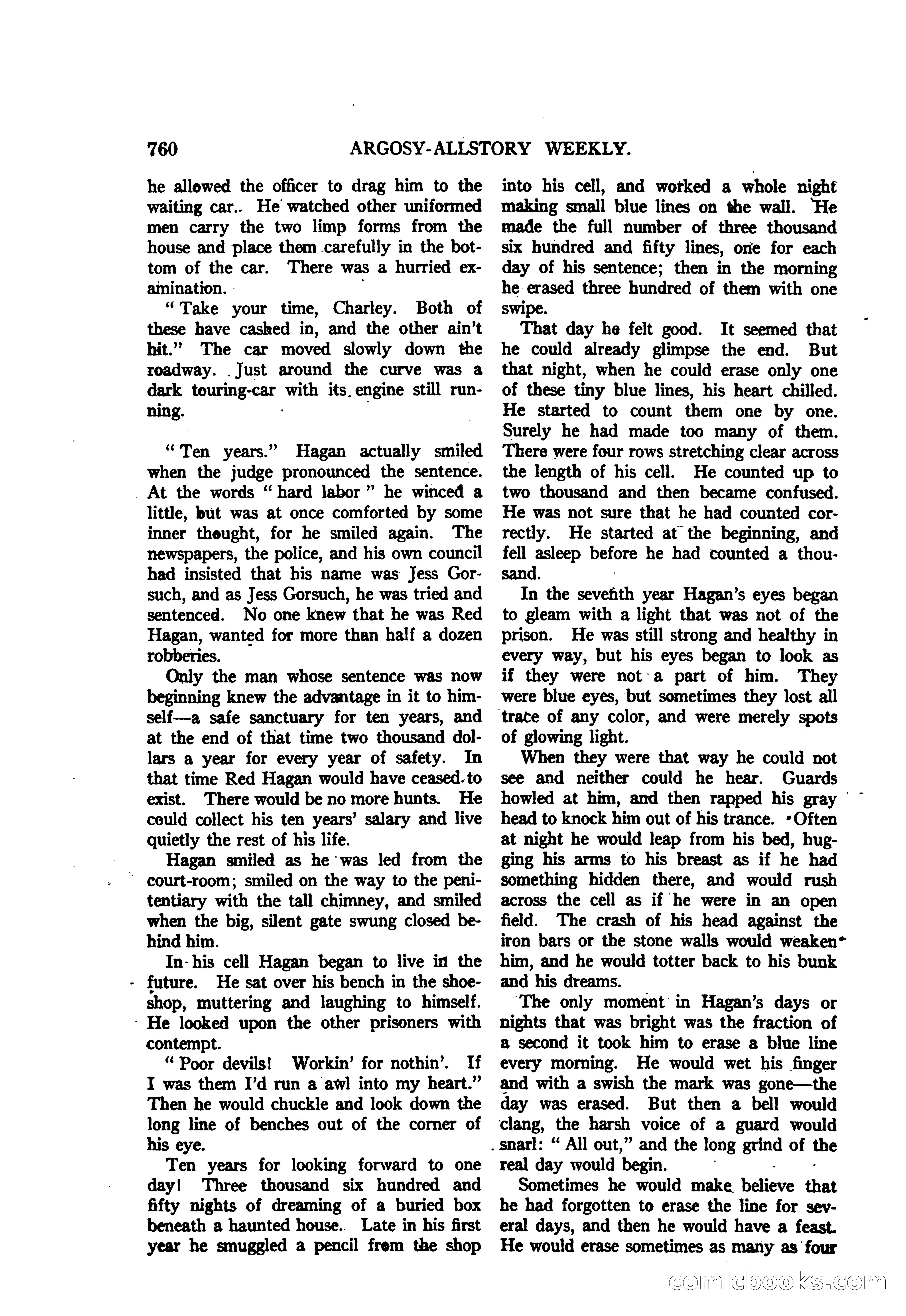
A restored page from Pulp Fiction, 1920. Page through the whole issue in the reader above.
📄 Transcribed text from this page (OCR, searchable)
Machine-transcribed from the original scan — historical spelling and the odd misread are preserved.
8 760 he allowed the officer to drag him to the waiting car.. He watched other uniformed men carry the two limp forms from the house and place them carefully in the bot- tom of the car. There was a hurried ex- ainination. - “Take your time, Charley. -Both of these have cashed in, and the other ain’t hit.” The car moved slowly down the roadway. .Just around the curve was a dark touring-car with its. engine still run- “Ten years.” Hagan actually smiled when the judge pronounced the sentence. _ At the words “hard labor” he winced a little, but was at once comforted by some inner theught, for he smiled again. The newspapers, the police, and his own council had insisted that his name was Jess Gor- such, and as Jess Gorsuch, he was tried and sentenced. No one knew that he was Red Hagan, wanted for more than half a dozen robberies. Only the man whose sentence was now beginning knew the advantage in it to him- self—a safe sanctuary for ten years, and at the end of that time two thousand dol- lars a year for every year of safety. In that time Red Hagan would have ceased.to exist. There would be no more hunts. He could collect his ten years’ salary and live quietly the rest of his life. Hagan smiled as he was led from the * court-room; smiled on the way to the peni- tentiary with the tall chimney, and smiled when the big, silent gate swung closed be- hind him. In-his cell Hagan began to live in the future. He sat over his bench in the shoe- shop, muttering and laughing to himself. - He looked upon the other prisoners with contempt. “ Poor devils! Workin’ for nothin’. If I was them I’d run a awl into my heart.” Then he would chuckle and look down the long line of benches out of the corner of his eye. Ten years for looking forward to one day! Three thousand six hundred and fifty nights of dreaming of a buried box beneath a haunted house.. Late in his first year he smuggled a pencil frem the shop ARGOSY-ALLSTORY WEEKLY. into his cell, and wotked a whole night making small blue lines on the wall. “He made the full number of three thousand six hundred and fifty lines, one for each day of his sentence; then in the morning he erased three hundred of them with one swipe. That day he felt good. It seemed that he could already glimpse the end. But that night, when he could erase only one of these tiny blue lines, his heart chilled. He started to count them one by one. Surely he had made too many of them. There were four rows stretching clear across the length of his cell. He counted up to two thousand and then became confused. He was not sure that he had counted cor- rectly. He started at the beginning, and fell asleep nelore he had counted a thou- sand. In the sevefith year Hagan’s eyes began to gleam with a light that was not of the prison. He was still strong and healthy in every way, but his eyes began to look as if they were nota part of him. They were blue eyes, but sometimes they lost all trace of any color, and were merely spots of glowing light. When they were that way he could not see and neither could he hear. Guards howled at him, and then rapped his gray © head to knock him out of his trance. -Often at night he would leap from his bed, hug- ging his arms to his breast as if he had something hidden there, and would rush across the cell as if he were in an open field. The crash of his head against the iron bars or the stone walls would weaken* him, and he would totter back to his bunk and his dreams. ‘The only moment in Hagan’s days or nights that was bright was the fraction of a second it took him to erase a blue line every morning. He would wet his finger and with a swish the mark was gone—the day was erased. But then a bell would clang, the harsh voice of a guard would . snarl: “ All out,” and the long grind of the real day would begin. Sometimes he would make believe that he had forgotten to erase the line for sev- eral days, and then he would have a feast. He would erase sometimes as many as four cComiclooks (C(O)