
Pulp Fiction, 1920 · page 195 of 208
Argosy All-Story Weekly — "The Purple Limited" — page 195: what you’re looking at
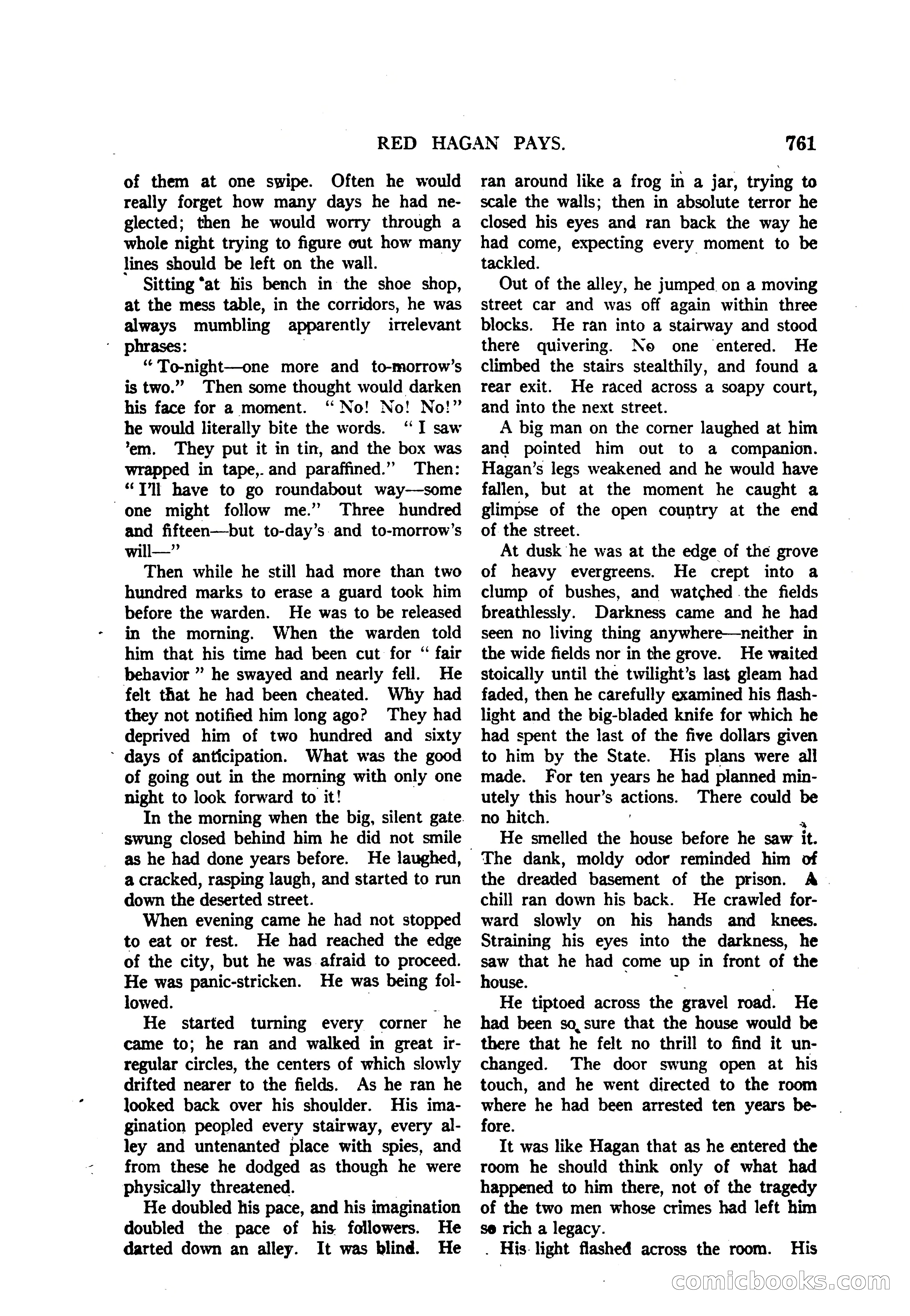
A restored page from Pulp Fiction, 1920. Page through the whole issue in the reader above.
📄 Transcribed text from this page (OCR, searchable)
Machine-transcribed from the original scan — historical spelling and the odd misread are preserved.
RED HAGAN PAYS. of them at one swipe. Often he would really forget how many days he had ne- glected; then he would worry through a whole night trying to figure out how many lines should be left on the wall. Sitting “at his bench in the shoe shop, at the mess table, in the corridors, he was always mumbling apparently irrelevant ‘ phrases: | “ To-night—one more and to-morrow’s is two.” Then some thought would darken his face for a moment. ‘“‘ No! No! No!” he would literally bite the words. ‘I saw ‘em. They put it in tin, and the box was wrapped in tape,. and paraffined.” Then: “Tl have to go roundabout way—some one might follow me.’’ Three hundred and fifteen—but to-day’s.and to-morrow’s will—”’ Then while he still had more than two hundred marks to erase a guard took him before the warden. He was to be released in the morning. When the warden told him that his time had been cut for “ fair behavior ” he swayed and nearly fell. He felt that he had been cheated. Why had they not notified him long ago? They had deprived him of two hundred and sixty * days of anticipation. What was the good of going out in the morning with only one night to look forward to it! In the morning when the big, silent gate. swung closed behind him he did not smile as he had done years before. a cracked, rasping laugh, and started to run down the deserted street. When evening came he had not stopped to eat or rest. He had reached the edge of the city, but he was afraid to proceed. He was panic-stricken. He was being fol- lowed. | - He started turning every corner he came to; he ran and walked in great ir- regular circles, the centers of which slowly drifted nearer to the fields. As he ran he looked back over his shoulder. His ima- gination peopled every stairway, every al- ley and untenanted place with spies, and from these he dodged as though he were physically threatened. | He doubled his pace, and his imagination doubled the pace of his followers. He darted down an alley. It was blind. He He laughed, © 761 ran around like a frog in a jar, trying to scale the walls; then in absolute terror he closed his eyes and ran back the way he had come, expecting every moment to be tackled. Out of the alley, he jumped on a moving street car and was off again within three blocks. He ran into a stairway and stood there quivering. No one entered. He climbed the stairs stealthily, and found a rear exit. He raced across a soapy court, and into the next street. A big man on the corner laughed at him and pointed him out to a companion. Hagan’s legs weakened and he would have fallen, but at the moment he caught a glimpse of the open country at the end of the street. At dusk he was at the edge of the grove of heavy evergreens. He crept into a clump of bushes, and watched .the fields breathlessly. Darkness came and he had seen no living thing anywhere—neither in the wide fields nor in the grove. He waited stoically until the twilight’s last gleam had faded, then he carefully examined his flash- light and the big-bladed knife for which he had spent the last of the five dollars given to him by the State. His plans were all made. For ten years he had planned min- utely this hour’s actions. There could be no hitch. a He smelled the house before he saw it. The dank, moldy odor reminded him of the dreaded basement of the prison. A. chill ran down his back. He crawled for- ward slowly on his hands and knees. Straining his eyes into the darkness, he saw that he had come up in front of the house. He tiptoed across the gravel road. He had been so, sure that the house would be there that he felt no thrill to find it un- changed. The door swung open at his touch, and he went directed to the room where he had been arrested ten years be- fore. It was like Hagan that as he entered the room he should think only of what had happened to him there, not of the tragedy of the two men whose crimes had left him se rich a legacy. . His. light flashed across the room. His 6)(0)©) (C(O) nn) (C S (C(O) nn