
Pulp Fiction, 1921 · page 50 of 146
Argosy All-Story Weekly, February 5, 1921 — page 50: what you’re looking at
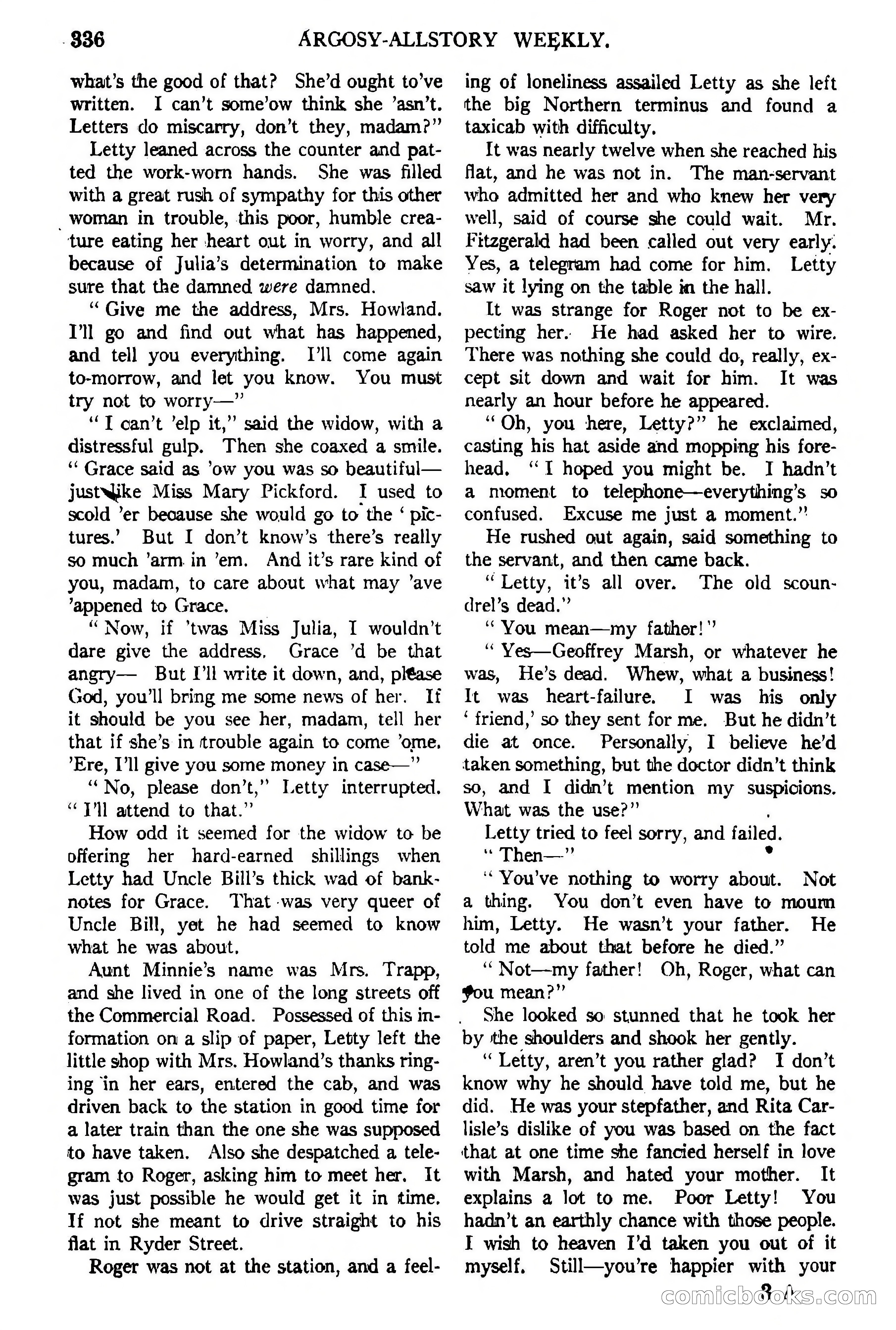
A restored page from Pulp Fiction, 1921. Page through the whole issue in the reader above.
📄 Transcribed text from this page (OCR, searchable)
Machine-transcribed from the original scan — historical spelling and the odd misread are preserved.
- 336 what’s the good of that? She’d ought to’ve written. I can’t some’ow think she ’asn’t. Letters do miscarry, don’t they, madam?”’ Letty leaned across the counter and pat- ted the work-worn hands. She was filled with a great rush of sympathy for this other _woman in trouble, this poor, humble crea- ture eating her heart out in worry, and all because of Julia’s determination to make sure that the damned were damned. “Give me the address, Mrs. Howland. I'll go and find out what has happened, and tell you everything. I'll come again to-morrow, and let you know. You must try not to worry—”’ “T can’t ’elp it,” said the widow, with a distressful gulp. Then she coaxed a smile. ‘“‘ Grace said as ‘ow you was so beautiful— justNike Miss Mary Pickford. I used to scold ’er because she would go to the ‘ pic- tures.’ But I don’t know’s there’s really so much ’arm. in ’em. And it’s rare kind of you, madam, to care about what may ’ave ’7appened to Grace. 7 “ Now, If ‘twas Miss Julia, I wouldn’t dare give the address, Grace ’d be that angry— But I'll write it down, and, pl€ase God, you'll bring me some news of her. If it should be you see her, madam, tell her that if she’s in trouble again to come ’ome, Ere, I'll give you some money in case—”’ ‘““No, please don’t,” Letty interrupted. ‘““T'll attend to that.” How odd it seemed for the widow to be offering her hard-earned shillings when Letty had Uncle Bill’s thick wad of bank- notes for Grace. That -was very queer of Uncle Bill, yet he had seemed to know what he was about. Aunt Minnie’s name was Mrs. Trapp, and she lived in one of the long streets off the Commercial Road. Possessed of this in- formation on a slip of paper, Letty left the little shop with Mrs. Howland’s thanks ring- ing in her ears, entered the cab, and was driven back to the station in good time for a later train than the one she was supposed to have taken. Also she despatched a tele- gram to Roger, asking him to meet her. It was just possible he would get it in time. If not she meant to drive straight to his flat in Ryder Street. Roger was not at the station, and a feel- ARGOSY-ALLSTORY WEEKLY. ing of loneliness assailed Letty as she left the big Northern terminus and found a taxicab with difficulty, It was nearly twelve when she reached his flat, and he was not in. The man-servant who admitted her and who knew her very well, said of course she could wait. Mr. Fitzgerald had been called out very early. Yes, a telegram had come for him. Letty saw it lying on the table in the hall. [t was strange for Roger not to be ex- pecting her. He had asked her to wire. There was nothing she could do, really, ex- cept sit down and wait for him. It was nearly an hour before he appeared. ‘“Qh, you here, Letty?” he exclaimed, casting his hat aside and mopping his fore- head. ‘I hoped you might be. I hadn’t a moment to telephone—everything’s so confused. Excuse me just a moment.” He rushed out again, said something to the servant, and then came back. “Letty, it’s all over. The old scoun- drel’s dead.” ‘You mean—my father!” ‘“ Yes—Geoffrey Marsh, or whatever he was, He’s dead. Whew, what a business! It was heart-failure. I was his only ‘ friend,’ so they sent forme. But he didn’t die at once. Personally, I believe he’d taken something, but the doctor didn’t think so, and | didn’t mention my suspicions. What was the use?” ; Letty tried to feel sorry, and failed. ve Then—.”’ e ‘You've nothing to worry about. Not a thing. You don’t even have to moun him, Letty. He wasn’t your father. He told me about that before he died.” ‘““Not—my father! Oh, Roger, what can fou mean?”’ She looked so stunned that he took her by the shoulders and shook her gently. “Letty, aren’t you rather glad? I don’t know why he should have told me, but he did. He was your stepfather, and Rita Car- lisle’s dislike of you was based on the fact that at one time she fancied herself in love with Marsh, and hated your mother. It explains a lot to me. Poor Letty! You hadn’t an earthly chance with those people. I wish to heaven I’d taken you out of it myself. Still—you’re happier with your comicbdoks.com