
Pulp Fiction, 1921 · page 51 of 146
Argosy All-Story Weekly, February 5, 1921 — page 51: what you’re looking at
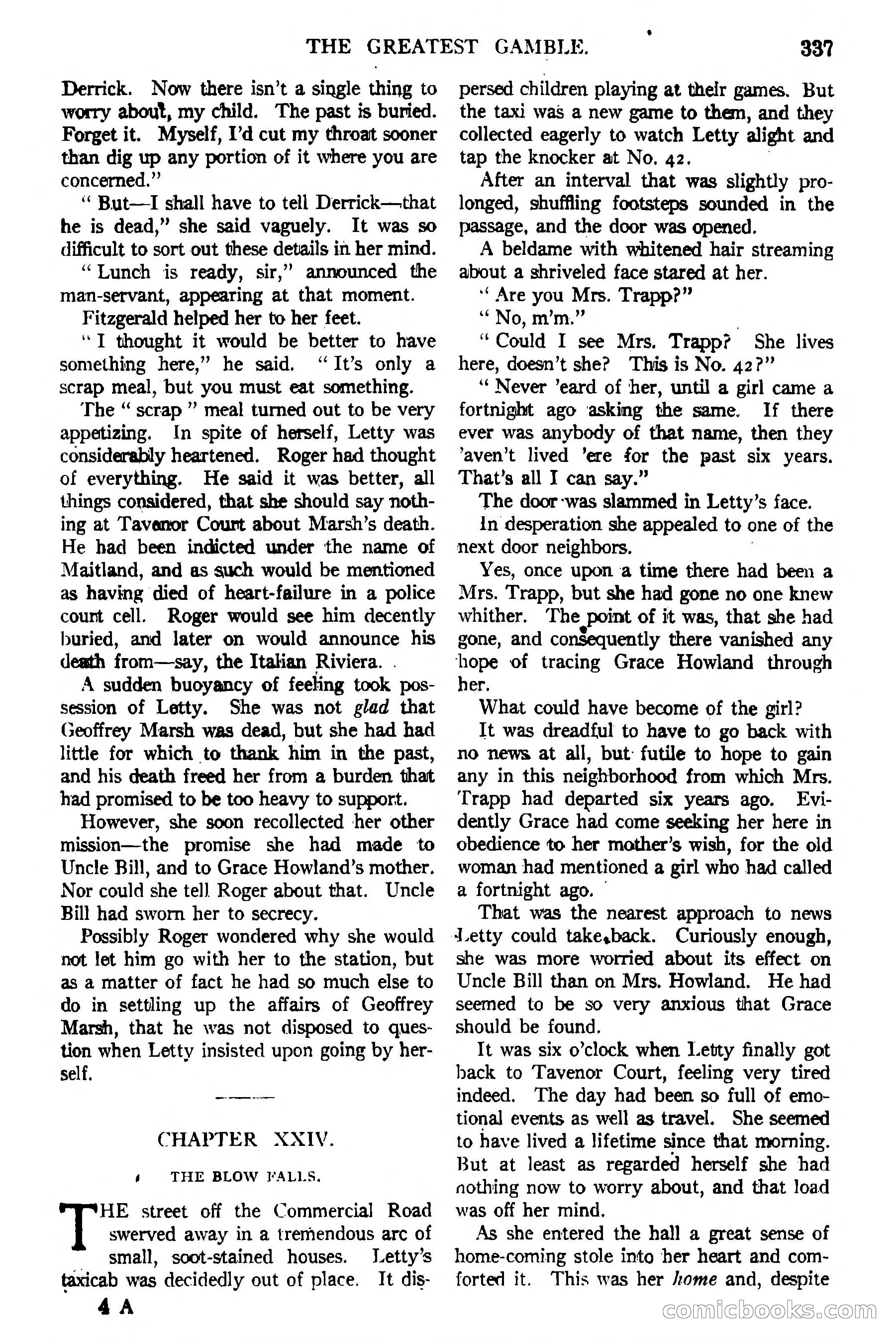
A restored page from Pulp Fiction, 1921. Page through the whole issue in the reader above.
📄 Transcribed text from this page (OCR, searchable)
Machine-transcribed from the original scan — historical spelling and the odd misread are preserved.
THE GREATEST GAMBLE. Derrick. Now there isn’t a single thing to worry about, my child. The past is buried. Forget it. Myself, I’d cut my throat sooner than dig up any portion of it where you are concerned.” ‘“ But—TI shall have to tell Derrick—that he is dead,” she said vaguely. It was so difficult to sort out these details in her mind. “Lunch is ready, sir,’ announced the man-servant, appearing at that moment. Fitzgerald helped her to her feet. ‘I thought it would be better to have something here,” he said. “It’s only a scrap meal, but you must eat something. The “ scrap ” meal turned out to be very appetizing. In spite of herself, Letty was considerably heartened. Roger had thought of everything. He said it was better, all things considered, that she should say noth- ing at Tavenor Court about Marsh’s death. He had been indicted under the name of Maitland, and as such would be mentioned as having died of heart-failure in a police count cell. Roger would see him decently buried, and later on would announce his death from—say, the Italian Riviera. . A sudden buoyancy of feeling took pos- session of Letty. She was not glad that Geoffrey Marsh was dead, but she had had little for which to thank him in the past, and his death freed her from a burden that had promised to be too heavy to support. However, she soon recollected her other mission—the promise she had made to Uncle Bill, and to Grace Howland’s mother. Nor could she tel) Roger about that. Uncle Bill had sworn her to secrecy. Possibly Roger wondered why she would not let him go with her to the station, but as a matter of fact he had so much else to do in settling up the affairs of Geoffrey Marsh, that he was not disposed to ques- tion when Letty insisted upon going by her- self. — ees CHAPTER XAIV. 4 THE BLOW FALLS. HE street off the Commercial Road swerved away in a tremendous arc of small, soot-stained houses. Jetty’s taxicab was decidedly out of place. It dis- 4A oot persed children playing at thelr games. But the taxi was a new game to them, and they collected eagerly to watch Letty alight and tap the knocker at No. 42. After an interval that was slightly pro- longed, shuffling footsteps sounded in the passage, and the door was opened. A beldame with whitened hair streaming about a shriveled face stared at her. ‘« Are you Mrs. Trapp?” 6e No, m’ m. ” = Could I see Mrs. Trapp? She lives here, doesn’t she? This is No. 42?” - Never ’eard of her, until a girl came a fortnight ago asking the same. If there ever was anybody of that name, then they ‘aven’t lived ’ere for the past six years. That’s all I can say.” The door-was slammed in Letty’s face. in desperation she appealed to one of the next door neighbors. Yes, once upon a time there had been a Mrs. Trapp, but she had gone no one knew whither. The point of it was, that she had gone, and consequently there vanished any hope of tracing Grace Howland through her. What could have become of the girl? It was dreadful to have to go back with no news at all, but: futile to hope to gain any in this neighborhood from which Mrs. Trapp had departed six years ago. Evi- dently Grace had come seeking her here in obedience to her mother’s wish, for the old woman had mentioned a girl who had called a fortnight ago. © That was the nearest approach to news ‘Letty could take,back. Curiously enough, she was more worried about its effect on Uncle Bill than on Mrs. Howland. He had seemed to be so very anxious that Grace should be found. It was six o’clock when Letty finally got back to Tavenor Court, feeling very tired indeed. The day had been so full of emo- tional events as well as travel. She seemed to have lived a lifetime since that morning. But at least as regarded herself she had nothing now to worry about, and that load was off her mind. As she entered the hall a great sense of home-coming stole into her heart and com- forted it. This was her ome and, despite COMmiclbooks.€O©