
Pulp Fiction, 1923 · page 52 of 184
Argosy All-Story Weekly, January 13, 1923 — page 52: what you’re looking at
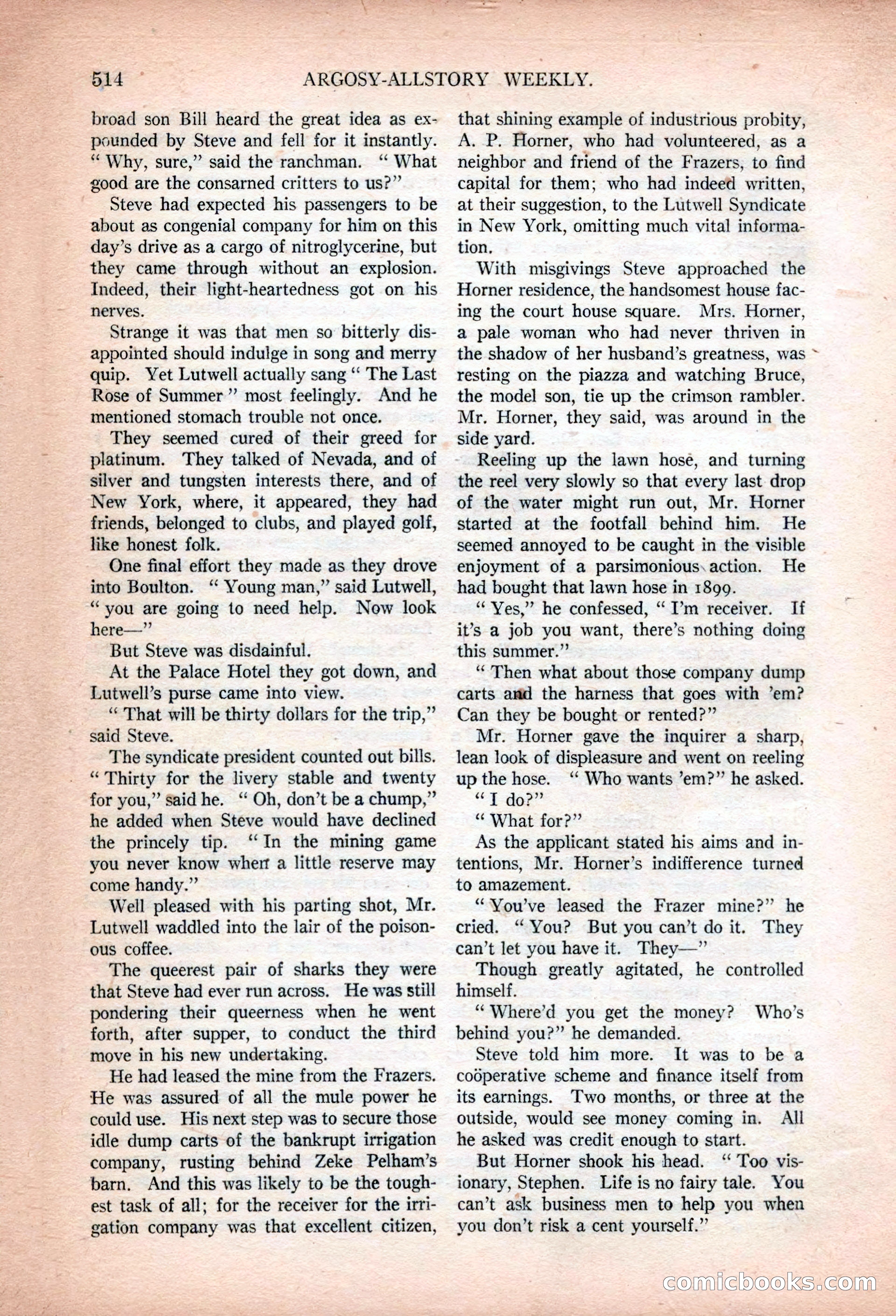
A restored page from Pulp Fiction, 1923. Page through the whole issue in the reader above.
📄 Transcribed text from this page (OCR, searchable)
Machine-transcribed from the original scan — historical spelling and the odd misread are preserved.
514 broad son Bill heard the great idea as ex- pounded by Steve and fell for it instantly. “Why, sure,” said the ranchman. ‘‘ What good are the consarned critters to us?” Steve had expected his passengers to be about as congenial company for him on this day’s drive as a cargo of nitroglycerine, but they came through without an explosion. Indeed, their light-heartedness got on his nerves. Strange it was that men so bitterly dis- appointed should indulge in song and merry quip. Yet Lutwell actually sang “‘ The Last Rose of Summer” most feelingly. And he mentioned stomach trouble not once. They seemed cured of their greed for platinum. They talked of Nevada, and of silver and tungsten interests there, and of New York, where, it appeared, they had friends, belonged to clubs, and played golf, like honest folk. One final effort they made as they drove into Boulton. ‘“ Young man,” said Lutwell, “you are going to need help. Now look here—” But Steve was disdainful. At the Palace Hotel they got down, and Lutwell’s purse came into view. ‘That will be thirty dollars for the trip,” said Steve. The syndicate president counted out bills. “Thirty for the livery stable and twenty for you,” said he. “ Oh, don’t be a chump,” he added when Steve would have declined the princely tip. ‘In the mining game you never know whert a little reserve may come handy.” . Well pleased with his parting shot, Mr. Lutwell waddled into the lair of the poison- ous coffee. The queerest pair of sharks they were that Steve had ever run across. He was still pondering their queerness when he went forth, after supper, to conduct the third move in his new undertaking. He had leased the mine from the Frazers. He was assured of all the mule power he could use. His next step was to secure those idle dump carts of the bankrupt irrigation company, rusting behind Zeke Pelham’s barn. And this was likely to be the tough- est task of all; for the receiver for the irri- gation company was that excellent citizen, ARGOSY-ALLSTORY WEEKLY. that shining example of industrious probity, A. P. Horner, who had volunteered, as a neighbor and friend of the Frazers, to find capital for them; who had indeed written, at their suggestion, to the Lutwell Syndicate in New York, omitting much vital informa- tion. With misgivings Steve approached the Horner residence, the handsomest house fac- ing the court house square. Mrs. Horner, a pale woman who had never thriven in the shadow of her husband’s greatness, was ~ resting on the piazza and watching Bruce, the model son, tie up the crimson rambler. Mr. Horner, they said, was around in the side yard. Reeling up the lawn hose, and turning the reel very slowly so that every last drop of the water might run out, Mr. Horner started at the footfall behind him. He seemed annoyed to be caught in the visible enjoyment of a parsimonious, action. He had bought that lawn hose in 1899. ‘“‘ Yes,” he confessed, “I’m receiver. If it’s a job you want, there’s nothing doing this summer.” “Then what about those company dump carts avid the harness that goes with ’em? Can they be bought or rented?” Mr. Horner gave the inquirer a sharp, lean look of displeasure and went on reeling up the hose. ‘‘ Who wants ’em?” he asked. “* What for?” As the applicant stated his aims and in- tentions, Mr. Horner’s indifference turned to amazement. “You’ve leased the Frazer mine?” he cried. “You? But you can’t do it. They can’t let you have it. They—” Though greatly agitated, he controlled himself. ‘““Where’d you get the money? behind you?” he demanded. Steve told him more. It was to be a cooperative scheme and finance itself from its earnings. Two months, or three at the Who’s outside, would see money coming in. All he asked was credit enough to start. But Horner shook his head. ‘“ Too vis- ionary, Stephen. Life is no fairy tale. You can’t ask business men to help you when you don’t risk a cent yourself.” Gomicbook (E@)