
Pulp Fiction, 1923 · page 53 of 184
Argosy All-Story Weekly, January 13, 1923 — page 53: what you’re looking at
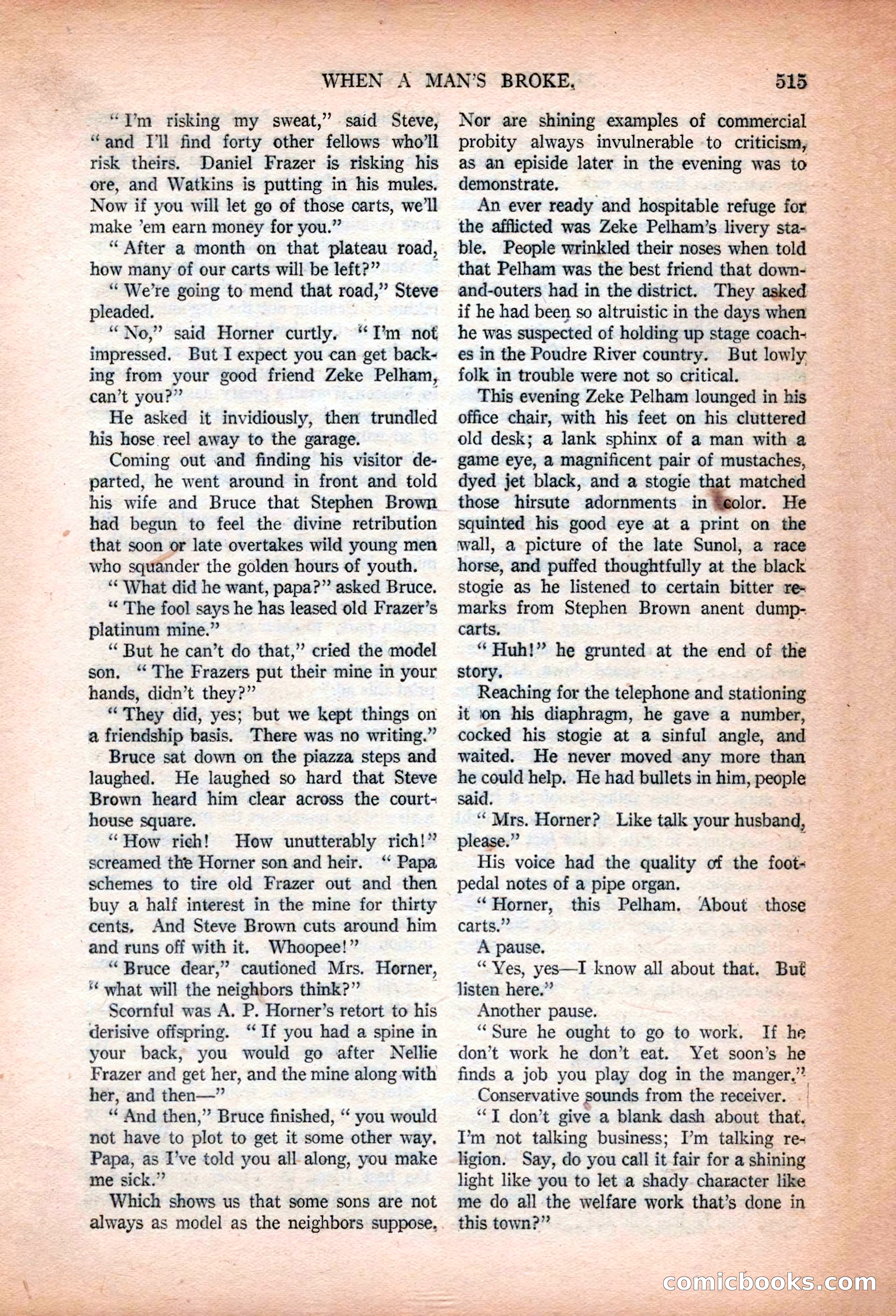
A restored page from Pulp Fiction, 1923. Page through the whole issue in the reader above.
📄 Transcribed text from this page (OCR, searchable)
Machine-transcribed from the original scan — historical spelling and the odd misread are preserved.
and runs off with it. WHEN A MAN’S BROKE, “J’m risking my sweat,’ said Steve, “and I'll find forty other fellows who'll risk theirs. Daniel Frazer is risking his ore, and Watkins is putting in his mules. Now if you will let go of those carts, we'll make ’em earn money for you.” “After a month on that plateau road, how many of our carts will be left?” “We're going to mend that road,” Steve pleaded. “No,” said Horner curtly. “I’m not impressed. But I expect you can get back- ing from your good friend Zeke Pelham, can’t you?” He asked it invidiously, then trundled his hose reel away to the garage. Coming out and finding his visitor de- parted, he went around in front and told his wife and Bruce that Stephen Brown had begun to feel the divine retribution that soon or late overtakes wild young men who squander the golden hours of youth. ‘“* What did he want, papa?” asked Bruce. “The fool says he has leased old Frazer’s platinum mine.” — “ But he can’t do that,” cried the model son. “ The Frazers put their mine in your hands, didn’t they?” “They did, yes; but we kept things on a friendship basis. There was no writing.” Bruce sat down on the piazza steps and laughed. He laughed so hard that Steve Brown heard him clear across the court- house square. “How rich! How unutterably rich!” screamed the Horner son and heir. “ Papa schemes to tire old Frazer out and then buy a half interest in the mine for thirty cents, And Steve Brown cuts around him Whoopee!” “Bruce dear,” cautioned Mrs. Horner, what will the neighbors think?” : Scornful was A. P. Horner’s retort to his derisive offspring. “If you had a spine in your back, you would go after Nellie Frazer and get her, and the mine along with her, and then—” *“* And then,” Bruce finished, “‘ you would not have to plot to get it some other way. Papa, as I’ve told you all along, you make me sick.” Which shows us that some sons are not always as model as the neighbors suppose, . Nor are shining examples of commercial _ probity always invulnerable to criticism, as an episide later in the evening was to demonstrate. An ever ready and hospitable refuge for. the afflicted was Zeke Pelham’s livery sta- ble. People wrinkled their noses when told that Pelham was the best friend that down- and-outers had in the district. They asked if he had been so altruistic in the days when he was suspected of holding up stage coach- es in the Poudre River country. But lowly folk in trouble were not so critical. This evening Zeke Pelham lounged in his office chair, with his feet on his cluttered old desk; a lank sphinx of a man with a game eye, a magnificent pair of mustaches, dyed jet black, and a stogie that matched those hirsute adornments in “olor. He squinted his good eye at a print on the wall, a picture of the late Sunol, a race horse, and puffed thoughtfully at the black stogie as he listened to certain bitter re« marks from Stephen Brown anent dump- carts. “ Huh!” he grunted at the end of the story. Reaching for the telephone and stationing it ion his diaphragm, he gave a number, cocked his stogie at a sinful angle, and waited. He never moved any more than he could help. He had bullets in him, people said. “Mrs. Horner? Like talk your husband, please.” His voice had the quality of the foot pedal notes of a pipe organ. “Horner, this Pelham. ‘About those carts.” A pause. “Yes, yes—I know all about that. Buf listen here.” Another pause. “Sure he ought to go to work. If he don’t work he don’t eat. Yet soon’s he finds a job you play dog in the manger.” Conservative sounds from the receiver. — “JT don’t give a blank dash about that. I’m not talking business; I’m talking re- ligion. Say, do you call it fair for a shining light like you to let a shady character like me do all the welfare work that’s done in this town?”