
Pulp Fiction, 1923 · page 166 of 196
Argosy All-Story Weekly, October 6, 1923 — page 166: what you’re looking at
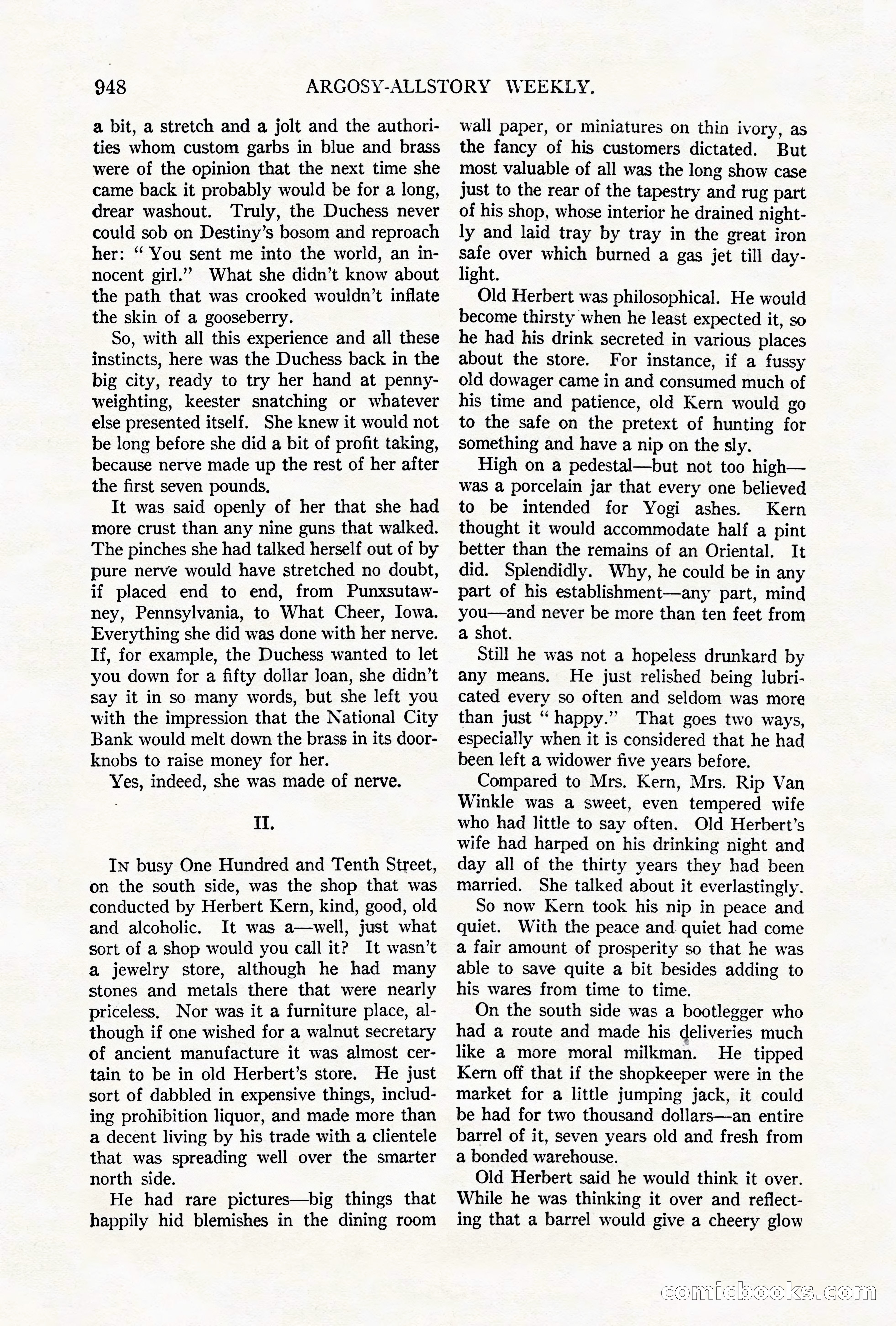
A restored page from Pulp Fiction, 1923. Page through the whole issue in the reader above.
📄 Transcribed text from this page (OCR, searchable)
Machine-transcribed from the original scan — historical spelling and the odd misread are preserved.
948 a bit, a stretch and a jolt and the authori- ties whom custom garbs in blue and brass were of the opinion that the next time she came back it probably would be for a long, drear washout. Truly, the Duchess never could sob on Destiny’s bosom and reproach her: “‘ You sent me into the world, an in- nocent girl.” What she didn’t know about the path that was crooked wouldn’t inflate the skin of a gooseberry. So, with all this experience and all these instincts, here was the Duchess back in the big city, ready to try her hand at penny- weighting, keester snatching or whatever else presented itself. She knew it would not be long before she did a bit of profit taking, because nerve made up the rest of her after the first seven pounds, It was said openly of her that she had more crust than any nine guns that walked. The pinches she had talked herself out of by pure nerve would have stretched no doubt, if placed end to end, from Punxsutaw- ney, Pennsylvania, to What Cheer, Iowa. Everything she did was done with her nerve. If, for example, the Duchess wanted to let you down for a fifty dollar loan, she didn’t say it in so many words, but she left you with the impression that the National City Bank would melt down the brass in its door- knobs to raise money for her. Yes, indeed, she was made of nerve. II. In busy One Hundred and Tenth Street, on the south side, was the shop that was conducted by Herbert Kern, kind, good, old and alcoholic. It was a—well, just what sort of a shop would you call it? It wasn’t a jewelry store, although he had many stones and metals there that were nearly priceless. Nor was it a furniture place, al- though if one wished for a walnut secretary of ancient manufacture it was almost cer- tain to be in old Herbert’s store. He just sort of dabbled in expensive things, includ- ing prohibition liquor, and made more than a decent living by his trade with a clientele that was spreading well over the smarter north side. He had rare pictures—big things that happily hid blemishes in the dining room ARGOSY-ALLSTORY WEEKLY. wall paper, or miniatures on thin ivory, as the fancy of his customers dictated. But most valuable of all was the long show case Just to the rear of the tapestry and rug part of his shop, whose interior he drained night- ly and laid tray by tray in the great iron safe over which burned a gas jet till day- light. Old Herbert was philosophical. He would become thirsty when he least expected it, so he had his drink secreted in various places about the store. For instance, if a fussy old dowager came in and consumed much of his time and patience, old Kern would go to the safe on the pretext of hunting for something and have a nip on the sly. High on a pedestal—but not too high— was a porcelain jar that every one believed to be intended for Yogi ashes. Kern thought it would accommodate half a pint better than the remains of an Oriental. It did. Splendidly. Why, he could be in any part of his establishment—any part, mind you—and never be more than ten feet from a shot. Still he was not a hopeless drunkard by any means. He just relished being lubri- cated every so often and seldom was more than just “happy.” That goes two ways, especially when it is considered that he had been left a widower five years before. Compared to Mrs. Kern, Mrs. Rip Van Winkle was a sweet, even tempered wife who had little to say often. Old Herbert’s wife had harped on his drinking night and day all of the thirty years they had been married. She talked about it everlastingly. So now Kern took his nip in peace and quiet. With the peace and quiet had come a fair amount of prosperity so that he was able to save quite a bit besides adding to his wares from time to time. On the south side was a bootlegger who had a route and made his deliveries much like a more moral milkman. He tipped Kern off that if the shopkeeper were in the market for a little jumping jack, it could be had for two thousand dollars—an entire barrel of it, seven years old and fresh from a bonded warehouse. Old Herbert said he would think it over. While he was thinking it over and reflect- ing that a barrel would give a cheery glow COmiclooe (©