
Pulp Fiction, 1923 · page 29 of 196
Argosy All-Story Weekly, October 6, 1923 — page 29: what you’re looking at
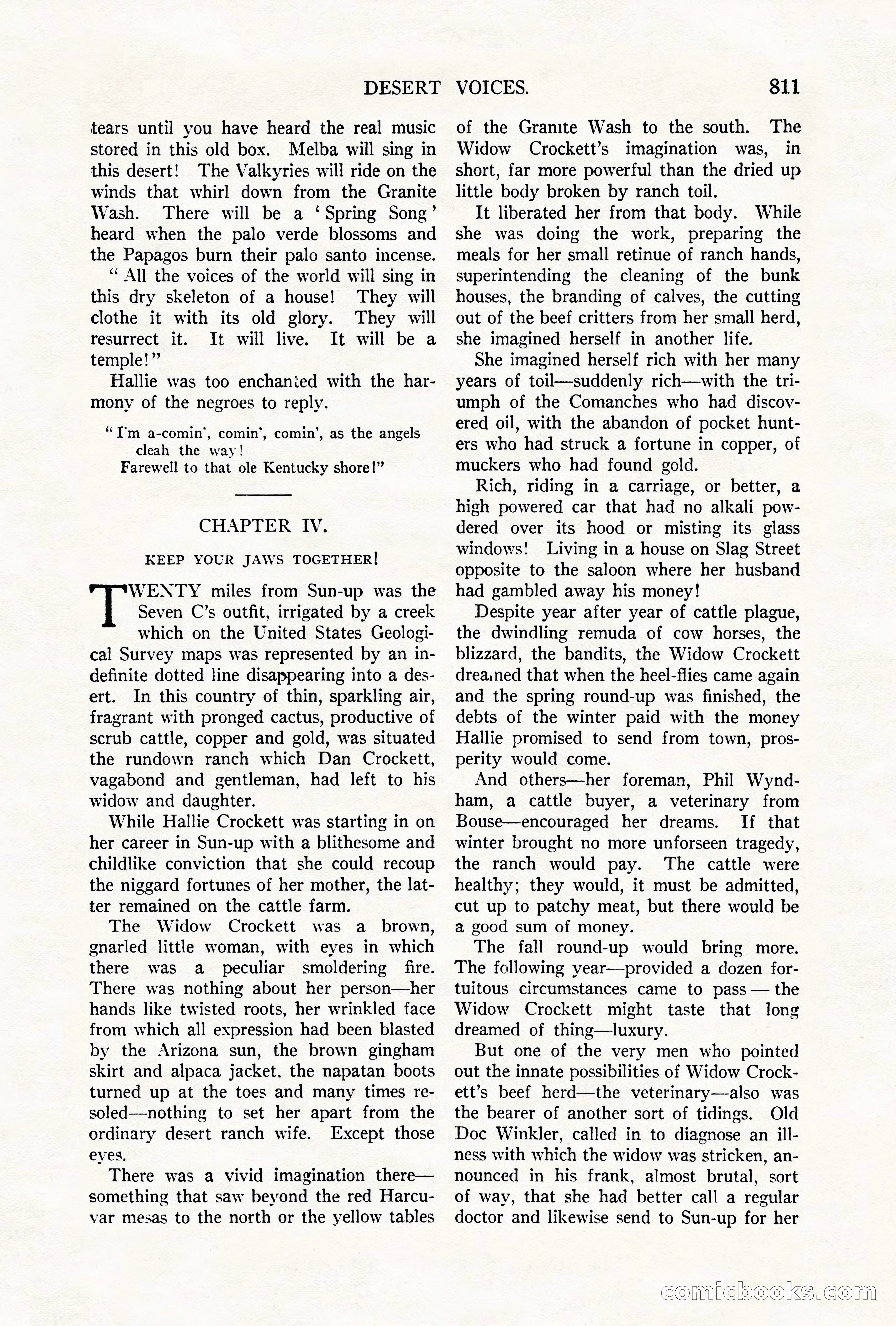
A restored page from Pulp Fiction, 1923. Page through the whole issue in the reader above.
📄 Transcribed text from this page (OCR, searchable)
Machine-transcribed from the original scan — historical spelling and the odd misread are preserved.
DESERT tears until you have heard the real music stored in this old box. Melba will sing in this desert! The Valkyries will ride on the winds that whirl down from the Granite Wash. There will be a ‘Spring Song’ heard when the palo verde blossoms and the Papagos burn their palo santo incense. ‘* All the voices of the world will sing in this dry skeleton of a house! They will clothe it with its old glory. They will resurrect it. It will live. It will be a temple!” Hallie was too enchanied with the har- mony of the negroes to reply. “Tm a-comin’, comin’, comin’, as the angels cleah the way! Farewell to that ole Kentucky shore!” CHAPTER IV. KEEP YOUR JAWS TOGETHER! WENTY miles from Sun-up was the Seven C’s outfit, irrigated by a creek which on the United States Geologi- cal Survey maps was represented by an in- definite dotted line disappearing into a des- ert. In this country of thin, sparkling air, fragrant with pronged cactus, productive of scrub cattle, copper and gold, was situated the rundown ranch which Dan Crockett, vagabond and gentleman, had left to his widow and daughter. While Hallie Crockett was starting in on her career in Sun-up with a blithesome and childlike conviction that she could recoup the niggard fortunes of her mother, the lat- ter remained on the cattle farm. The Widow Crockett was a_ brown, gnarled little woman, with eves in which there was a peculiar smoldering fire. There was nothing about her person—her hands like twisted roots, her wrinkled face from which all expression had been blasted by the Arizona sun, the brown gingham skirt and alpaca jacket, the napatan boots turned up at the toes and many times re- soled—nothing to set her apart from the ordinary desert ranch wife. Except those eyes. There was a vivid imagination there— something that saw beyond the red Harcu- var mesas to the north or the yellow tables VOICES. 811 of the Granite Wash to the south. The Widow Crockett’s imagination was, in short, far more powerful than the dried up little body broken by ranch toil. It liberated her from that body. While she was doing the work, preparing the meals for her small retinue of ranch hands, superintending the cleaning of the bunk houses, the branding of calves, the cutting out of the beef critters from her small herd, she imagined herself in another life. She imagined herself rich with her many years of toil—suddenly rich—with the tri- umph of the Comanches who had discov- ered oil, with the abandon of pocket hunt- ers who had struck a fortune in copper, of muckers who had found gold. Rich, riding in a carriage, or better, a high powered car that had no alkali pow- dered over its hood or misting its glass windows! Living in a house on Slag Street opposite to the saloon where her husband had gambled away his money! Despite year after year of cattle plague, the dwindling remuda of cow horses, the blizzard, the bandits, the Widow Crockett dreained that when the heel-flies came again and the spring round-up was finished, the debts of the winter paid with the money Hallie promised to send from town, pros- perity would come. And others—her foreman, Phil Wynd- ham, a cattle buyer, a veterinary from Bouse—encouraged her dreams. If that winter brought no more unforseen tragedy, the ranch would pay. The cattle were healthy; they would, it must be admitted, cut up to patchy meat, but there would be a good sum of money. The fall round-up would bring more. The following year—provided a dozen for- tuitous circumstances came to pass — the Widow Crockett might taste that long dreamed of thing—luxury. But one of the very men who pointed out the innate possibilities of Widow Crock- ett’s beef herd—the veterinary—also was the bearer of another sort of tidings. Old Doc Winkler, called in to diagnose an ill- ness with which the widow was stricken, an- nounced in his frank, almost brutal, sort of way, that she had better call a regular doctor and likewise send to Sun-up for her COMmMiclooe (©