
Pulp Fiction, 1923 · page 33 of 196
Argosy All-Story Weekly, October 6, 1923 — page 33: what you’re looking at
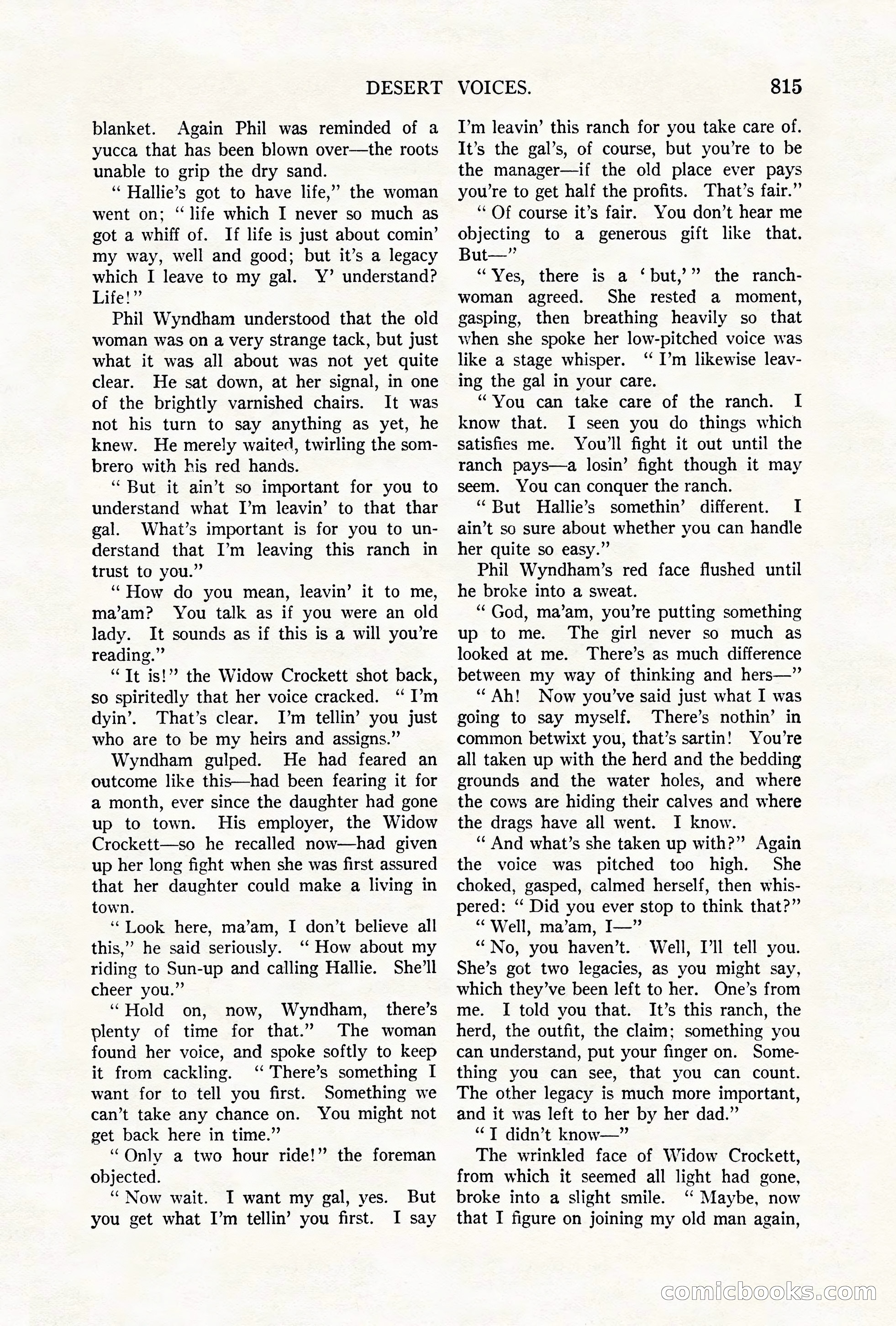
A restored page from Pulp Fiction, 1923. Page through the whole issue in the reader above.
📄 Transcribed text from this page (OCR, searchable)
Machine-transcribed from the original scan — historical spelling and the odd misread are preserved.
DESERT blanket. Again Phil was reminded of a yucca that has been blown over—the roots unable to grip the dry sand. ‘“‘ Hallie’s got to have life,” the woman went on; “life which I never so much as got a whiff of. If life is just about comin’ my way, well and good; but it’s a legacy which I leave to my gal. Y’ understand? Life!” Phil Wyndham understood that the old woman was on a very strange tack, but just what it was all about was not yet quite clear. He sat down, at her signal, in one of the brightly varnished chairs. It was not his turn to say anything as yet, he knew. He merely waited, twirling the som- brero with his red hands. ‘“ But it ain’t so important for you to understand what I’m leavin’ to that thar gal. What’s important is for you to un- derstand that I’m leaving this ranch in trust to you.” ‘‘How do you mean, leavin’ it to me, ma’am? You talk as if you were an old lady. It sounds as if this is a will you’re reading.” “Tt is!?? the Widow Crockett shot back, so spiritedly that her voice cracked. ‘“ I’m dyin’. That’s clear. I’m tellin’ you just who are to be my heirs and assigns.” Wyndham gulped. He had feared an outcome like this—had been fearing it for a month, ever since the daughter had gone up to town. His employer, the Widow Crockett—so he recalled now—had given up her long fight when she was first assured that her daughter could make a living in town. ‘‘Look here, ma’am, I don’t believe all this,” he said seriously. ‘‘ How about my riding to Sun-up and calling Hallie. She’ll cheer you.” “Hold on, now, Wyndham, _ there’s plenty of time for that.” The woman found her voice, and spoke softly to keep it from cackling. ‘‘ There’s something I want for to tell you first. Something we can’t take any chance on. You might not get back here in time.” “Only a two hour ride!” the foreman objected. ‘““Now wait. I want my gal, yes. But you get what I’m tellin’ you first. I say VOICES. 815 I’m leavin’ this ranch for you take care of. It’s the gal’s, of course, but you’re to be the manager—if the old place ever pays you're to get half the profits. That’s fair.” “Of course it’s fair. You don’t hear me objecting to a generous gift like that. But—’” “Yes, there is a ‘but,’” the ranch- woman agreed. She rested a moment, gasping, then breathing heavily so that when she spoke her low-pitched voice was like a stage whisper. ‘ I’m likewise leav- ing the gal in your care. “You can take care of the ranch. I know that. I seen you do things which satisfies me. You'll fight it out until the ranch pays—a losin’ fight though it may seem. You can conquer the ranch. ‘But Hallie’s somethin’ different. I ain’t so sure about whether you can handle her quite so easy.” Phil Wyndham’s red face flushed until he broke into a sweat. ‘“‘ God, ma’am, you’re putting something up to me. The girl never so much as looked at me. There’s as much difference between my way of thinking and hers—” ‘* Ah! Now you’ve said just what I was going to say myself. There’s nothin’ in common betwixt you, that’s sartin! You’re all taken up with the herd and the bedding grounds and the water holes, and where the cows are hiding their calves and where the drags have all went. I know. ‘“¢ And what’s she taken up with?” Again the voice was pitched too high. She choked, gasped, calmed herself, then whis- pered: ‘‘ Did you ever stop to think that?” ** Well, ma’am, I—” ‘““ No, you haven’t. Well, [ll tell you. She’s got two legacies, as you might say, which they’ve been left to her. One’s from me. I told you that. It’s this ranch, the herd, the outfit, the claim; something you can understand, put your finger on. Some- thing you can see, that you can count. The other legacy is much more important, and it was left to her by her dad.” “T didn’t know—” The wrinkled face of Widow Crockett, from which it seemed all light had gone, broke into a slight smile. ‘‘ Maybe, now that I figure on joining my old man again, COMmMiiclooe (©