
Pulp Fiction, 1923 · page 35 of 196
Argosy All-Story Weekly, October 6, 1923 — page 35: what you’re looking at
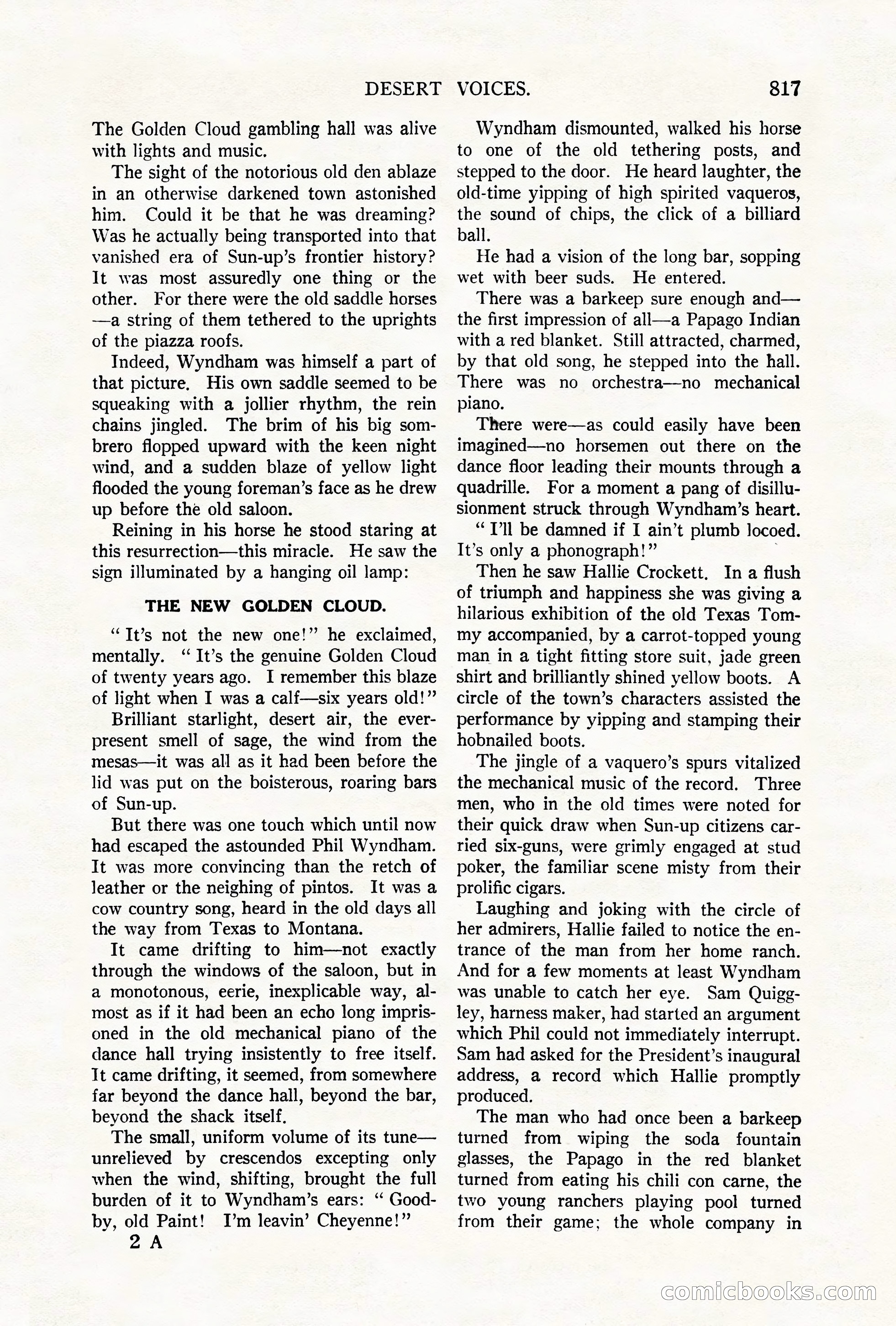
A restored page from Pulp Fiction, 1923. Page through the whole issue in the reader above.
📄 Transcribed text from this page (OCR, searchable)
Machine-transcribed from the original scan — historical spelling and the odd misread are preserved.
DESERT The Golden Cloud gambling hall was alive with lights and music. The sight of the notorious old den ablaze in an otherwise darkened town astonished him. Could it be that he was dreaming? Was he actually being transported into that vanished era of Sun-up’s frontier history? It was most assuredly one thing or the other. For there were the old saddle horses ——a string of them tethered to the uprights of the piazza roofs. Indeed, Wyndham was himself a part of that picture. His own saddle seemed to be squeaking with a jollier rhythm, the rein chains jingled. The brim of his big som- brero flopped upward with the keen night wind, and a sudden blaze of yellow light flooded the young foreman’s face as he drew up before the old saloon. Reining in his horse he stood staring at this resurrection—this miracle. He saw the sign illuminated by a hanging oil lamp: THE NEW GOLDEN CLOUD. “It’s not the new one!” he exclaimed, mentally. ‘It’s the genuine Golden Cloud of twenty years ago. I remember this blaze of light when I was a calf—six years old!” Brilliant starlight, desert air, the ever- present smell of sage, the wind from the mesas—it was all as it had been before the lid was put on the boisterous, roaring bars of Sun-up. But there was one touch which until now had escaped the astounded Phil Wyndham. It was more convincing than the retch of leather or the neighing of pintos. It was a cow country song, heard in the old days all the way from Texas to Montana. It came drifting to him—not exactly through the windows of the saloon, but in a monotonous, eerie, inexplicable way, al- most as if it had been an echo long impris- oned in the old mechanical piano of the dance hall trying insistently to free itself. It came drifting, it seemed, from somewhere far beyond the dance hall, beyond the bar, beyond the shack itself, The small, uniform volume of its tune— unrelieved by crescendos excepting only when the wind, shifting, brought the full burden of it to Wyndham’s ears: ‘“‘ Good- by, old Paint! I’m leavin’ Cheyenne!” 2A VOICES. 817 Wyndham dismounted, walked his horse to one of the old tethering posts, and stepped to the door. He heard laughter, the old-time yipping of high spirited vaqueros, the sound of chips, the click of a billiard ball. He had a vision of the long bar, sopping wet with beer suds. He entered. There was a barkeep sure enough and— the first impression of all—a Papago Indian with a red blanket. Still attracted, charmed, by that old song, he stepped into the hall. There was no orchestra—no mechanical piano. There were—as could easily have been imagined—no horsemen out there on the dance floor leading their mounts through a quadrille. For a moment a pang of disillu- sionment struck through Wyndham’s heart. ‘ Tll be damned if I ain’t plumb locoed. It’s only a phonograph!” Then he saw Hallie Crockett. In a flush of triumph and happiness she was giving a hilarious exhibition of the old Texas Tom- my accompanied, by a carrot-topped young man in a tight fitting store suit, jade green shirt and brilliantly shined yellow boots. A circle of the town’s characters assisted the performance by yipping and stamping their hobnailed boots. The jingle of a vaquero’s spurs vitalized the mechanical music of the record. Three men, who in the old times were noted for their quick draw when Sun-up citizens car- tried six-guns, were grimly engaged at stud poker, the familiar scene misty from their prolific cigars. Laughing and joking with the circle of her admirers, Hallie failed to notice the en- trance of the man from her home ranch. And for a few moments at least Wyndham was unable to catch her eye. Sam Quigg- ley, harness maker, had started an argument which Phil could not immediately interrupt. Sam had asked for the President’s inaugural address, a record which Hallie promptly produced. The man who had once been a barkeep turned from wiping the soda fountain glasses, the Papago in the red blanket turned from eating his chili con carne, the two young ranchers playing pool turned from their game; the whole company in COMmiclooe S (©