
Pulp Fiction, 1923 · page 43 of 196
Argosy All-Story Weekly, October 6, 1923 — page 43: what you’re looking at
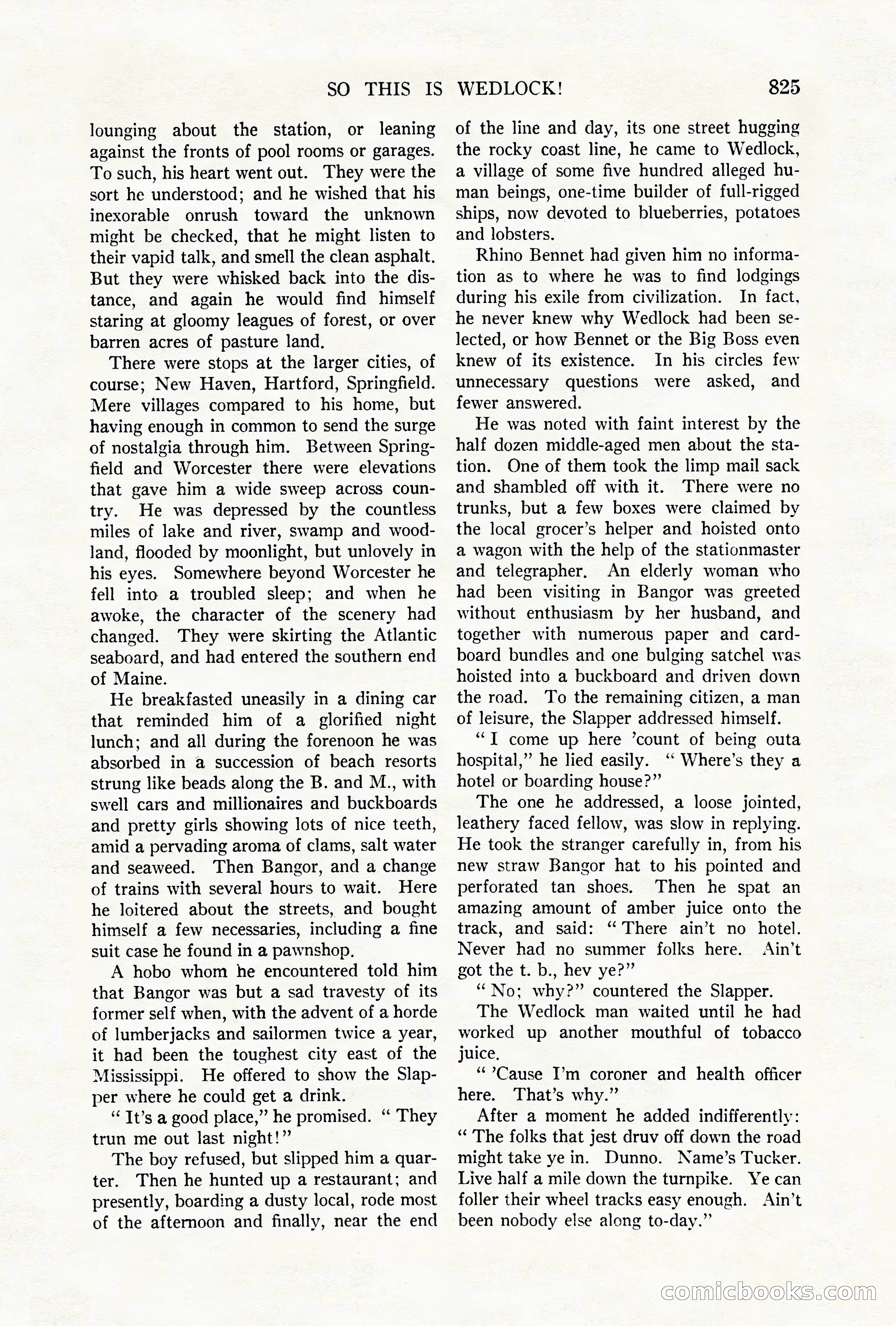
A restored page from Pulp Fiction, 1923. Page through the whole issue in the reader above.
📄 Transcribed text from this page (OCR, searchable)
Machine-transcribed from the original scan — historical spelling and the odd misread are preserved.
SO THIS IS lounging about the station, or leaning against the fronts of pool rooms or garages. To such, his heart went out. They were the sort he understood; and he wished that his inexorable onrush toward the unknown might be checked, that he might listen to their vapid talk, and smell the clean asphalt. But they were whisked back into the dis- tance, and again he would find himself staring at gloomy leagues of forest, or over barren acres of pasture land. There were stops at the larger cities, of course; New Haven, Hartford, Springfield. Mere villages compared to his home, but having enough in common to send the surge of nostalgia through him. Between Spring- field and Worcester there were elevations that gave him a wide sweep across coun- try. He was depressed by the countless miles of lake and river, swamp and wood- land, flooded by moonlight, but unlovely in his eyes. Somewhere beyond Worcester he fell into a troubled sleep; and when he awoke, the character of the scenery had changed. They were skirting the Atlantic seaboard, and had entered the southern end of Maine. He breakfasted uneasily in a dining car that reminded him of a glorified night lunch; and all during the forenoon he was absorbed in a succession of beach resorts strung like beads along the B. and M., with swell cars and millionaires and buckboards and pretty girls showing lots of nice teeth, amid a pervading aroma of clams, salt water and seaweed. Then Bangor, and a change of trains with several hours to wait. Here he loitered about the streets, and bought himself a few necessaries, including a fine suit case he found in a pawnshop. A hobo whom he encountered told him that Bangor was but a sad travesty of its former self when, with the advent of a horde of lumberjacks and sailormen twice a year, it had been the toughest city east of the Mississippi. He offered to show the Slap- per where he could get a drink. “It’s a good place,” he promised. “ They trun me out last night!” The boy refused, but slipped him a quar- ter. Then he hunted up a restaurant; and presently, boarding a dusty local, rode most of the afternoon and finally, near the end WEDLOCK! 825 of the line and day, its one street hugging the rocky coast line, he came to Wedlock, a village of some five hundred alleged hu- man beings, one-time builder of full-rigged ships, now devoted to blueberries, potatoes and lobsters. Rhino Bennet had given him no informa- tion as to where he was to find lodgings during his exile from civilization. In fact, he never knew why Wedlock had been se- lected, or how Bennet or the Big Boss even knew of its existence. In his circles few unnecessary questions were asked, and fewer answered. He was noted with faint interest by the half dozen middle-aged men about the sta- tion. One of them took the limp mail sack and shambled off with it. There were no trunks, but a few boxes were claimed by the local grocer’s helper and hoisted onto a wagon with the help of the stationmaster and telegrapher, An elderly woman who had been visiting in Bangor was greeted without enthusiasm by her husband, and together with numerous paper and card- board bundles and one bulging satchel was hoisted into a buckboard and driven down the road. To the remaining citizen, a man of leisure, the Slapper addressed himself. ‘““I come up here ’count of being outa hospital,” he lied easily. ‘‘ Where’s they a hotel or boarding house?” The one he addressed, a loose jointed, leathery faced fellow, was slow in replying. He took the stranger carefully in, from his new straw Bangor hat to his pointed and perforated tan shoes. Then he spat an amazing amount of amber juice onto the track, and said: “‘ There ain’t no hotel. Never had no summer folks here. Ain't got the t. b., hev ye?” ‘““ No; why?” countered the Slapper. The Wedlock man waited until he had worked up another mouthful of tobacco juice, ‘“*’Cause I’m coroner and health officer here. That’s why.” After a moment he added indifferently: ‘“* The folks that jest druv off down the road might take ye in. Dunno. Name’s Tucker. Live half a mile down the turnpike. Ye can foller their wheel tracks easy enough. Ain’t been nobody else along to-day.” COMmiicloo® (©