
Pulp Fiction, 1923 · page 48 of 196
Argosy All-Story Weekly, October 6, 1923 — page 48: what you’re looking at
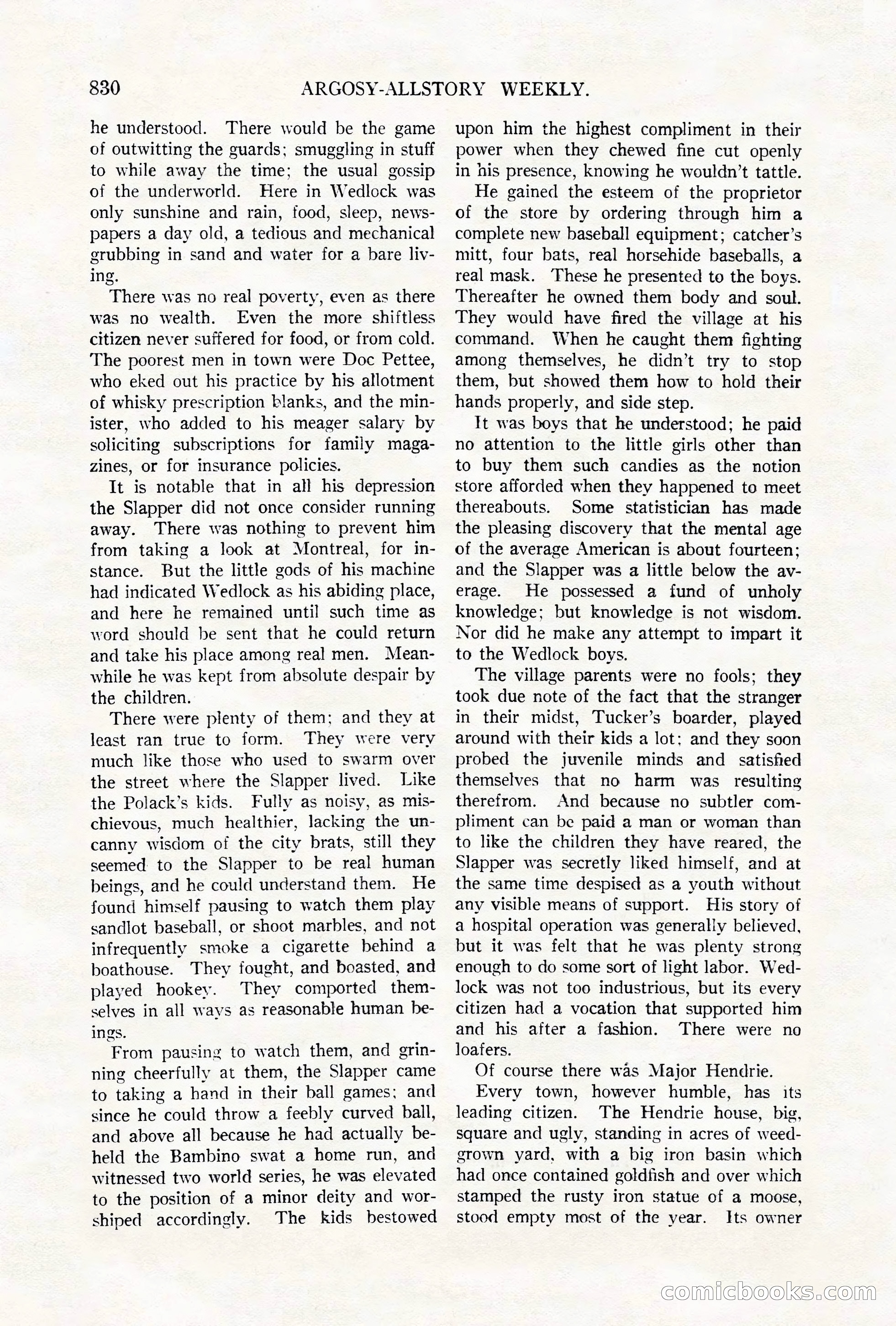
A restored page from Pulp Fiction, 1923. Page through the whole issue in the reader above.
📄 Transcribed text from this page (OCR, searchable)
Machine-transcribed from the original scan — historical spelling and the odd misread are preserved.
830 he understood. There would be the game of outwitting the guards; smuggling in stuff to while away the time; the usual gossip of the underworld. Here in Wedlcock was only sunshine and rain, food, sleep, news- papers a day old, a tedious and mechanical grubbing in sand and water for a bare liv- ing. There was no real poverty, even as there was no wealth. Even the more shiftless citizen never suffered for food, or from cold. The poorest men in town were Doc Pettee, who eked out his practice by his allotment of whisky prescription blanks, and the min- ister, who added to his meager salary by soliciting subscriptions for family maga- zines, or for insurance policies. It is notable that in all his depression the Slapper did not once consider running away. There was nothing to prevent him from taking a look at Montreal, for in- stance. But the little gods of his machine had indicated Wedlock as his abiding place, and here he remained until such time as word should be sent that he could return and take his place among real men. Mean- while he was kept from absolute despair by the children. There were plenty of them; and they at least ran true to form. They were very much like those who used to swarm over the street where the Slapper lived. Like the Polack’s kids. Fully as noisy, as mis- chievous, much healthier, lacking the un- canny wisdom of the city brats, still they seemed: to the Slapper to be real human beings, and he could understand them. He found himself pausing to watch them play sandlot baseball, or shoot marbles, and not infrequently smoke a cigarette behind a boathouse. They fought, and boasted, and played hookey. They comported them- selves in all ways as reasonable human be- ings. From pausing to watch them, and grin- ning cheerfully at them, the Slapper came to taking a hand in their ball games; and since he could throw a feebly curved ball, and above all because he had actually be- held the Bambino swat a home run, and witnessed two world series, he was elevated to the position of a minor deity and wor- shiped accordingly. The kids bestowed ARGOSY-ALLSTORY WEEKLY. upon him the highest compliment in their power when they chewed fine cut openly in nis presence, knowing he wouldn’t tattle. He gained the esteem of the proprietor of the store by ordering through him a complete new baseball equipment; catcher’s mitt, four bats, real horsehide baseballs, a real mask. These he presented to the boys. Thereafter he owned them body and soul. They would have fired the village at his command. When he caught them fighting among themselves, he didn’t try to stop them, but showed them how to hold their hands properly, and side step. It was boys that he understood; he paid no attention to the little girls other than to buy them such candies as the notion store afforded when they happened to meet thereabouts. Some statistician has made the pleasing discovery that the mental age of the average American is about fourteen; and the Slapper was a little below the av- erage. He possessed a fund of unholy knowledge; but knowledge is not wisdom. Nor did he make any attempt to impart it to the Wedlock boys. The village parents were no fools; they took due note of the fact that the stranger in their midst, Tucker’s boarder, played around with their kids a lot; and they soon probed the juvenile minds and satisfied themselves that no harm was resulting therefrom. And because no subtler com- pliment can be paid a man or woman than to like the children they have reared, the Slapper was secretly liked himself, and at the same time despised as a youth without any visible means of support. His story of a hospital operation was generally believed, but it was felt that he was plenty strong enough to do some sort of light labor. Wed- lock was not too industrious, but its every citizen had a vocation that supported him and his after a fashion. There were no loafers. Of course there was Major Hendrie. Every town, however humble, has its leading citizen. The Hendrie house, big, Square and ugly, standing in acres of weed- grown yard, with a big iron basin which had once contained goldfish and over which stamped the rusty iron statue of a moose, stood empty most of the year. Its owner GomiilGdoo (©