
Pulp Fiction, 1923 · page 50 of 196
Argosy All-Story Weekly, October 6, 1923 — page 50: what you’re looking at
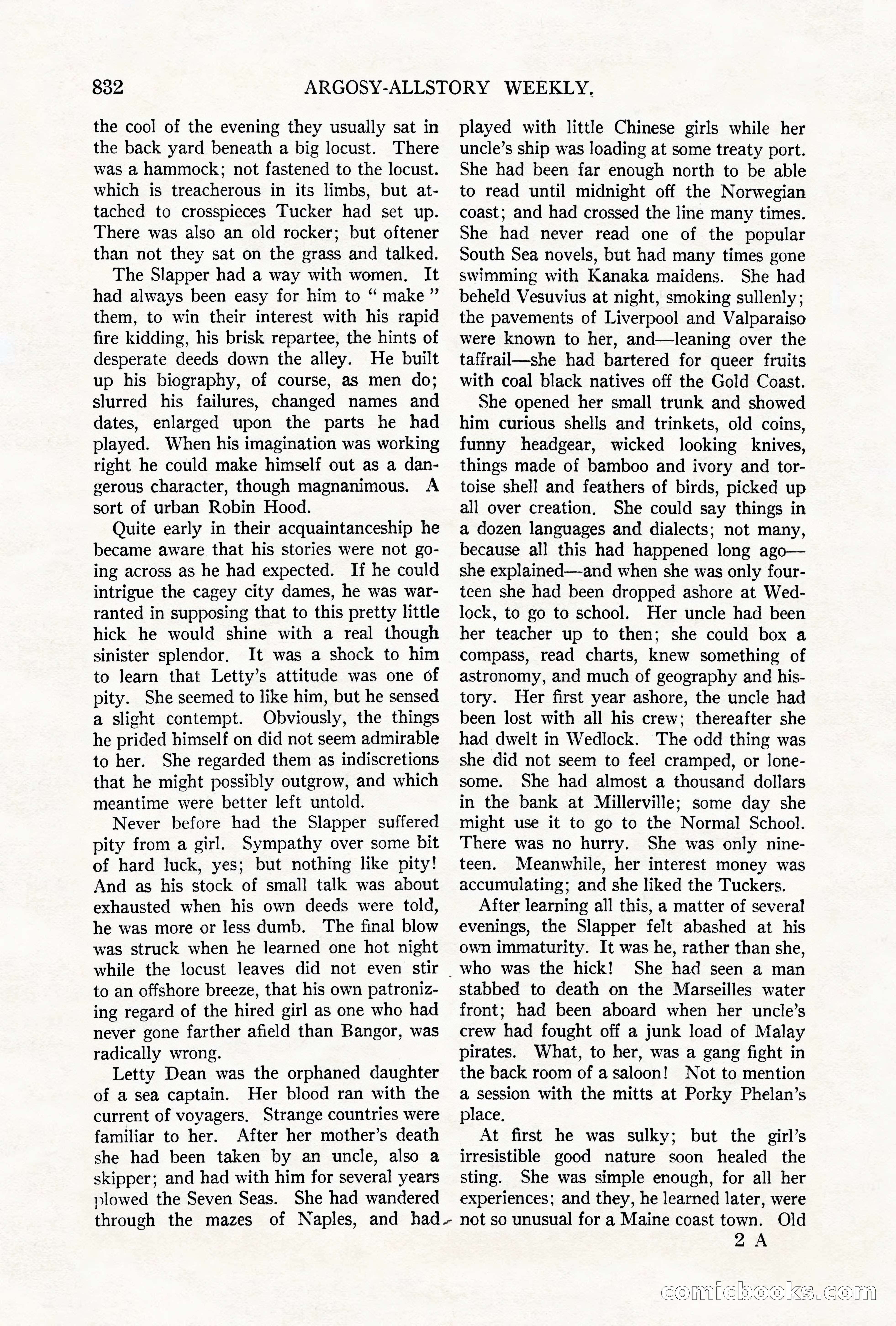
A restored page from Pulp Fiction, 1923. Page through the whole issue in the reader above.
📄 Transcribed text from this page (OCR, searchable)
Machine-transcribed from the original scan — historical spelling and the odd misread are preserved.
832 the cool of the evening they usually sat in the back yard beneath a big locust. There was a hammock; not fastened to the locust. which is treacherous in its limbs, but at- tached to crosspieces Tucker had set up. There was also an old rocker; but oftener than not they sat on the grass and talked. The Slapper had a way with women. It had always been easy for him to “ make” them, to win their interest with his rapid fire kidding, his brisk repartee, the hints of desperate deeds down the alley. He built up his biography, of course, as men do; slurred his failures, changed names and dates, enlarged upon the parts he had played. When his imagination was working right he could make himself out as a dan- gerous character, though magnanimous. A sort of urban Robin Hood. Quite early in their acquaintanceship he became aware that his stories were not go- ing across as he had expected. If he could intrigue the cagey city dames, he was war- ranted in supposing that to this pretty little hick he would shine with a real though sinister splendor. It was a shock to him to learn that Letty’s attitude was one of pity. She seemed to like him, but he sensed a slight contempt. Obviously, the things he prided himself on did not seem admirable to her. She regarded them as indiscretions that he might possibly outgrow, and which meantime were better left untold. Never before had the Slapper suffered pity from a girl. Sympathy over some bit of hard luck, yes; but nothing like pity! And as his stock of small talk was about exhausted when his own deeds were told, he was more or less dumb. The final blow was struck when he learned one hot night while the locust leaves did not even stir to an offshore breeze, that his own patroniz- ing regard of the hired girl as one who had never gone farther afield than Bangor, was radically wrong. Letty Dean was the orphaned daughter of a sea captain. Her blood ran with the current of voyagers. Strange countries were familiar to her. After her mother’s death she had been taken by an uncle, also a skipper; and had with him for several years plowed the Seven Seas. She had wandered _who was the hick! ARGOSY-ALLSTORY WEEKLY, played with little Chinese girls while her uncle’s ship was loading at some treaty port. She had been far enough north to be able to read until midnight off the Norwegian coast; and had crossed the line many times. She had never read one of the popular South Sea novels, but had many times gone swimming with Kanaka maidens. She had beheld Vesuvius at night, smoking sullenly; the pavements of Liverpool and Valparaiso were known to her, and—leaning over the tafirail—she had bartered for queer fruits with coal black natives off the Gold Coast. She opened her small trunk and showed him curious shells and trinkets, old coins, funny headgear, wicked looking knives, things made of bamboo and ivory and tor- toise shell and feathers of birds, picked up all over creation. She could say things in a dozen languages and dialects; not many, because all this had happened long ago— she explained—and when she was only four- teen she had been dropped ashore at Wed- lock, to go to school. Her uncle had been her teacher up to then; she could box a compass, read charts, knew something of astronomy, and much of geography and his- tory. Her first year ashore, the uncle had been lost with all his crew; thereafter she had dwelt in Wedlock. The odd thing was she did not seem to feel cramped, or lone- some. She had almost a thousand dollars in the bank at Millerville; some day she might use it to go to the Normal School. There was no hurry. She was only nine- teen. Meanwhile, her interest money was accumulating; and she liked the Tuckers. After learning all this, a matter of several evenings, the Slapper felt abashed at his own immaturity. It was he, rather than she, She had seen a man stabbed to death on the Marseilles water front; had been aboard when her uncle’s crew had fought off a junk load of Malay pirates. What, to her, was a gang fight in the back room of a saloon! Not to mention a session with the mitts at Porky Phelan’s place. At first he was sulky; but the girl’s irresistible good nature soon healed the sting. She was simple enough, for all her experiences; and they, he learned later, were through the mazes of Naples, and had- not so unusual for a Maine coast town. Old 2A COMiclooe (©