
Pulp Fiction, 1924 · page 100 of 177
Argosy All-Story Weekly, March 15, 1924 — page 100: what you’re looking at
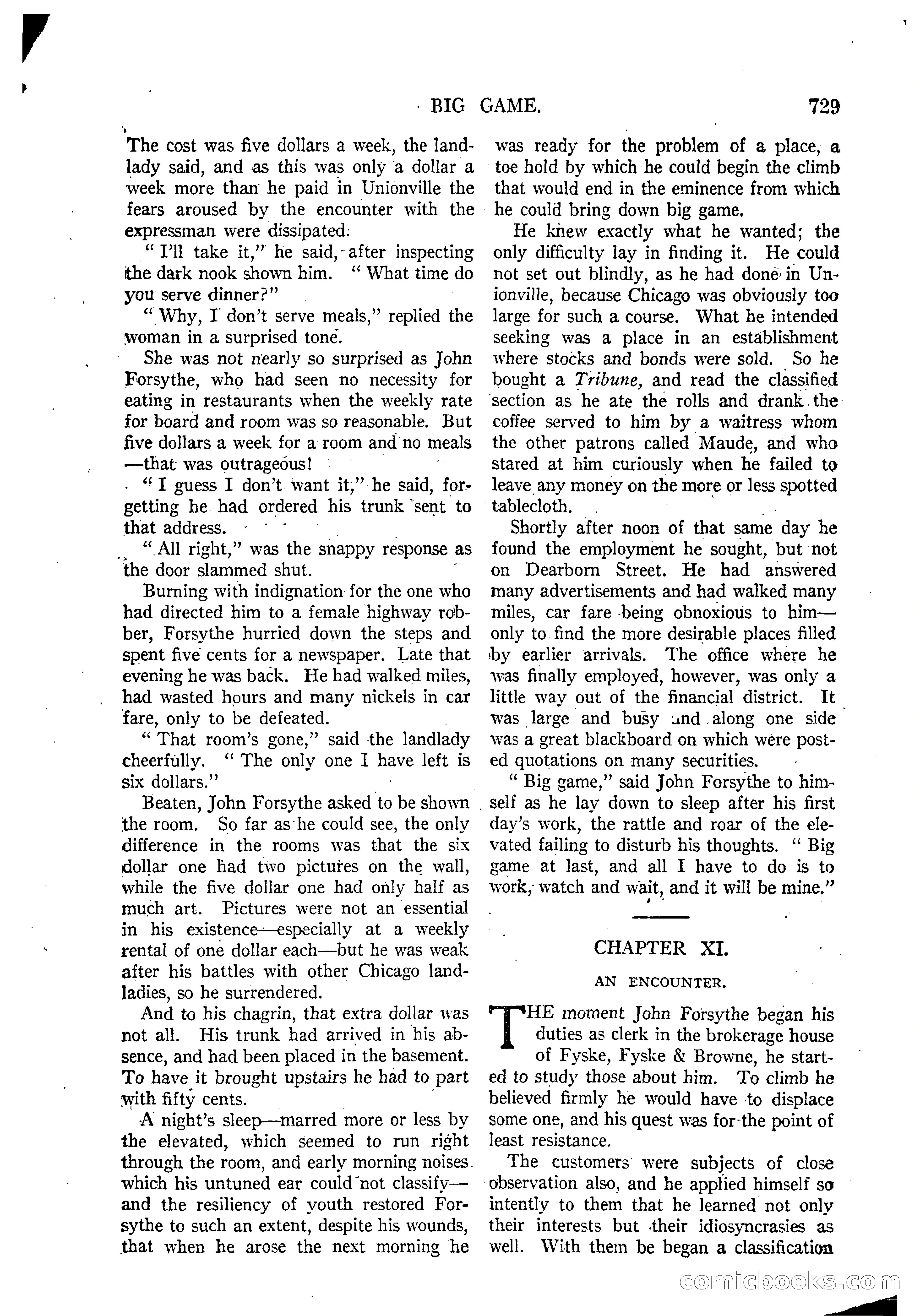
A restored page from Pulp Fiction, 1924. Page through the whole issue in the reader above.
📄 Transcribed text from this page (OCR, searchable)
Machine-transcribed from the original scan — historical spelling and the odd misread are preserved.
- BIG GAME. The cost was five dollars a week, the land- lady said, and as this was only a dollar a week more than he paid in Unionville the fears aroused by the encounter with the > expressman were dissipated: “TH take it,” he said,-after inspecting the dark nook shown him. ‘“‘ What time do you serve dinner?” : “Why, I don’t serve meals,” replied the woman in a surprised tone. She was not nearly so surprised as John Forsythe, who had seen no necessity for eating in restaurants when the weekly rate for board and room was so reasonable. But five dollars a week for a: room and no meals —that was outrageous! - “T guess I don’t. want it,” he said, for- getting he. had ordered his trunk ‘sent to that address. _ “All right,” was the snappy response as the door slammed shut. Burning with indignation: for the one who had directed him to a female highway rob- ber, Forsythe hurried down the steps and spent five cents for a newspaper, Late that evening he was back. He had walked miles, had wasted hours and many nickels in car fare, only to be defeated. “e That room’s gone,” said the landlady cheerfully. ‘“ The only one I have left is six dollars.” Beaten, John Forsythe asked to be shown . the room. So far as‘he could see, the only difference in the rooms was that the six dollar one had two pictures on the wall, while the five dollar one had only half as much art. Pictures were not an essential in his existence—especially at a weekly rental of one dollar each—but he was weak after his battles with other Chicago land- ladies, so he surrendered. And to his chagrin, that extra dollar was not all. His trunk had arrived in his ab- sence, and had been placed in the basement. To have it brought upstairs he had to part with fifty cents. A night’s sleep—marred more or less by the elevated, which seemed to run right through the room, and early morning noises. which his untuned ear could not classify— and the resiliency of vouth restored For- sythe to such an extent, despite his wounds, that when he arose the next morning he 729 was ready for the problem of a place, a toe hold by which he could begin the climb that would end in the eminence from which he could bring down big game. He knew exactly what he wanted; the only difficulty lay in finding it. He could not set out blindly, as he had done in Un- ionville, because Chicago was obviously too large for such a course. What he intended seeking was a place in an establishment where stocks and bonds were sold. So he bought a Tribune, and read the classified ‘section as he ate the rolls and drank.the: coffee served to him by a waitress whom the other patrons called Maude, and who Stared at him curiously when he failed to leave any money on the more or less spotted tablecloth. Shortly after noon of that same ‘day he found the employment he sought, but ‘not on Dearborn Street. He had answered many advertisements and had walked many miles, car fare -being obnoxious to him— only to find the more desirable places filled iby earlier arrivals. The office where he was finally employed, however, was only a little way out of the financial district. It was large and busy und along one side was a great blackboard on which were post- ed quotations on many securities, “ Big game,” said John Forsythe to him- self as he lay down to sleep after his first day’s work, the rattle and roar of the ele- vated failing to disturb his thoughts. “ Big game at last, and all I have to do is to work, watch and wait, and it will be mine.” CHAPTER XI. AN ENCOUNTER. HE moment John Forsythe began his duties as clerk in the brokerage house of Fyske, Fyske & Browne, he start- ed to study those about him. To climb he believed firmly he would have to displace some one, and his quest was for-the point of least resistance. The customers’ were subjects of close ‘observation also, and he applied himself so intently to them that he learned not only their interests but their idiosyncrasies as well. With them be began a classification comicloookks CO _