
Pulp Fiction, 1924 · page 101 of 177
Argosy All-Story Weekly, March 15, 1924 — page 101: what you’re looking at
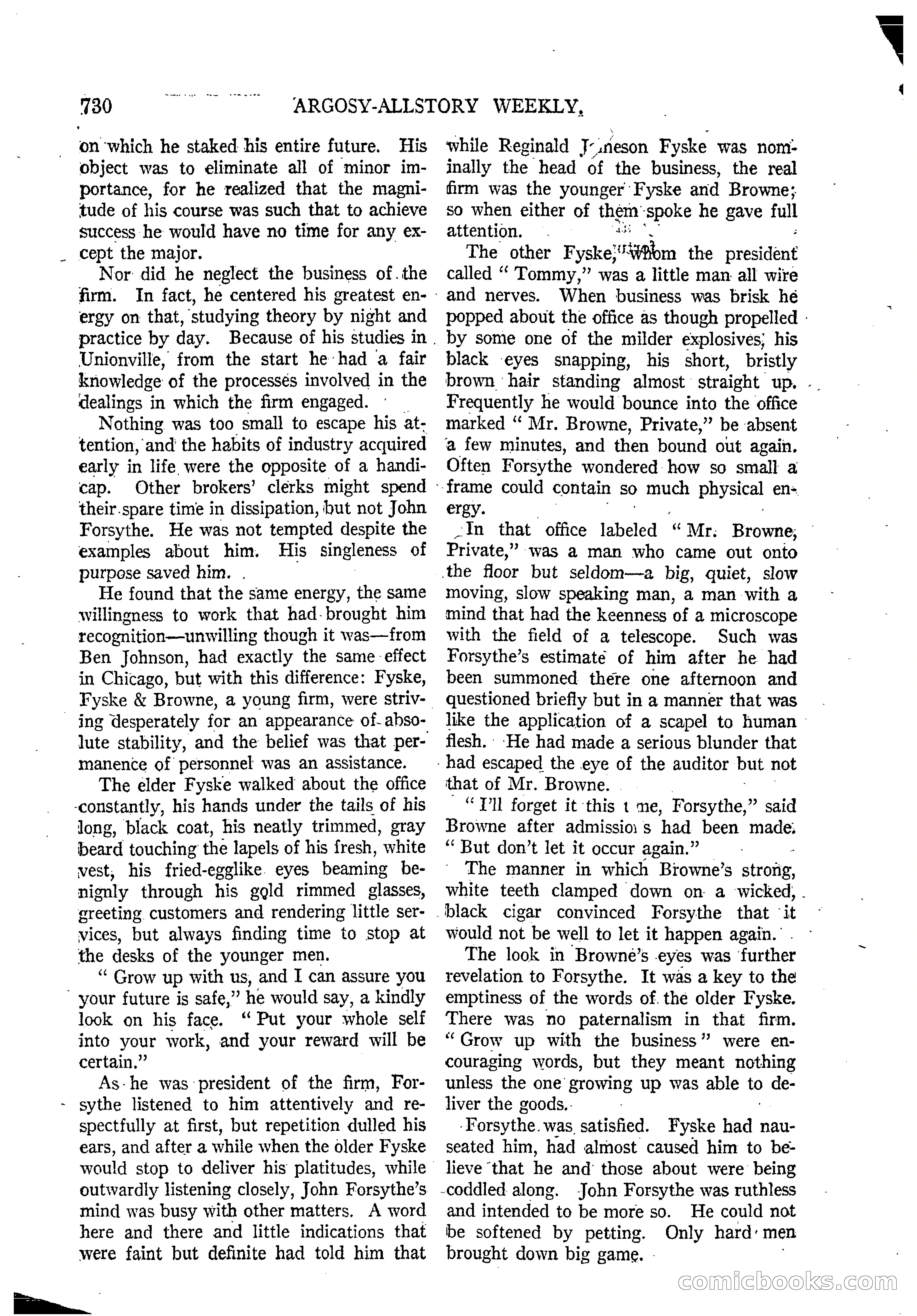
A restored page from Pulp Fiction, 1924. Page through the whole issue in the reader above.
📄 Transcribed text from this page (OCR, searchable)
Machine-transcribed from the original scan — historical spelling and the odd misread are preserved.
730 on which he staked: his entire future. His object was to eliminate all of minor im- portance, for he realized that the magni- tude of his course was such that to achieve success he would have no time for any ex- cept the major. Nor: did he neglect the business of.the firm. In fact, he centered his greatest en- - ergy on that, studying theory by night and practice by day. Because of his studies in Unionville, from the start he had a fair knowledge of the processés involved in the dealings in which the firm engaged. Nothing was too small to escape his at- tention, and the habits of industry acquired early in life were the opposite of a handi- cap. Other brokers’ clerks might spend their.spare time in dissipation, but not John Forsythe. He was not tempted despite the examples about him. His singleness of purpese saved him. He found that the same energy, the same willingness to work that had-brought him recognition—unwilling though it was—from Ben Johnson, had exactly the same effect in Chicago, but with this difference: Fyske, _ Fyske & Browne, a young firm, were striv-_ ing desperately for an appearance of- abso- lute stability, and the belief was that per- manence of personnel was an assistance. The elder Fyske walked about the office -constantly, his hands under the tails of his long, black coat, his neatly trimmed, gray beard touching the lapels of his fresh, white vest, his fried-egglike. eyes beaming be- nignly through his ggld rimmed glasses, ereeting. customers and rendering little ser- vices, but always finding time to stop at the desks of the younger men. ‘Grow up with us, and I can assure you "your future is safe,” he would say, a kindly look on his face. ‘Put your whole self into your work, and your reward will be certain.” | As-he was president of the firm, For- - sythe listened to him attentively and re- spectfully at first, but repetition dulled his ears, and after a while when the older Fyske would stop to deliver his platitudes, while outwardly listening closely, John Forsythe’s mind was busy with other matters. A word here and there and little indications that were faint but definite had told him that a -coddied. along. ARGOSY-ALLSTORY WEEKLY, while Reginald J- -gleson Fyske was nom- inally the head of the business, the real firm was the younger Fyske and Browne; so when either of ccc ‘spoke he gave full attention. The other Fyske?! om the president called “ Tommy,’ was a little man: all wire and nerves. When business was brisk hé popped about the office as though propelled - . by some one of the milder explosives; his black eyes snapping, his short, bristly brown ‘hair standing almost. straight up. - Frequently he would bounce into the office marked “ Mr. Browne, Private,” be absent a few minutes, and then bound out again. Often Forsythe wondered how so small a -frame could contain so » much payaical en ergy. -In that office labeled “ Mr: Private, » was aman who came out onto the floor but seldom—a big, quiet, slow moving, slow speaking man, a man with a mind that had the keenness of a microscope with the field of a telescope. Such was Forsythe’s estimate of him after he had been summoned there one afternoon and questioned briefly but in a manner that was like the application of a scapel to human > flesh. ‘He had made a serious blunder that had escaped the eye of the auditor ‘but not that of Mr. Browne. . . “Tl forget it this t me, Forsythe, ” said Browne after admission § had been made; “ But don’t let it occur again.” The manner in which Biowne’s strove: white teeth clamped down on. a wicked, . black cigar convinced Forsythe that ‘it would not be well to let it happen again.’ The look in Browne’s -eyes was further revelation to Forsythe. It was a key to the emptiness of the words of. the older Fyske. There was no paternalism in that firm. “Grow up with the business” were en- couraging words, but they meant nothing unless the one growing up was able to de- liver the goods..- ‘Forsythe. was satisfied. Fyske had nau- seated him, had almost caused him to be- lieve ‘that he and those about were being John Forsythe was ruthless and intended to be more so. He could not be softened by petting. _ Only hard: men brought down big game. Browne; — . «fl COIN C DOO So CO@