
Pulp Fiction, 1924 · page 13 of 186
Argosy All-Story Weekly, May 3, 1924 — page 13: what you’re looking at
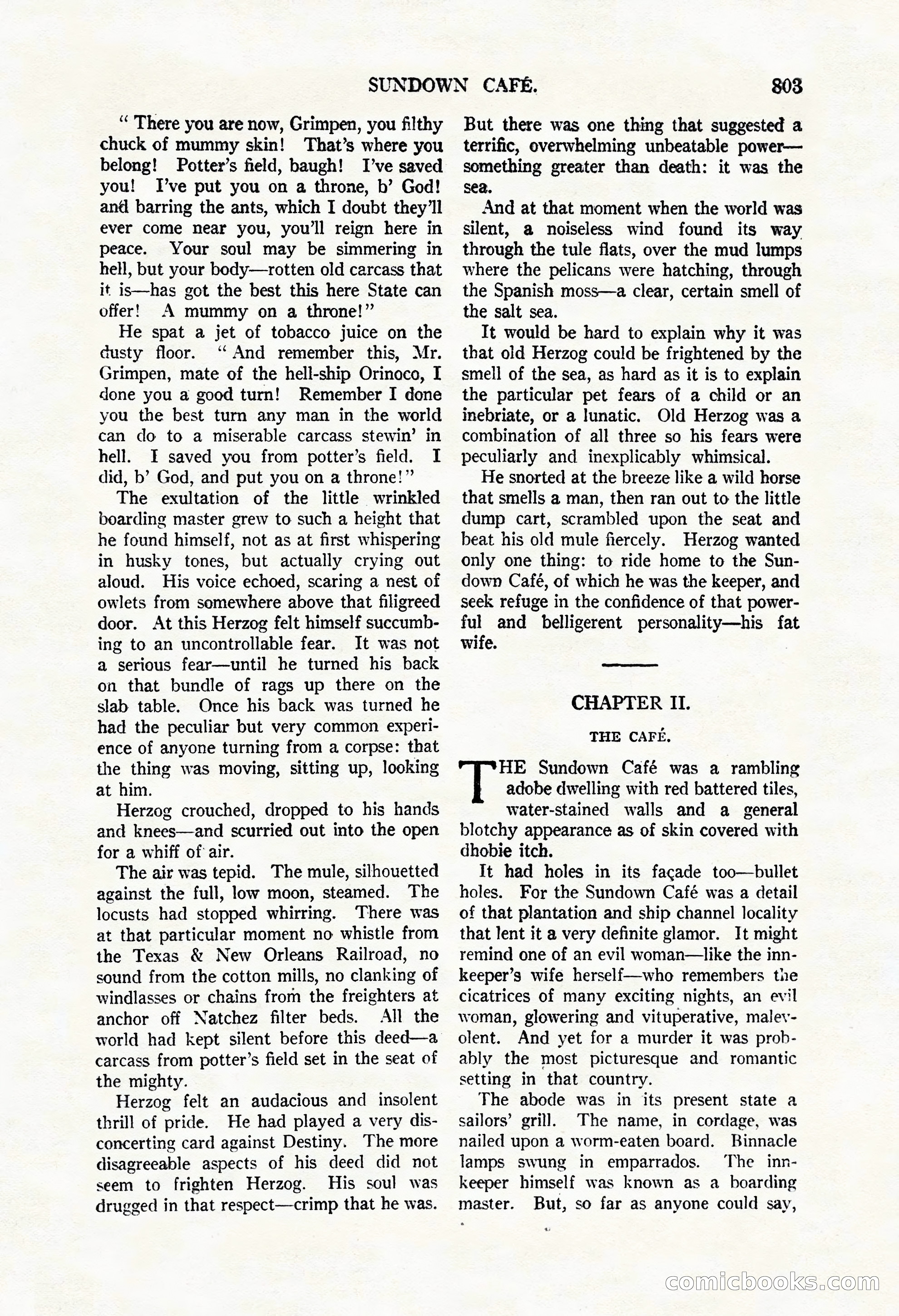
A restored page from Pulp Fiction, 1924. Page through the whole issue in the reader above.
📄 Transcribed text from this page (OCR, searchable)
Machine-transcribed from the original scan — historical spelling and the odd misread are preserved.
SUNDOWN CAFE. ‘‘ There you are now, Grimpen, you filthy chuck of mummy skin! That’s where you belong! Potter’s field, baugh! I’ve saved you! I’ve put you on a throne, b’ God! and barring the ants, which I doubt they'll ever come near you, you'll reign here in peace. Your soul may be simmering in hell, but your body—rotten old carcass that it is—has got the best this here State can offer! A mummy on a throne!” He spat a jet of tobacco juice on the dusty floor. ‘‘ And remember this, Mr. Grimpen, mate of the hell-ship Orinoco, I done you a good turn! Remember I done you the best turn any man in the world can do to a miserable carcass stewin’ in hell. IE saved you from potter’s field. I did, b’ God, and put you on a throne!” The exultation of the little wrinkled boarding master grew to such a height that he found himself, not as at first whispering in husky tones, but actually crying out aloud. His voice echoed, scaring a nest of owlets from somewhere above that filigreed door. At this Herzog felt himself succumb- ing to an uncontrollable fear. It was not a serious fear—until he turned his back on that bundle of rags up there on the slab table. Once his back was turned he had the peculiar but very common experi- ence of anyone turning from a corpse: that the thing was moving, sitting up, looking at him. Herzog crouched, dropped to his hands and knees—and scurried out into the open for a whiff of air. The air was tepid. The mule, silhouetted against the full, low moon, steamed. The locusts had stopped whirring. There was at that particular moment no whistle from the Texas & New Orleans Railroad, no sound from the cotton mills, no clanking of windlasses or chains from the freighters at anchor off Natchez filter beds. All the world had kept silent before this deed—a carcass from potter’s field set in the seat of the mighty. Herzog felt an audacious and insolent thrill of pride. He had played a very dis- concerting card against Destiny. The more disagreeable aspects of his deed did not seem to frighten Herzog. His soul was drugged in that respect—crimp that he was. =] 803 But there was one thing that suggested a terrific, overwhelming unbeatable power-— something greater than death: it was the sea. And at that moment when the world was silent, a noiseless wind found its way through the tule flats, over the mud lumps where the pelicans were hatching, through the Spanish moss—a clear, certain smell of the salt sea. It would be hard to explain why it was that old Herzog could be frightened by the smell of the sea, as hard as it is to explain the particular pet fears of a child or an inebriate, or a lunatic. Old Herzog was a combination of all three so his fears were peculiarly and inexplicably whimsical. He snorted at the breeze like a wild horse that smells a man, then ran out to the little dump cart, scrambled upon the seat and beat his old mule fiercely. Herzog wanted only one thing: to ride home to the Sun- down Cafe, of which he was the keeper, and seek refuge in the confidence of that power- ful and belligerent personality—his fat wife. CHAPTER II. THE CAFE, HE Sundown Café was a rambling adobe dwelling with red battered tiles, water-stained walls and a general blotchy appearance as of skin covered with dhobie itch. It had holes in its facade too—bullet holes. For the Sundown Café was a detail of that plantation and ship channel locality that lent it a very definite glamor. It might remind one of an evil woman—like the inn- keeper’s wife herseli—who remembers the cicatrices of many exciting nights, an evil woman, glowering and vituperative, malev- olent. And yet for a murder it was prob- ably the most picturesque and romantic setting in that country. The abode was in its present state a sailors’ grill. The name, in cordage, was nailed upon a worm-eaten board. Binnacle lamps swung in emparrados. The inn- keeper himself was known as a_ boarding master. But, so far as anyone could say, DOO Conn (©