
Pulp Fiction, 1924 · page 31 of 186
Argosy All-Story Weekly, May 3, 1924 — page 31: what you’re looking at
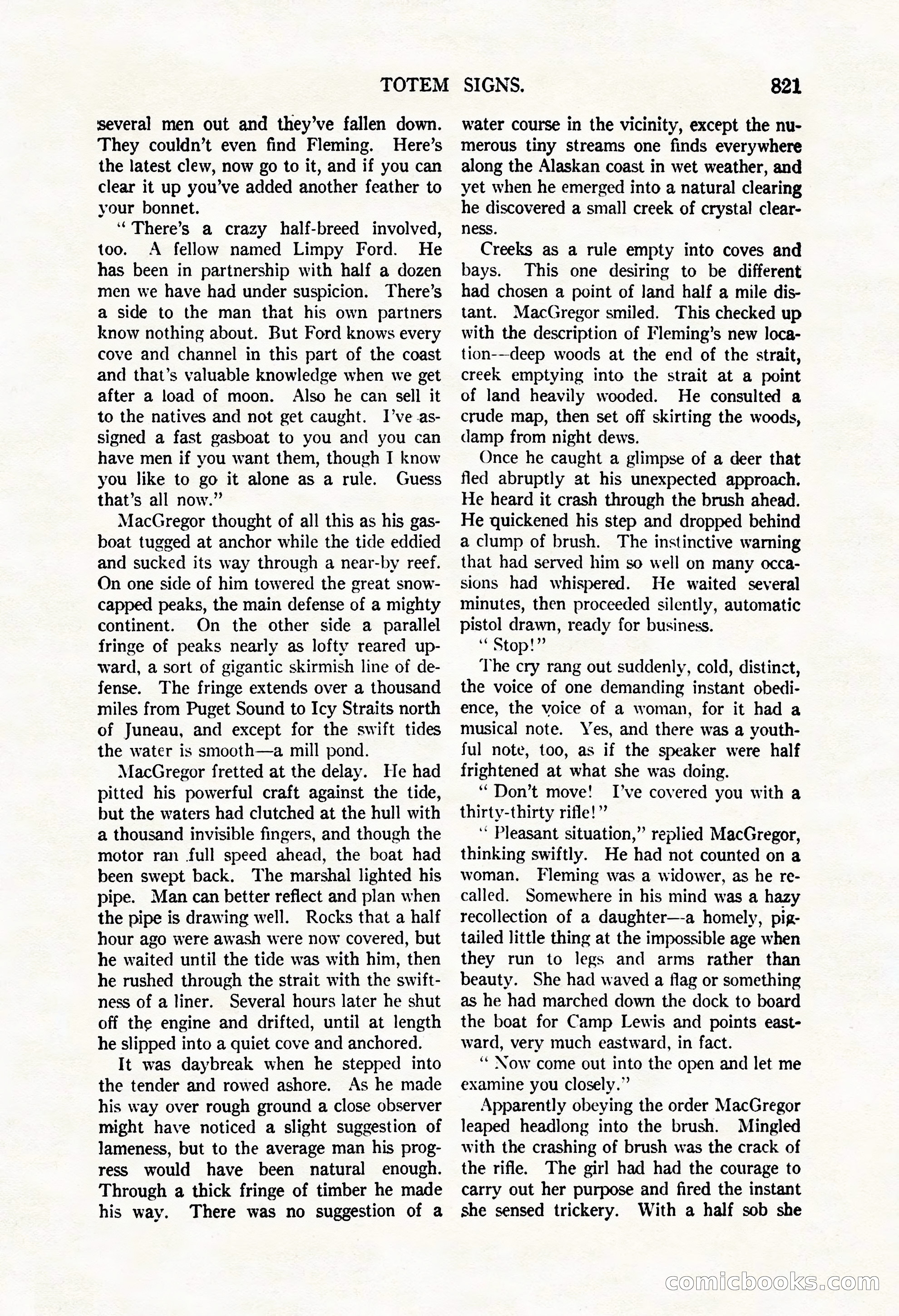
A restored page from Pulp Fiction, 1924. Page through the whole issue in the reader above.
📄 Transcribed text from this page (OCR, searchable)
Machine-transcribed from the original scan — historical spelling and the odd misread are preserved.
TOTEM SIGNS. several men out and they’ve fallen down. They couldn’t even find Fleming. Here’s the latest clew, now go to it, and if you can clear it up you’ve added another feather to your bonnet. ‘“There’s a crazy half-breed involved, too. A fellow named Limpy Ford. He has been in partnership with half a dozen men we have had under suspicion. There’s a side to the man that his own partners know nothing about. But Ford knows every cove and channel in this part of the coast and that’s valuable knowledge when we get after a load of moon. Also he can sell it to the natives and not get caught. I’ve as- signed a fast gasboat to you and you can have men if you want them, though I know you like to go it alone as a rule. Guess that’s all now.” MacGregor thought of all this as his gas- boat tugged at anchor while the tide eddied and sucked its way through a near-by reef. On one side of him towered the great snow- capped peaks, the main defense of a mighty continent. On the other side a parallel fringe of peaks nearly as loftv reared up- ward, a sort of gigantic skirmish line of de- fense. The fringe extends over a thousand miles from Puget Sound to Icy Straits north of Juneau, and except for the swift tides the water is smooth—a mill pond. MacGregor fretted at the delay. He had pitted his powerful craft against the tide, but the waters had clutched at the hull with a thousand invisible fingers, and though the motor ran full speed ahead, the boat had been swept back. The marshal lighted his pipe. Man can better reflect and plan when the pipe is drawing well. Rocks that a half hour ago were awash were now covered, but he waited until the tide was with him, then he rushed through the strait with the swift- ness of a liner. Several hours later he shut off the engine and drifted, until at length he slipped into a quiet cove and anchored. It was daybreak when he stepped into the tender and rowed ashore. As he made his way over rough ground a close observer might have noticed a slight suggestion of lameness, but to the average man his prog- ress would have been natural enough. Through a thick fringe of timber he made his way. There was no suggestion of a 821 water course in the vicinity, except the nu- merous tiny streams one finds everywhere along the Alaskan coast in wet weather, and yet when he emerged into a natural clearing he discovered a small creek of crystal clear- ness. Creeks as a rule empty into coves and bays. This one desiring to be different had chosen a point of land half a mile dis- tant. MacGregor smiled. This checked up with the description of Fleming’s new loca- tion-—deep woods at the end of the strait, creek emptying into the strait at a point of land heavily wooded. He consulted a crude map, then set off skirting the woods, damp from night dews. Once he caught a glimpse of a deer that fled abruptly at his unexpected approach. He heard it crash through the brush ahead. He quickened his step and dropped behind a clump of brush. The instinctive warning that had served him so well on many occa- sions had whispered. He waited several minutes, then proceeded silently, automatic pistol drawn, ready for business. The cry rang out suddenly, cold, distinct, the voice of one demanding instant obedi- ence, the voice of a woman, for it had a musical note. Yes, and there was a youth- ful note, too, as if the speaker were half frightened at what she was doing. ‘“Don’t move! I’ve covered you with a thirty-thirty rifle!” ‘* Pleasant situation,” replied MacGregor, thinking swiftly. He had not counted on a woman. Fleming was a widower, as he re- called. Somewhere in his mind was a hazy recollection of a daughter—-a homely, pig- tailed little thing at the impossible age when they run to legs and arms rather than beauty. She had waved a flag or something as he had marched down the dock to board the boat for Camp Lewis and points east- ward, very much eastward, in fact. ‘* Now come out into the open and let me examine you closely.” Apparently obeying the order MacGregor leaped headlong into the brush. Mingled with the crashing of brush was the crack of the rifle. The girl had had the courage to carry out her purpose and fired the instant she sensed trickery. With a half sob she COMIGD OO! (©