
Pulp Fiction, 1924 · page 154 of 172
Argosy All-Story Weekly, August 9, 1924 — page 154: what you’re looking at
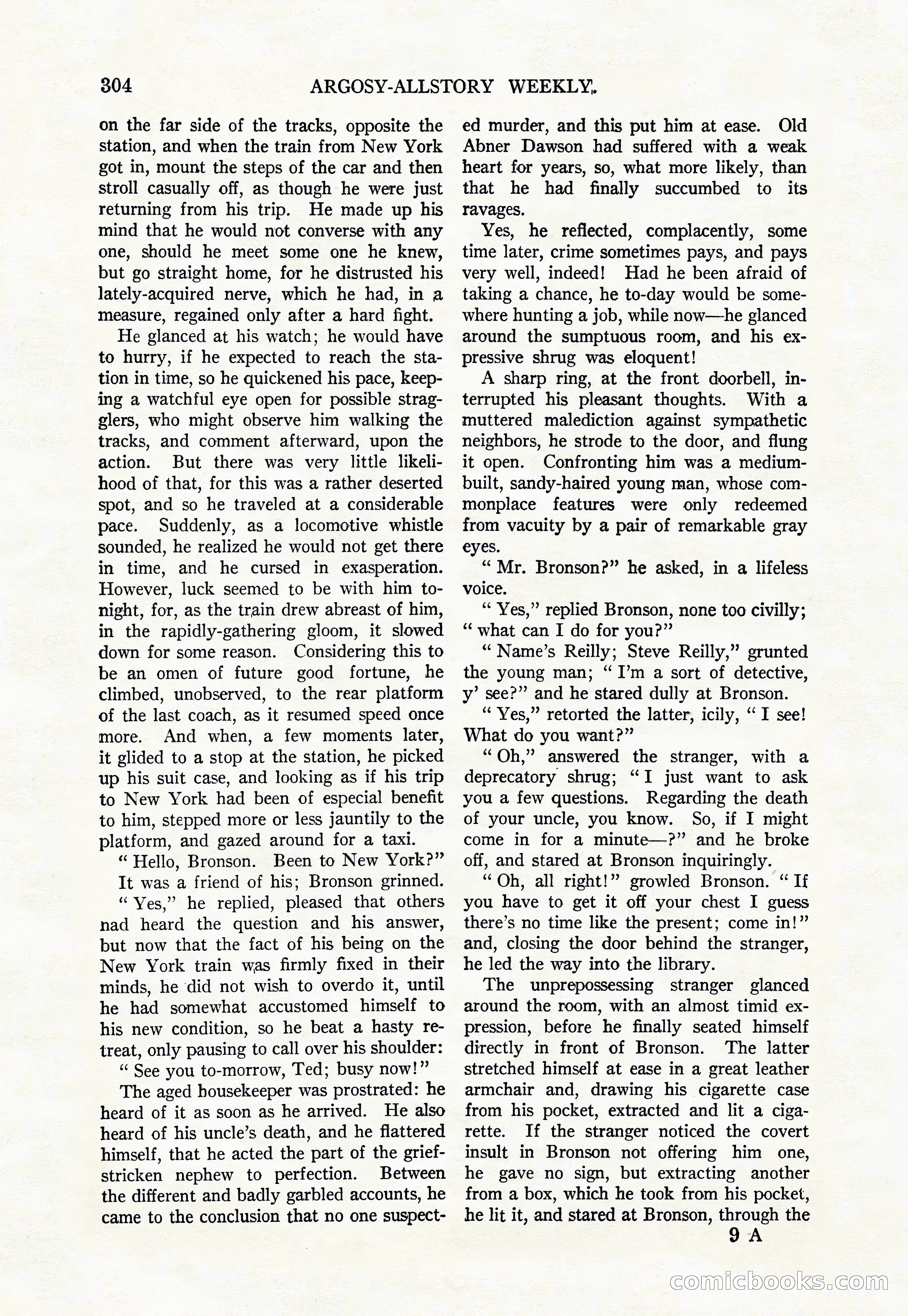
A restored page from Pulp Fiction, 1924. Page through the whole issue in the reader above.
📄 Transcribed text from this page (OCR, searchable)
Machine-transcribed from the original scan — historical spelling and the odd misread are preserved.
304 on the far side of the tracks, opposite the station, and when the train from New York got in, mount the steps of the car and then stroll casually off, as though he were just returning from his trip. He made up his mind that he would not converse with any one, should he meet some one he knew, but go straight home, for he distrusted his Jately-acquired nerve, which he had, in a measure, regained only after a hard fight. He glanced at his watch; he would have to hurry, if he expected to reach the sta- tion in time, so he quickened his pace, keep- ing a watchful eye open for possible strag- glers, who might observe him walking the tracks, and comment afterward, upon the action. But there was very little likeli- hood of that, for this was a rather deserted spot, and so he traveled at a considerable pace. Suddenly, as a locomotive whistle sounded, he realized he would not get there in time, and he cursed in exasperation. However, luck seemed to be with him to- night, for, as the train drew abreast of him, in the rapidly-gathering gloom, it slowed down for some reason. Considering this to be an omen of future good fortune, he climbed, unobserved, to the rear platform of the last coach, as it resumed speed once more. And when, a few moments later, it glided to a stop at the station, he picked up his suit case, and looking as if his trip to New York had been of especial benefit to him, stepped more or less jauntily to the platform, and gazed around for a taxi. “ Hello, Bronson. Been to New York?” It was a friend of his; Bronson grinned. “Ves,” he replied, pleased that others nad heard the question and his answer, but now that the fact of his being on the New York train was firmly fixed in their minds, he did not wish to overdo it, until he had somewhat accustomed himself to his new condition, so he beat a hasty re- treat, only pausing to call over his shoulder: “See you to-morrow, Ted; busy now!” The aged housekeeper was prostrated: he heard of it as soon as he arrived. He also heard of his uncle’s death, and he flattered himself, that he acted the part of the grief- stricken nephew to perfection. Between the different and badly garbled accounts, he came to the conclusion that no one suspect- ARGOSY-ALLSTORY WEEKLY. ed murder, and this put him at ease. Old Abner Dawson had suffered with a weak heart for years, so, what more likely, than that he had finally succumbed to its ravages. Yes, he reflected, complacently, some time later, crime sometimes pays, and pays very well, indeed! Had he been afraid of taking a chance, he to-day would be some- where hunting a job, while now—he glanced around the sumptuous room, and his ex- pressive shrug was eloquent! A sharp ring, at the front doorbell, in- terrupted his pleasant thoughts. With a muttered malediction against sympathetic neighbors, he strode to the door, and flung it open. Confronting him was a medium- built, sandy-haired young man, whose com- monplace features were only redeemed from vacuity by a pair of remarkable gray eyes. “Mr. Bronson?” he asked, in a lifeless voice. “Yes,” replied Bronson, none too civilly; ‘“‘ what can I do for you?” ‘““ Name’s Reilly; Steve Reilly,” grunted the young man; “I’m a sort of detective, y’ see?” and he stared dully at Bronson. “Yes,” retorted the latter, icily, ‘‘ I see! What do you want?” ‘““Oh,” answered the stranger, with a deprecatory shrug; “I just want to ask you a few questions. Regarding the death of your uncle, you know. So, if I might come in for a minute—?” and he broke off, and stared at Bronson inquiringly. “Oh, all right!” growled Bronson. “ If you have to get it off your chest I guess there’s no time like the present; come in!” and, closing the door behind the stranger, he led the way into the library. The unprepossessing stranger glanced around the room, with an almost timid ex- pression, before he finally seated himself directly in front of Bronson. The latter stretched himself at ease in a great leather armchair and, drawing his cigarette case from his pocket, extracted and lit a ciga- rette. If the stranger noticed the covert insult in Bronson not offering him one, he gave no sign, but extracting another from a box, which he took from his pocket, he lit it, and stared at Bronson, through the A GOMIIGIOO S CO) nn