
Pulp Fiction, 1924 · page 155 of 172
Argosy All-Story Weekly, August 9, 1924 — page 155: what you’re looking at
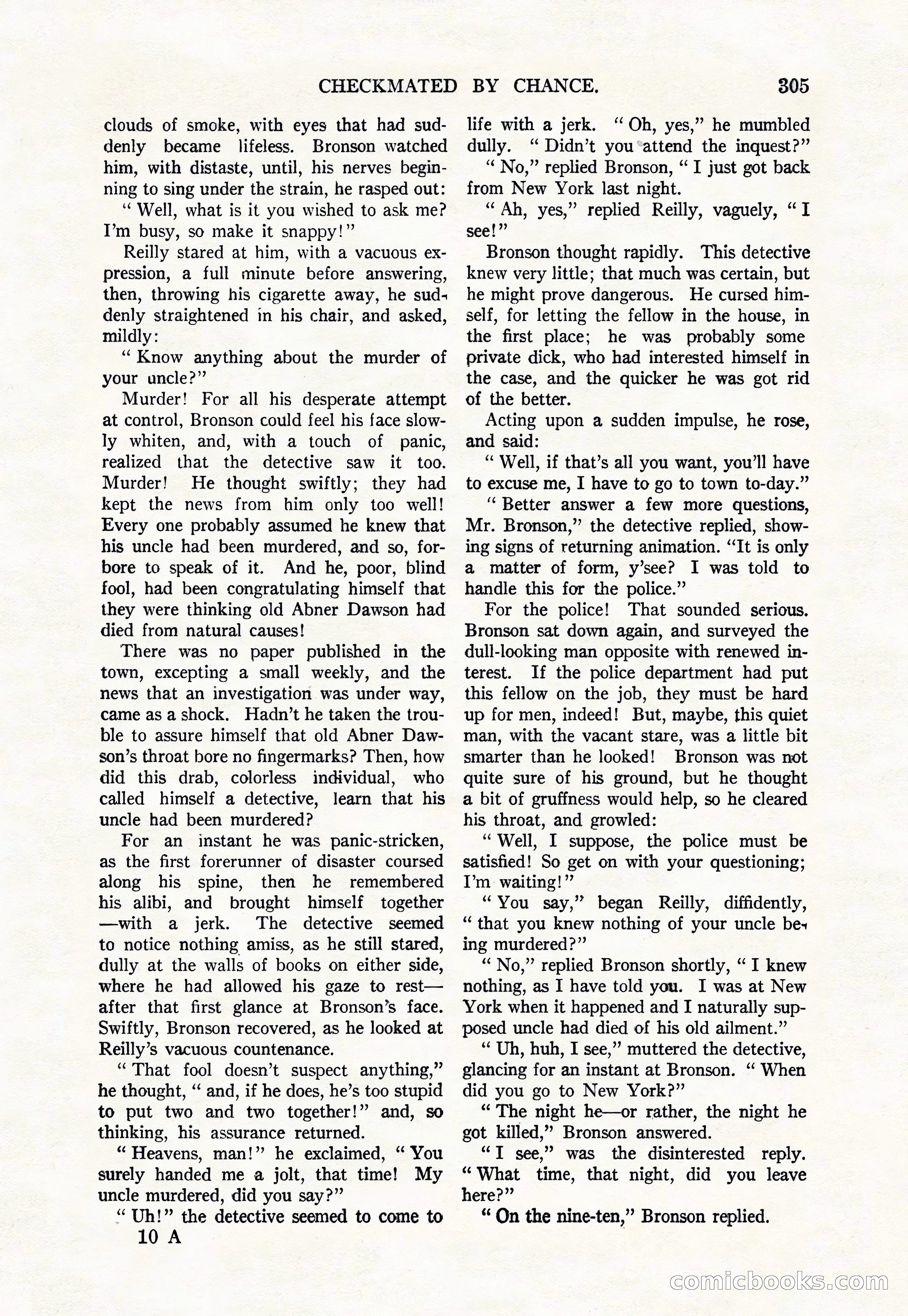
A restored page from Pulp Fiction, 1924. Page through the whole issue in the reader above.
📄 Transcribed text from this page (OCR, searchable)
Machine-transcribed from the original scan — historical spelling and the odd misread are preserved.
CHECKMATED BY CHANCE. clouds of smoke, with eyes that had sud- denly became lifeless. Bronson watched him, with distaste, until, his nerves begin- ning to sing under the strain, he rasped out: ‘“ Well, what is it you wished to ask me? I’m busy, so make it snappy!” Reilly stared at him, with a vacuous ex- pression, a full minute before answering, then, throwing his cigarette away, he sud- denly straightened in his chair, and asked, mildly: ‘Know anything about the murder of your uncle?” Murder! For all his desperate attempt at control, Bronson could feel his face slow- ly whiten, and, with a touch of panic, realized that the detective saw it too. Murder! He thought swiftly; they had kept the news from him only too well! Every one probably assumed he knew that his uncle had been murdered, and so, for- bore to speak of it. And he, poor, blind fool, had been congratulating himself that they were thinking old Abner Dawson had died from natural causes! There was no paper published in the town, excepting a small weekly, and the news that an investigation was under way, came as a shock. Hadn’t he taken the trou- ble to assure himself that old Abner Daw- son’s throat bore no fingermarks? Then, how did this drab, colorless individual, who called himself a detective, learn that his uncle had been murdered? For an instant he was panic-stricken, as the first forerunner of disaster coursed along his spine, then he remembered his alibi, and brought himself together —with a jerk. The detective seemed to notice nothing amiss, as he still stared, dully at the walls of books on either side, where he had allowed his gaze to rest— after that first glance at Bronson’s face. Swiftly, Bronson recovered, as he looked at Reilly’s vacuous countenance. “That fool doesn’t suspect anything,” he thought, “ and, if he does, he’s too stupid to put two and two together!” and, so thinking, his assurance returned. *“‘ Heavens, man!” he exclaimed, ‘“ You surely handed me a jolt, that time! My uncle murdered, did you say?” “Uh!” the detective seemed to come to 10 A 305 life with a jerk. ‘‘ Oh, yes,” he mumbled dully. ‘ Didn’t you°attend the inquest?” “No,” replied Bronson, “I just got back from New York last night. ‘“‘ Ah, yes,” replied Reilly, vaguely, “I see!” Bronson thought rapidly. This detective knew very little; that much was certain, but he might prove dangerous. He cursed him- self, for letting the fellow in the house, in the first place; he was probably some private dick, who had interested himself in the case, and the quicker he was got rid of the better. Acting upon a sudden impulse, he rose, and said: “ Well, if that’s all you want, you’ll have to excuse me, I have to go to town to-day.” ‘* Better answer a few more questions, Mr. Bronson,” the detective replied, show- ing signs of returning animation. “It is only a matter of form, y’see? I was told to handle this for the police.” For the police! That sounded serious. Bronson sat down again, and surveyed the dull-looking man opposite with renewed in- terest. If the police department had put this fellow on the job, they must be hard up for men, indeed! But, maybe, this quiet man, with the vacant stare, was a little bit smarter than he looked! Bronson was not quite sure of his ground, but he thought a bit of gruffness would help, so he cleared his throat, and growled: ‘‘' Well, I suppose, the police must be satisfied! So get on with your questioning; I’m waiting!” “You say,” began Reilly, diffidently, “that you knew nothing of your uncle be- ing murdered?”’ “No,” replied Bronson shortly, “ I knew nothing, as I have told you. I was at New York when it happened and I naturally sup- posed uncle had died of his old ailment.” ‘‘ Uh, huh, I see,’”’ muttered the detective, glancing for an instant at Bronson. ‘‘ When did you go to New York?” “The night he—or rather, the night he got killed,” Bronson answered. “TI see,” was the disinterested reply. “What time, that night, did you leave here?” “ On the nine-ten,” Bronson replied. GOMIGIOO S GO) nn