
Pulp Fiction, 1924 · page 163 of 172
Argosy All-Story Weekly, August 9, 1924 — page 163: what you’re looking at
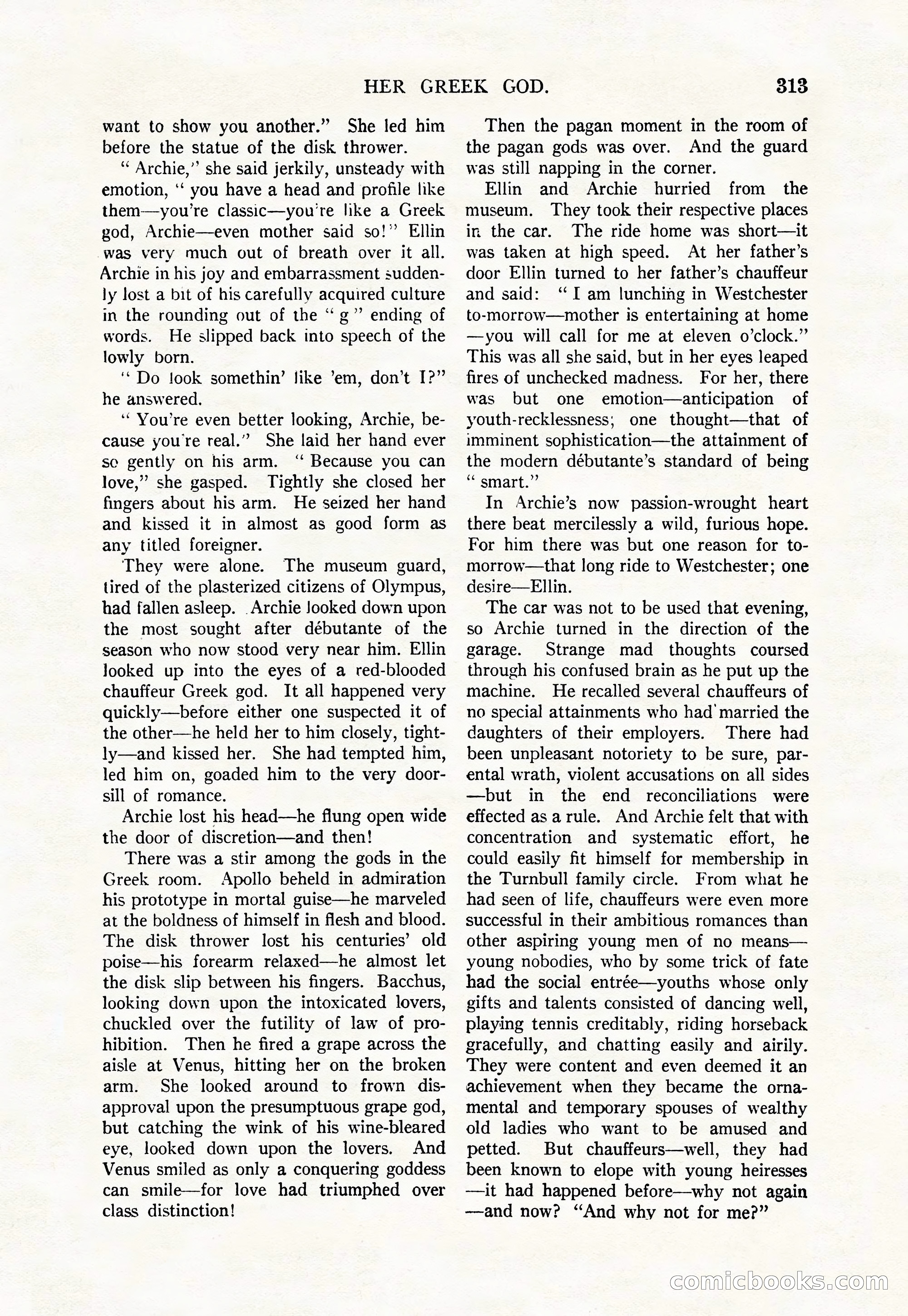
A restored page from Pulp Fiction, 1924. Page through the whole issue in the reader above.
📄 Transcribed text from this page (OCR, searchable)
Machine-transcribed from the original scan — historical spelling and the odd misread are preserved.
HER GREEK GOD. want to show you another.” She led him before the statue of the disk thrower. “ Archie,’’ she said jerkily, unsteady with emotion, ‘‘ you have a head and profile like them—you’re classic—you’re lke a Greek pod, Archie—even mother said so!” Ellin -was very much out of breath over it all. Archie in his joy and embarrassment sudden- ly lost a bit of his carefully acquired culture in the rounding out of the ‘“ g” ending of words. He slipped back into speech of the lowly born. ‘“ Do took somethin’ like ’em, don’t I?” he answered. ‘“ You’re even better looking, Archie, be- cause youre real.”’ She laid her hand ever sc gently on his arm. ‘“‘ Because you can love,” she gasped. Tightly she closed her fingers about his arm. He seized her hand and kissed it in almost as good form as any titled foreigner. They were alone. The museum guard, tired of the plasterized citizens of Olympus, had fallen asleep. Archie Jooked down upon the most sought after débutante of the season who now stood very near him. Ellin looked up into the eyes of a red-blooded chauffeur Greek god. It all happened very quickly—before either one suspected it of the other—he held her to him closely, tight- ly—and kissed her. She had tempted him, led him on, goaded him to the very door- sill of romance. Archie lost his head—he flung open wide the door of discretion—and then! There was a stir among the gods in the Greek room. Apollo beheld in admiration his prototype in mortal guise—he marveled at the boldness of himself in flesh and blood. The disk thrower lost his centuries’ old poise—his forearm relaxed—he almost let the disk slip between his fingers. Bacchus, looking down upon the intoxicated lovers, chuckled over the futility of law of pro- hibition. Then he fired a grape across the aisle at Venus, hitting her on the broken arm. She looked around to frown dis- approval upon the presumptuous grape god, but catching the wink of his wine-bleared eye, looked down upon the lovers. And Venus smiled as only a conquering goddess can smile—for love had triumphed over class distinction! o13 Then the pagan moment in the room of the pagan gods was over. And the guard was still napping in the corner. Ellin and Archie hurried from the museum. They took their respective places in the car. The ride home was short—it was taken at high speed. At her father’s door Ellin turned to her father’s chauffeur and said: ‘‘ I am lunching in Westchester to-morrow—mother is entertaining at home —you will call for me at eleven o’clock.” This was all she said, but in her eyes leaped fires of unchecked madness. For her, there was but one emotion—anticipation of youth-recklessness; one thought—that of imminent sophistication—the attainment of the modern débutante’s standard of being “smart.” In Archie’s now passion-wrought heart there beat mercilessly a wild, furious hope. For him there was but one reason for to- morrow—that long ride to Westchester; one desire—FEllin. The car was not to be used that evening, so Archie turned in the direction of the garage. Strange mad thoughts coursed through his confused brain as he put up the machine. He recalled several chauffeurs of no special attainments who had married the daughters of their employers. There had been unpleasant notoriety to be sure, par- ental wrath, violent accusations on all sides —but in the end reconciliations were effected asarule. And Archie felt that with concentration and systematic effort, he could easily fit himself for membership in the Turnbull family circle. From what he had seen of life, chauffeurs were even more successful in their ambitious romances than other aspiring young men of no means— young nobodies, who by some trick of fate had the social entrée—youths whose only gifts and talents consisted of dancing well, playing tennis creditably, riding horseback gracefully, and chatting easily and airily. They were content and even deemed it an achievement when they became the orna- mental and temporary spouses of wealthy old ladies who want to be amused and petted. But chauffeurs—well, they had been known to elope with young heiresses —it had happened before—why not again -—and now? “And why not for me?” Conn CloOolkK