
Pulp Fiction, 1924 · page 164 of 172
Argosy All-Story Weekly, August 9, 1924 — page 164: what you’re looking at
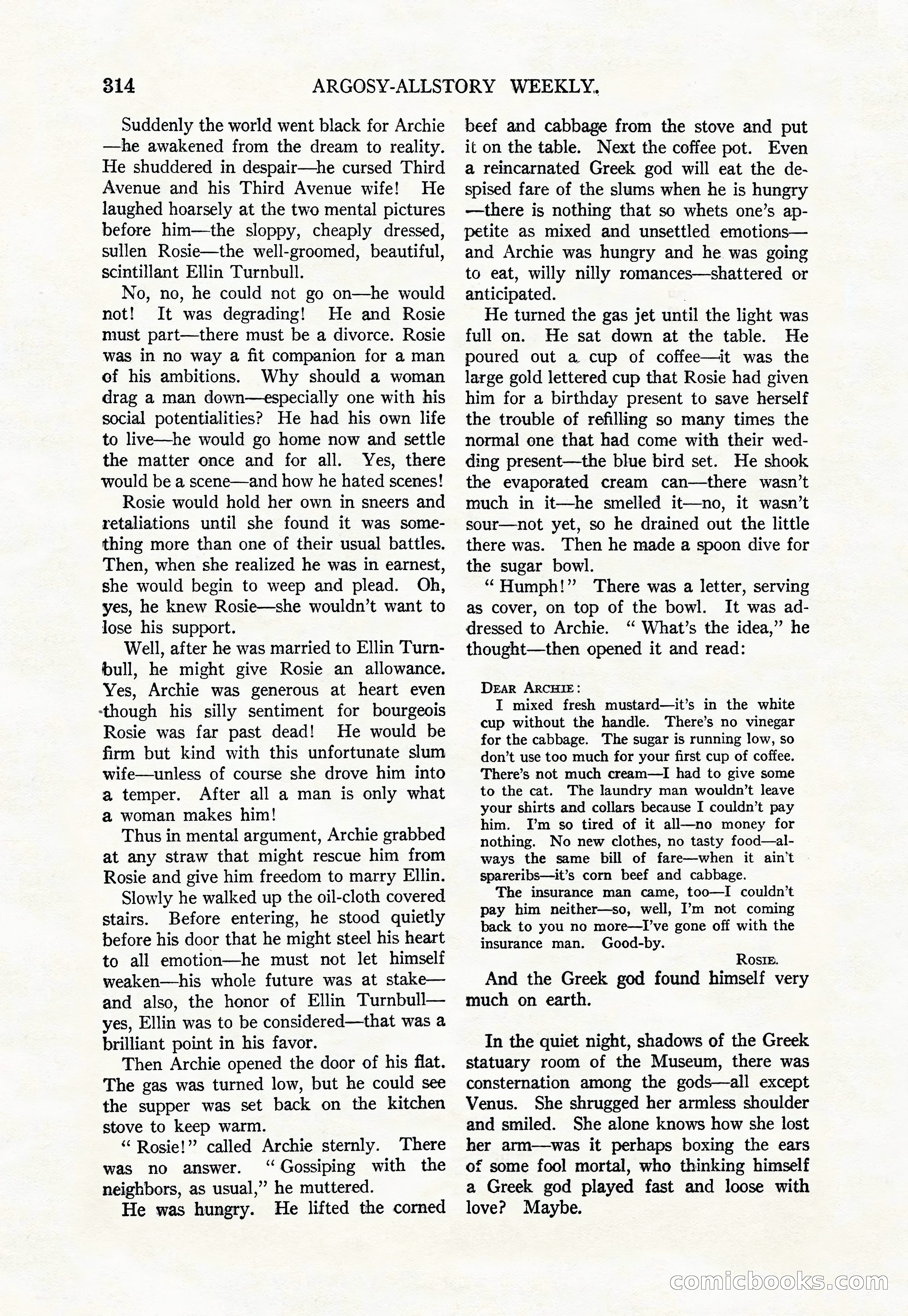
A restored page from Pulp Fiction, 1924. Page through the whole issue in the reader above.
📄 Transcribed text from this page (OCR, searchable)
Machine-transcribed from the original scan — historical spelling and the odd misread are preserved.
314 Suddenly the world went black for Archie —he awakened from the dream to reality. He shuddered in despair—he cursed Third Avenue and his Third Avenue wife! He laughed hoarsely at the two mental pictures before him—the sloppy, cheaply dressed, sullen Rosie—the well-groomed, beautiful, scintillant Ellin Turnbull. No, no, he could not go on—he would not! It was degrading! He and Rosie must part—there must be a divorce. Rosie Was in no way a fit companion for a man of his ambitions. Why should a woman drag a man down—especially one with his social potentialities? He had his own life to live—he would go home now and settle the matter once and for all. Yes, there would be a scene—and how he hated scenes! Rosie would hold her own in sneers and retaliations until she found it was some- thing more than one of their usual battles. Then, when she realized he was in earnest, she would begin to weep and plead. Oh, yes, he knew Rosie—she wouldn’t want to lose his support. Well, after he was married to Ellin Turn- bull, he might give Rosie an allowance. Yes, Archie was generous at heart even -though his silly sentiment for bourgeois Rosie was far past dead! He would be firm but kind with this unfortunate slum wife—unless of course she drove him into a temper. After all a man is only what a@ woman makes him! Thus in mental argument, Archie grabbed at any straw that might rescue him from Rosie and give him freedom to marry Ellin. Slowly he walked up the oil-cloth covered stairs. Before entering, he stood quietly before his door that he might steel his heart to all emotion—he must not let himself weaken—his whole future was at stake— and also, the honor of Ellin Turnbull— yes, Ellin was to be considered—that was a brilliant point in his favor. Then Archie opened the door of his flat. The gas was turned low, but he could see the supper was set back on the kitchen stove to keep warm. “ Rosie!” called Archie sternly. There was no answer. ‘Gossiping with the neighbors, as usual,” he muttered. He was hungry. He lifted the corned ARGOSY-ALLSTORY WEEKLY. beef and cabbage from the stove and put it on the table. Next the coffee pot. Even a reincarnated Greek god will eat the de- spised fare of the slums when he is hungry —there is nothing that so whets one’s ap- petite as mixed and unsettled emotions— and Archie was hungry and he was going to eat, willy nilly romances—shattered or anticipated. 7 He turned the gas jet until the light was full on. He sat down at the table. He poured out a cup of coffee—it was the large gold lettered cup that Rosie had given him for a birthday present to save herself the trouble of refilling so many times the normal one that had come with their wed- ding present—the blue bird set. He shook the evaporated cream can—there wasn’t much in it—he smelled it—no, it wasn’t sour—not yet, so he drained out the little there was. Then he made a spoon dive for the sugar bowl. ““Humph!” There was a letter, serving as cover, on top of the bowl. It was ad- dressed to Archie. ‘ What’s the idea,” he thought—then opened it and read: DEAR ARCHIE: I mixed fresh mustard—it’s in the white cup without the handle. There’s no vinegar for the cabbage. The sugar is running low, so don’t use too much for your first cup of coffee. There’s not much cream—I had to give some to the cat. The laundry man wouldn’t leave your shirts and collars because I couldn’t pay him. I’m so tired of it all—no money for nothing. No new clothes, no tasty food—al- ways the same bill of fare—when it ain't spareribs—it’s corn beef and cabbage. The insurance man came, too—I couldn’t pay him neither—so, well, I’m not coming back to you no more—I’ve gone off with the insurance man. Good-by. ROsIE. And the Greek god found himself very much on earth. In the quiet night, shadows of the Greek statuary room of the Museum, there was consternation among the gods—all except Venus. She shrugged her armless shoulder and smiled. She alone knows how she lost her arm—was it perhaps boxing the ears of some fool mortal, who thinking himself a Greek god played fast and loose with lover Maybe. CoOnmnicloookKs (CO