
Pulp Fiction, 1924 · page 12 of 172
Argosy All-Story Weekly, October 25, 1924 — page 12: what you’re looking at
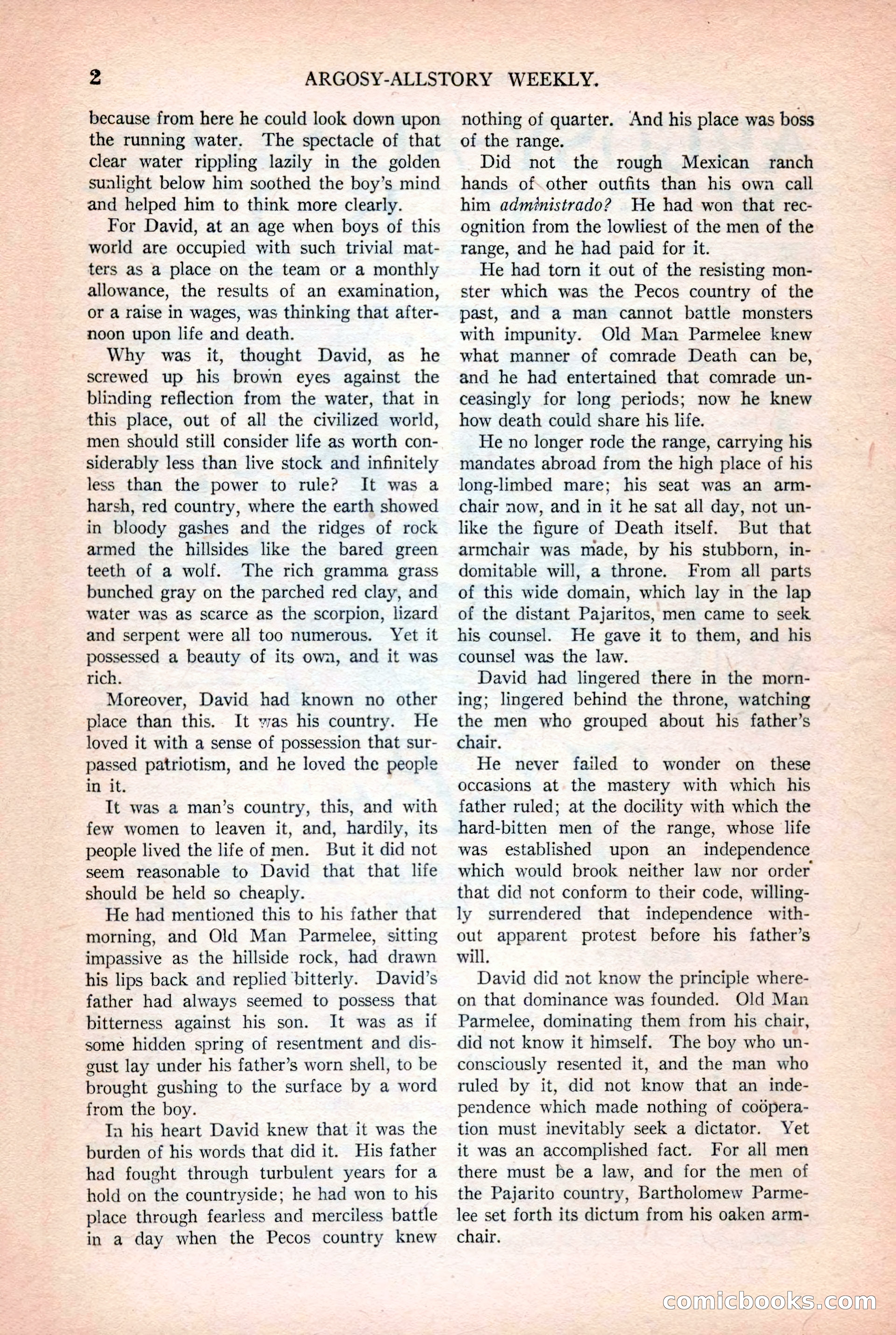
A restored page from Pulp Fiction, 1924. Page through the whole issue in the reader above.
📄 Transcribed text from this page (OCR, searchable)
Machine-transcribed from the original scan — historical spelling and the odd misread are preserved.
2 ARGOSY-ALLSTORY WEEKLY. because from here he could look down upon the running water. The spectacle of that clear water rippling lazily in the golden sunlight below him soothed the boy’s mind and helped him to think more clearly. For David, at an age when boys of this world are occupied with such trivial mat- ters as a place on the team or a monthly allowance, the results of an examination, or a raise in wages, was thinking that after- noon upon life and death. Why was it, thought David, as he screwed up his brown eyes against the blinding reflection from the water, that in this place, out of all the civilized world, men should still consider life as worth con- siderably less than live stock and infinitely less than the power to rule? It was a harsh, red country, where the earth showed in bloody gashes and the ridges of rock armed the hillsides like the bared green teeth of a wolf. The rich gramma grass bunched gray on the parched red clay, and water was as scarce as the scorpion, lizard and serpent were all too numerous. Yet it possessed a beauty of its own, and it was rich. Moreover, David had known no other place than this. It vas his country. He loved it with a sense of possession that sur- passed patriotism, and he loved the people in it. It was a man’s country, this, and with few women to leaven it, and, hardily, its people lived the life of men. But it did not seem reasonable to David that that life should be held so cheaply. He had mentioned this to his father that morning, and Old Man Parmelee, sitting impassive as the hillside rock, had drawn his lips back and replied bitterly. David’s father had always seemed to possess that bitterness against his son. It was as if some hidden spring of resentment and dis- eust lay under his father’s worn shell, to be brought gushing to the surface by a word from the boy. Ta his heart David knew that it was the burden of his words that did it. His father had fought through turbulent years for a hold on the countryside; he had won to his place through fearless and merciless battle in a day when the Pecos country knew nothing of quarter. And his place was boss of the range. Did not the rough Mexican ranch hands of.other outfits than his owa call him administrado? We had won that rec- ognition from the lowliest of the men of the range, and he had paid for it. He had torn it out of the resisting mon- ster which was the Pecos country of the past, and a man cannot battle monsters with impunity. Old Man Parmelee knew what manner of comrade Death can be, and he had entertained that comrade un- ceasingly for long periods; now he knew how death could share his life. He no longer rode the range, carrying his mandates abroad from the high place of his long-limbed mare; his seat was an arm- chair now, and in it he sat all day, not un- like the figure of Death itself. But that armchair was made, by his stubborn, in- domitable will, a throne. From all parts of this wide domain, which lay in the lap of the distant Pajaritos, men came to seek his counsel. He gave it to them, and his counsel was the law. David had lingered there in the morn- ing; lingered behind the throne, watching the men who grouped about his father’s chair. He never failed to wonder on these occasions at the mastery with which his father ruled; at the docility with which the hard-bitten men of the range, whose life was established upon an _ independence which would brook neither law nor order that did not conform to their code, willing- ly surrendered that independence with- out apparent protest before his father’s will. David did not know the principle where- on that dominance was founded. Old Man Parmelee, dominating them from his chair, did not know it himself. The boy who un- consciously resented it, and the man who ruled by it, did not know that an inde- pendence which made nothing of coopera- tion must inevitably seek a dictator. Yet it was an accomplished fact. For all men there must be a law, and for the men of the Pajarito country, Bartholomew Parme- lee set forth its dictum from his oaken arm- chair. GomiGcbdooks (C@