
Pulp Fiction, 1924 · page 13 of 172
Argosy All-Story Weekly, October 25, 1924 — page 13: what you’re looking at
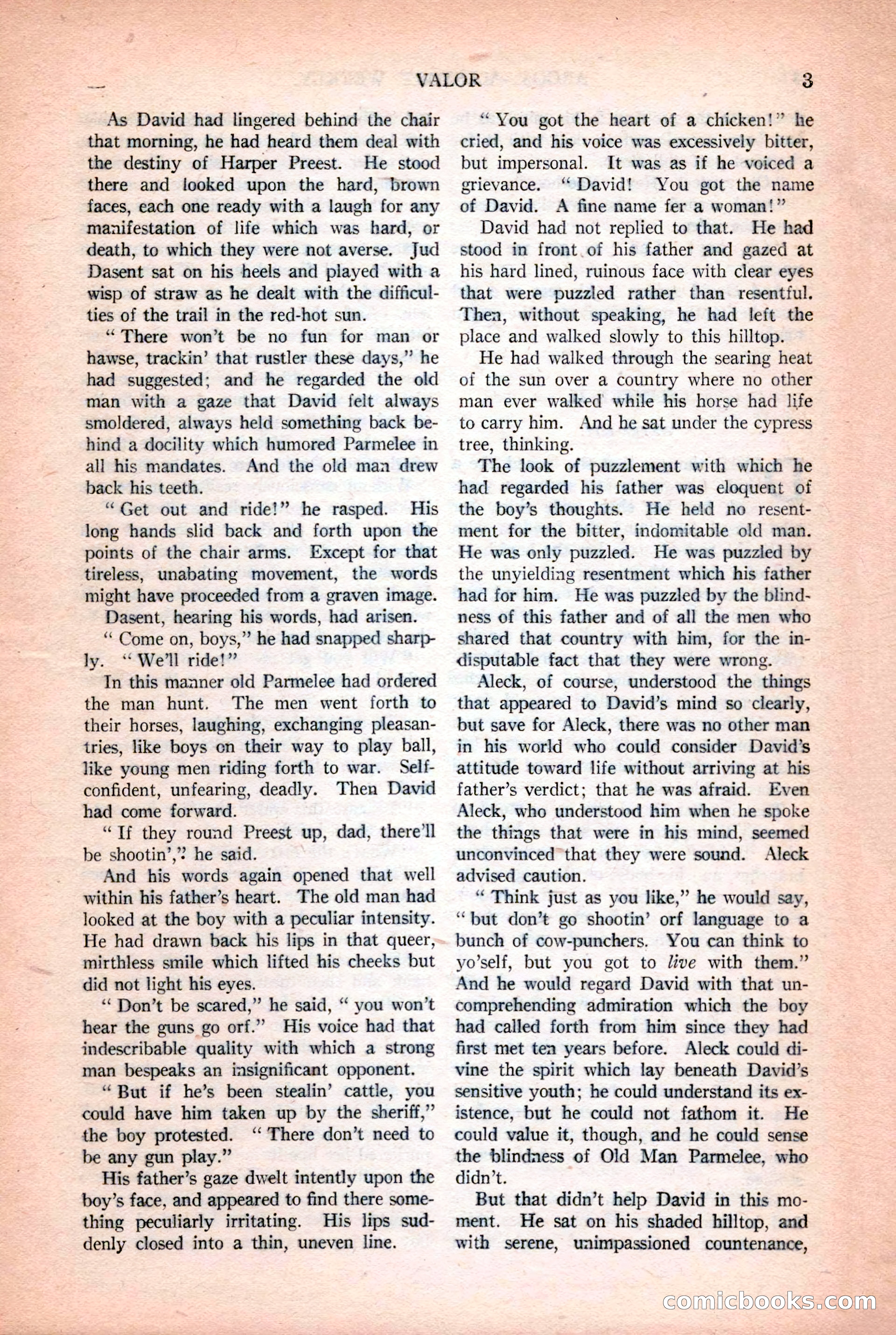
A restored page from Pulp Fiction, 1924. Page through the whole issue in the reader above.
📄 Transcribed text from this page (OCR, searchable)
Machine-transcribed from the original scan — historical spelling and the odd misread are preserved.
-—— As David had lingered behind the chair that morning, he had heard them deal with the destiny of Harper Preest. He stood there and looked upon the hard, brown faces, each one ready with a laugh for any manifestation of life which was hard, or death, to which they were not averse. Jud Dasent sat on his heels and played with a wisp of straw as he dealt with the difficul- ties of the trail in the red-hot sun. “There won’t be no fun for man or hawse, trackin’ that rustler these days,” he had suggested; and he regarded the old man with a gaze that David felt always smoldered, always held something back be- hind a docility which humored Parmelee in all his mandates. And the old man drew back his teeth. “Get out and ride!” he rasped. His long hands slid back and forth upon the points of the chair arms. Except for that tireless, unabating movement, the words might have proceeded from a graven image. Dasent, hearing his words, had arisen. “ Come on, boys,” he had snapped sharp- ly. ‘‘ We'll ride!” In this manner old Parmelee had ordered the man hunt. The men went forth to their horses, laughing, exchanging pleasan- tries, like boys on their way to play ball, like young men riding forth to war. Self- confident, unfearing, deadly. Then David had come forward. “Tf they round Preest up, dad, there'll be shootin’, he said. And his words again opened that well within his father’s heart. The old man had looked at the boy with a peculiar intensity. He had drawn back his lips in that queer, mirthless smile which lifted his cheeks but did not light his eyes. ‘Don’t be scared,” he said, “ you won’t hear the guns go orf.” His voice had that indescribable quality with which a strong man bespeaks an insignificant opponent. “But if he’s been stealin’ cattle, you could have him taken up by the sheriff,” the boy protested. ‘‘ There don’t need to be any gun play.” His father’s gaze dwelt intently upon the boy’s face, and appeared to find there some- thing peculiarly irritating. His lips sud- denly closed into a thin, uneven line. VALOR : 3 “You got the heart of a chicken!” he cried, and his voice was excessively bitter, but impersonal. It was as if he voiced a grievance. “ David! You got the name of David. A fine name fer a woman!” David had not replied to that. He had stood in front.of his father and gazed at his hard lined, ruinous face with clear eyes that were puzzled rather than resentful. Then, without speaking, he had left the place and walked slowly to this hilltop. He had walked through the searing heat of the sun over a country where no other man ever walked while his horse had life to carry him. And he sat under the cypress tree, thinking. The look of puzzlement with which he had regarded his father was eloquent of the boy’s thoughts. He held no resent- ment for the bitter, indomitable old man. He was only puzzled. He was puzzled by the unyielding resentment which his father had for him. He was puzzled by the blind- ness of this father and of all the men who shared that country with him, for the in- disputable fact that they were wrong. Aleck, of course, understood the things that appeared to David’s mind so clearly, but save for Aleck, there was no other man in his world who could consider David’s attitude toward life without arriving at his father’s verdict; that he was afraid. Even Aleck, who understood him when he spoke the things that were in his mind, seemed unconvinced that they were sound. Aleck advised caution. “Think just as you like,” he would say, ‘but don’t go shootin’ orf language to a bunch of cow-punchers. You can think to yo’self, but you got to live with them.” And he would regard David with that un- comprehending admiration which the boy had called forth from him since they had first met ten years before. Aleck could di- vine the spirit which lay beneath David’s sensitive youth; he could understand its ex- istence, but he could not fathom it. He could value it, though, and he could sense the blindness of Old Man Parmelee, who didn’t. But that didn’t help David in this mo- ment. He sat on his shaded hilltop, and with serene, unimpassioned countenance, COMMICLOOOKS (E@)