
Pulp Fiction, 1924 · page 160 of 172
Argosy All-Story Weekly, October 25, 1924 — page 160: what you’re looking at
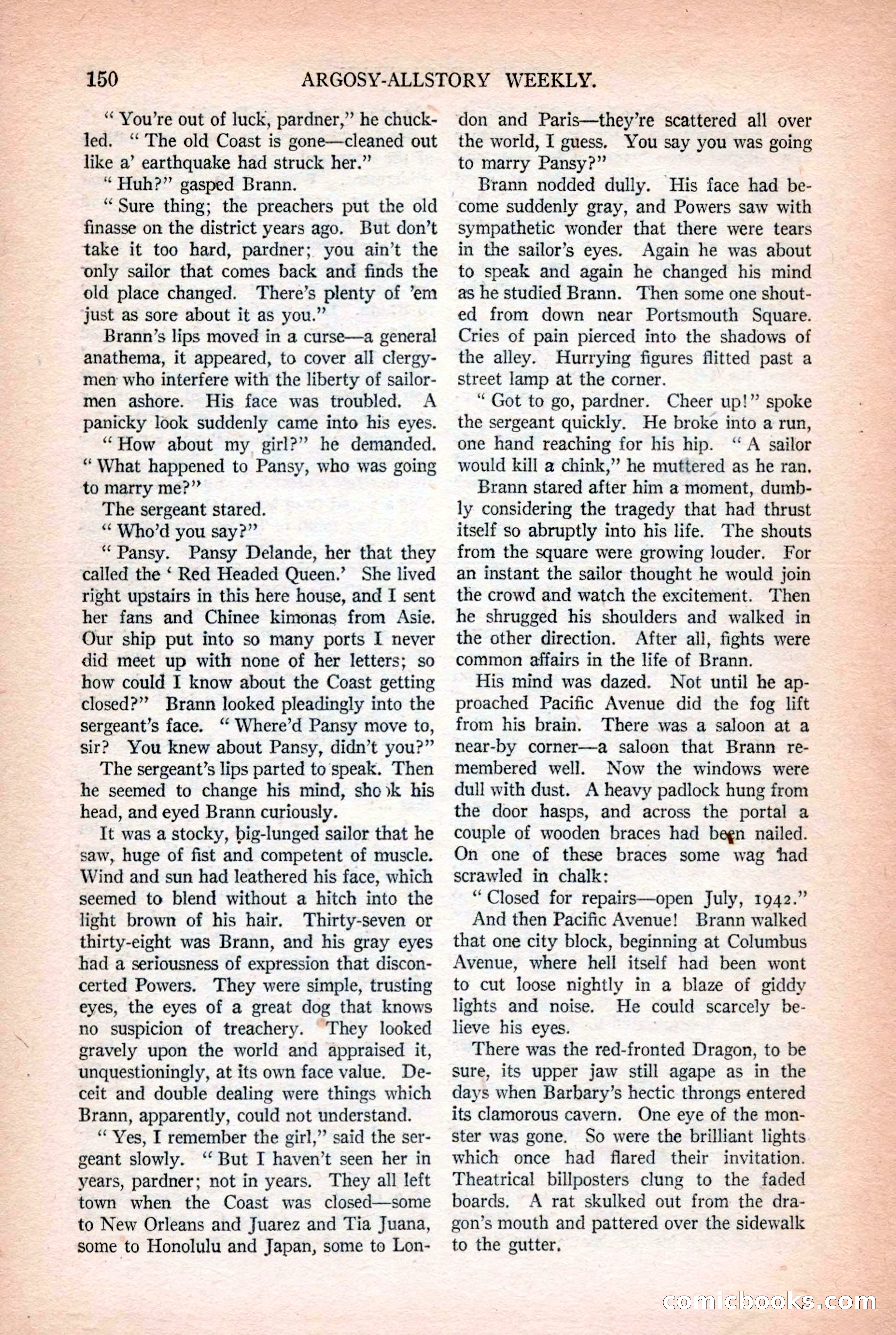
A restored page from Pulp Fiction, 1924. Page through the whole issue in the reader above.
📄 Transcribed text from this page (OCR, searchable)
Machine-transcribed from the original scan — historical spelling and the odd misread are preserved.
150 “You’re out of luck, pardner,” he chuck- led. ‘‘ The old Coast is gone—cleaned out like a’ earthquake had struck her.” “ Huh?” gasped Brann. “Sure thing; the preachers put the old finasse on the district years ago. But don’t take it too hard, pardner; you ain’t the only sailor that comes back and finds the old place changed. There’s plenty of ’em just as sore about it as you.” Brann’s lips moved in a curse—a general anathema, it appeared, to cover all clergy- men who interfere with the liberty of sailor- men ashore. His face was troubled. A panicky look suddenly came into his eyes. “How about my girl?” he demanded. “ What happened to Pansy, who was going to marry me?” The sergeant stared. * Who’d you say?” “Pansy. Pansy Delande, her that they called the ‘ Red Headed Queen.’ She lived right upstairs in this here house, and I sent her fans and Chinee kimonas from Asie. Our ship put into so many ports I never did meet up with none of her letters; so how could I know about the Coast getting closed?”” Brann looked pleadingly into the sergeant’s face. ‘“ Where’d Pansy move to, sir? You knew about Pansy, didn’t you?” The sergeant’s lips parted to speak. Then he seemed to change his mind, sho k his head, and eyed Brann curiously. It was a stocky, big-lunged sailor that he saw, huge of fist and competent of muscle. Wind and sun had leathered his face, which seemed to blend without a hitch into the light brown of his hair. Thirty-seven or thirty-eight was Brann, and his gray eyes had a seriousness of expression that discon- certed Powers. They were simple, trusting eyes, the eyes of a great dog that knows no suspicion of treachery. ‘They looked gravely upon the world and appraised it, unquestioningly, at its own face value. De- ceit and double dealing were things which Brann, apparently, could not understand. “Yes, I remember the girl,” said the ser- geant slowly. ‘“‘ But I haven’t seen her in years, pardner; not in years. They all left town when the Coast was closed—some to New Orleans and Juarez and Tia Juana, some to Honolulu and Japan, some to Lon- ARGOSY-ALLSTORY WEEKLY. don and Paris—they’re scattered all over the world, I guess. You say you was going to marry Pansy?” Brann nodded dully. His face had be- come suddenly gray, and Powers saw with sympathetic wonder that there were tears in the sailor’s eyes. Again he was about to speak and again he changed his mind as he studied Brann. Then some one shout- ed from down near Portsmouth Square. Cries of pain pierced into the shadows of the alley. Hurrying figures flitted past a Street lamp at the corner. “ Got to go, pardner. Cheer up!” spoke the sergeant quickly. He broke into a run, one hand reaching for his hip. “<A sailor would kill a chink,” he muttered as he ran. Brann stared after him a moment, dumb- ly considering the tragedy that had thrust itself so abruptly into his life. The shouts from the square were growing louder. For an instant the sailor thought he would join the crowd and watch the excitement. Then he shrugged his shoulders and walked in the other direction. After all, fights were common affairs in the life of Brann. His mind was dazed. Not until he ap- proached Pacific Avenue did the fog lift from his brain. There was a saloon at a near-by corner—a saloon that Brann re- membered well. Now the windows were dull with dust. A heavy padlock hung from the door hasps, and across the portal a couple of wooden braces had begn nailed. On one of these braces some wag ‘had scrawled in chalk: “Closed for repairs—open July, 1942.” And then Pacific Avenue! Brann walked that one city block, beginning at Columbus Avenue, where hell itself had been wont to cut loose nightly in a blaze of giddy lights and noise. He could scarcely be- lieve his eyes. There was the red-fronted Dragon, to be sure, its upper jaw still agape as in the days when Barbary’s hectic throngs entered its clamorous cavern. One eye of the mon- ster was gone. So were the brilliant lights which once had flared their invitation. Theatrical billposters clung to the faded boards. A rat skulked out from the dra- gon’s mouth and pattered over the sidewalk to the gutter. COMmMicloooks (E@)