
Pulp Fiction, 1924 · page 161 of 172
Argosy All-Story Weekly, October 25, 1924 — page 161: what you’re looking at
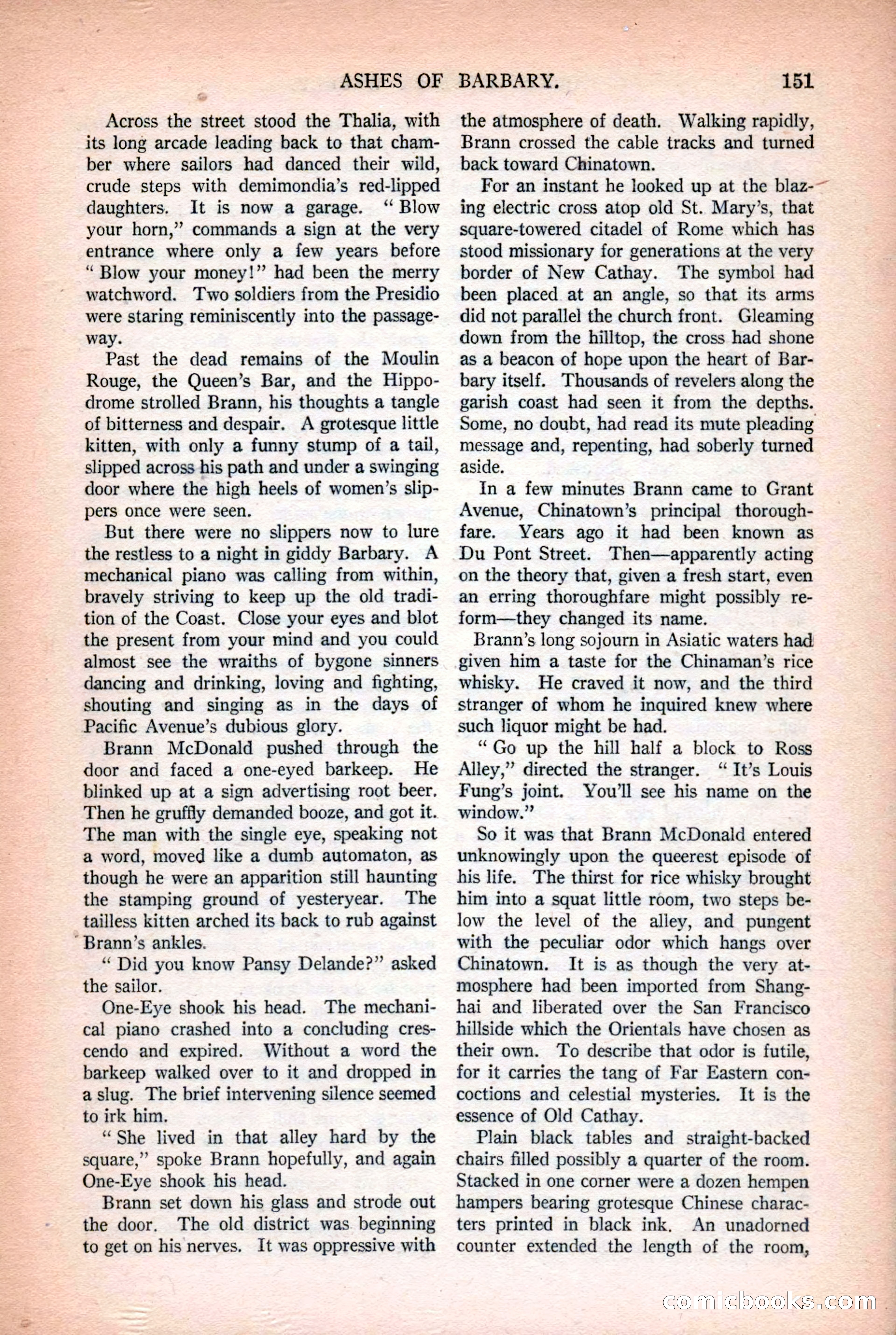
A restored page from Pulp Fiction, 1924. Page through the whole issue in the reader above.
📄 Transcribed text from this page (OCR, searchable)
Machine-transcribed from the original scan — historical spelling and the odd misread are preserved.
y ASHES OF Across the street stood the Thalia, with its long arcade leading back to that cham- ber where sailors had danced their wild, crude steps with demimondia’s red-lipped daughters. It is now a garage. “ Blow your horn,” commands a sign at the very entrance where only a few years before ‘“ Blow your money!” had been the merry watchword. Two soldiers from the Presidio were staring reminiscently into the passage- way. Past the dead remains of the Moulin Rouge, the Queen’s Bar, and the Hippo- drome strolled Brann, his thoughts a tangle of bitterness and despair. A grotesque little kitten, with only a funny stump of a tail, slipped across his path and under a swinging door where the high heels of women’s slip- pers once were seen. But there were no slippers now to lure the restless to a night in giddy Barbary. A mechanical piano was calling from within, bravely striving to keep up the old tradi- tion of the Coast. Close your eyes and blot the present from your mind and you could almost see the wraiths of bygone sinners dancing and drinking, loving and fighting, shouting and singing as in the days of Pacific Avenue’s dubious glory. Brann McDonald pushed through the door and faced a one-eyed barkeep. He blinked up at a sign advertising root beer. Then he gruffly demanded booze, and got it. The man with the single eye, speaking not a word, moved like a dumb automaton, as though he were an apparition still haunting the stamping ground of yesteryear. The tailless kitten arched its back to rub against. ’ Brann’s ankles. “ Did you know Pansy Delande?” asked the sailor. One-Eye shook his head. The mechani- cal piano crashed into a concluding cres- cendo and expired. Without a word the barkeep walked over to it and dropped in a slug. The brief intervening silence seemed to irk him. “She lived in that alley hard by the square,” spoke Brann hopefully, and again One-Eye shook his head. Brann set down his glass and strode out the door. The old district was beginning to get on his nerves. It was oppressive with 151 the atmosphere of death. Walking rapidly, Brann crossed the cable tracks and turned back toward Chinatown. BARBARY. For an instant he looked up at the blaz-— ing electric cross atop old St. Mary’s, that square-towered citadel of Rome which has stood missionary for generations at the very border of New Cathay. The symbol had been placed at an angle, so that its arms did not parallel the church front. Gleaming down from the hilltop, the cross had shone as a beacon of hope upon the heart of Bar- bary itself. Thousands of revelers along the garish coast had seen it from the depths. Some, no doubt, had read its mute pleading message and, repenting, had soberly turned aside. In a few minutes Brann came to Grant Avenue, Chinatown’s principal thorough- fare. Years ago it had been known as Du Pont Street. Then—apparently acting on the theory that, given a fresh start, even an erring thoroughfare might possibly re- form—they changed its name. Brann’s long sojourn in Asiatic waters had given him a taste for the Chinaman’s rice whisky. He craved it now, and the third stranger of whom he inquired knew where such liquor might be had. “Go up the hill half a block to Ross Alley,” directed the stranger. “ It’s Louis Fung’s joint. You'll see his name on the window.” So it was that Brann McDonald entered unknowingly upon the queerest episode of his life. The thirst for rice whisky brought him into a squat little room, two steps be- low the level of the alley, and pungent with the peculiar odor which hangs over Chinatown. It is as though the very at- mosphere had been imported from Shang- hai and liberated over the San Francisco hillside which the Orientals have chosen as their own. To describe that odor is futile, for it carries the tang of Far Eastern con- coctions and celestial mysteries. It is the essence of Old Cathay. Plain black tables and straight-backed chairs filled possibly a quarter of the room. Stacked in one corner were a dozen hempen hampers bearing grotesque Chinese charac- ters printed in black ink, An unadorned counter extended the length of the room, COMICMOoolks (C@ | tas ryt