
Pulp Fiction, 1925 · page 98 of 172
Argosy All-Story Weekly, April 18, 1925 — page 98: what you’re looking at
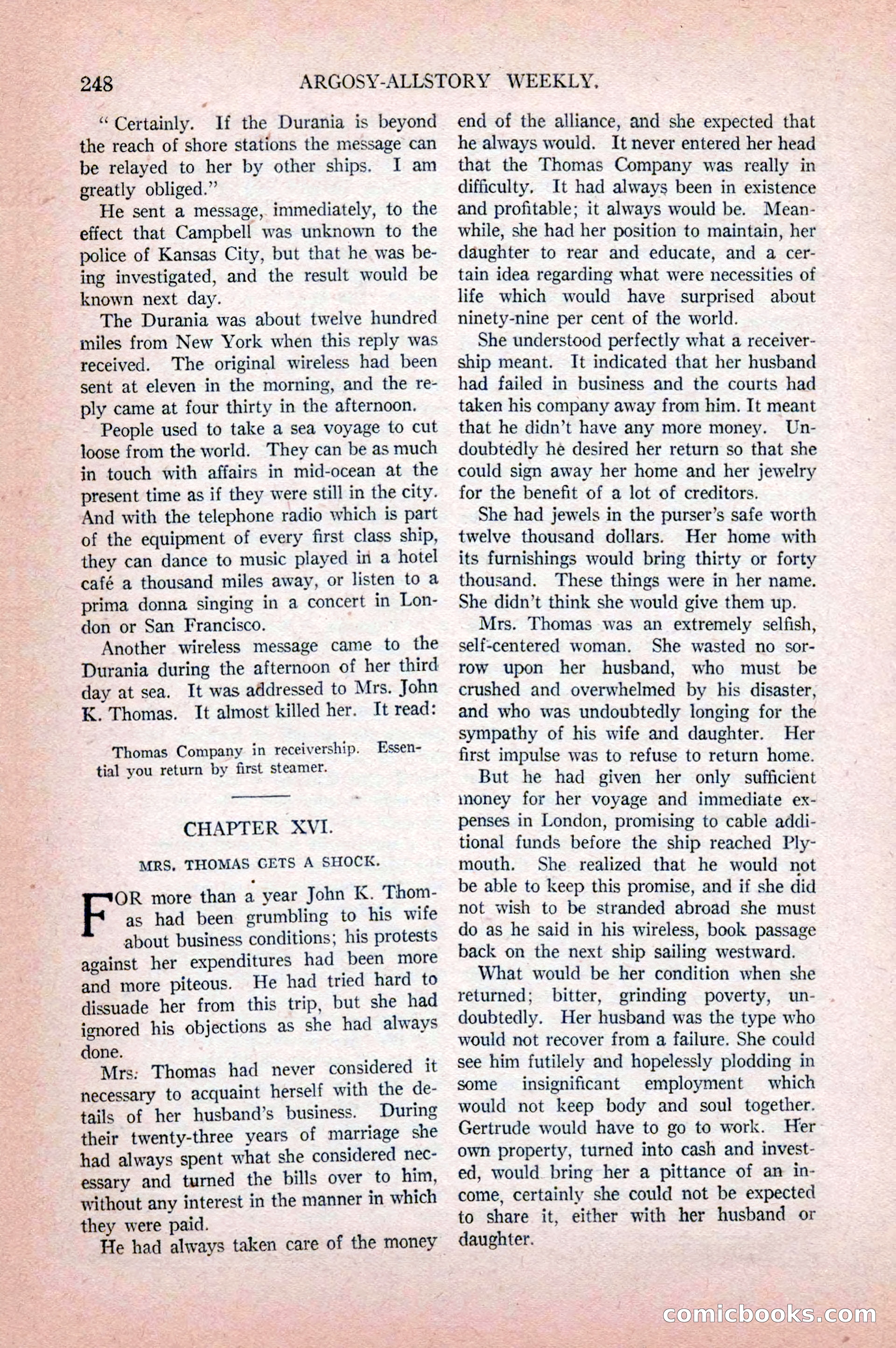
A restored page from Pulp Fiction, 1925. Page through the whole issue in the reader above.
📄 Transcribed text from this page (OCR, searchable)
Machine-transcribed from the original scan — historical spelling and the odd misread are preserved.
248 “Certainly. If the Durania is beyond the reach of shore stations the message can be relayed to her by other ships. I am greatly obliged.” He sent a message, immediately, to the effect that Campbell was unknown to the police of Kansas City, but that he was be- ing investigated, and the result would be known next day. The Durania was about twelve hundred miles from New York when this reply was received. The original wireless had been sent at eleven in the morning, and the re- ply came at four thirty in the afternoon. People used to take a sea voyage to cut loose from the world. They can be as much in touch with affairs in mid-ocean at the present time as if they were still in the city. And with the telephone radio which is part of the equipment of every first class ship, they can dance to music played in a hotel café a thousand miles away, or listen to a prima donna singing in a concert in Lon- don or San Francisco. Another wireless message came to the Durania during the afternoon of her third day at sea. It was addressed to Mrs. John K. Thomas. It almost killed her. It read: Thomas Company in receivership. Essen- tial you return by first steamer. CHAPTER XVI. MRS, THOMAS GETS A SHOCK. OR more than a year John K. Thom- as had been grumbling to his wife about business conditions; his protests against her expenditures had been more and more piteous. He had tried hard to dissuade her from this trip, but she had ignored his objections as she had always done. Mrs: Thomas had never considered it necessary to acquaint herself with the de- tails of her husband’s business. During their twenty-three years of marriage she had always spent what she considered nec- essary and turned the bills over to him, without any interest in the manner in which they were paid. He had always taken care of the money ARGOSY-ALLSTORY WEEKLY, end of the alliance, and she expected that he always would. It never entered her head that the Thomas Company was really in difficulty, It had always been in existence and profitable; it always would be. Mean- while, she had her position to maintain, her daughter to rear and educate, and a cer- tain idea regarding what were necessities of life which would have surprised about ninety-nine per cent of the world. She understood perfectly what a receiver- ship meant. It indicated that her husband had failed in business and the courts had taken his company away from him. It meant that he didn’t have any more money. Un- doubtedly he desired her return so that she could sign away her home and her jewelry for the benefit of a lot of creditors. She had jewels in the purser’s safe worth twelve thousand dollars. Her home with its furnishings would bring thirty or forty thousand. These things were in her name. She didn’t think she would give them up. Mrs. Thomas was an extremely selfish, self-centered woman. She wasted no sor- row upon her husband, who must be crushed and overwhelmed by his disaster, and who was undoubtedly longing for the sympathy of his wife and daughter. Her first impulse was to refuse to return home. But he had given her only sufficient inoney for her voyage and immediate ex- penses in London, promising to cable addi- tional funds before the ship reached Ply- mouth. She realized that he would not be able to keep this promise, and if she did not wish to be stranded abroad she must do as he said in his wireless, book passage back on the next ship sailing westward. What would be her condition when she returned; bitter, grinding poverty, wun- doubtedly. Her husband was the type who would not recover from a failure. She could see him futilely and hopelessly plodding in some insignificant employment which would not keep body and soul together. Gertrude would have to go to work. Her own property, turned into cash and invest- ed, would bring her a pittance of an in- come, certainly she could not be expected to share it, either with her husband or daughter. (E(0) DOOKS (E(0)