
Pulp Fiction, 1925 · page 99 of 172
Argosy All-Story Weekly, April 18, 1925 — page 99: what you’re looking at
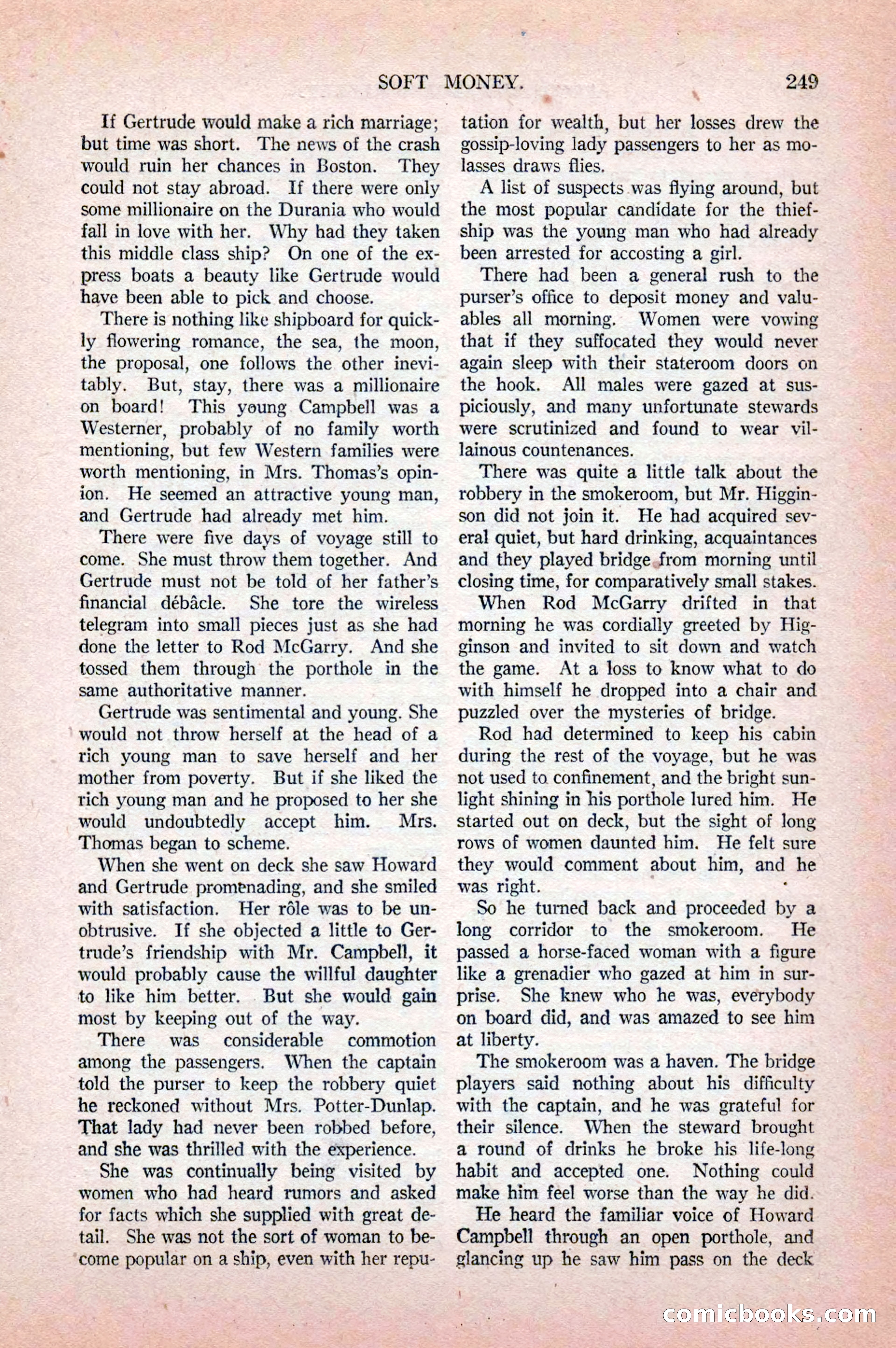
A restored page from Pulp Fiction, 1925. Page through the whole issue in the reader above.
📄 Transcribed text from this page (OCR, searchable)
Machine-transcribed from the original scan — historical spelling and the odd misread are preserved.
SOFT MONEY. If Gertrude would make a rich marriage; but time was short. The news of the crash would ruin her chances in Boston. They could not stay abroad. If there were only some millionaire on the Durania who would fall in love with her. Why had they taken this middle class ship? On one of the ex- press boats a beauty like Gertrude would have been able to pick and choose. There is nothing like shipboard for quick- ly flowering romance, the sea, the moon, the proposal, one follows the other inevi- tably. But, stay, there was a millionaire on board! This young Campbell was a Westerner, probably of no family worth mentioning, but few Western families were worth mentioning, in Mrs. Thomas’s opin- ion. He seemed an attractive young man, and Gertrude had already met him. There were five days of voyage still to come. She must throw them together. And Gertrude must not be told of her father’s financial débacle. She tore the wireless telegram into small pieces just as she had done the letter to Rod McGarry. And she tossed them through the porthole in the same authoritative manner. Gertrude was sentimental and young. She would not throw herself at the head of a rich young man to save herself and her mother from poverty. But if she liked the rich young man and he proposed to her she would undoubtedly accept him. Mrs. Thomas began to scheme. When she went on deck she saw Howard and Gertrude promenading, and she smiled with satisfaction. Her role was to be un- obtrusive. If she objected a little to Ger- trude’s friendship with Mr. Campbell, it would probably cause the willful daughter to like him better. .But she would gain most by keeping out of the way. There was considerable commotion among the passengers. When the captain told the purser to keep the robbery quiet he reckoned without Mrs. Potter-Dunlap. That lady had never been robbed before, and she was thrilled with the experience. She was continually being visited by women who had heard rumors and asked for facts which she supplied with great de- tail. She was not the sort of woman to be- ‘come popular on a ship, even with her repu- 249 * . tation for wealth, but her losses drew the gossip-loving lady passengers to her as mo- lasses draws flies. A list of suspects was flying around, but the most popular candidate for the thief- ship was the young man who had already been arrested for accosting a girl. There had been a general rush to the purser’s office to deposit money and valu- ables all morning. Women were vowing that if they suffocated they would never again sleep with their stateroom doors on the hook. All males were gazed at sus- piciously, and many unfortunate stewards were scrutinized and found to wear vil- lainous countenances. There was quite a little talk about the robbery in the smokeroom, but Mr. Higgin- son did not join it. He had acquired sev- eral quiet, but hard drinking, acquaintances and they played bridge.from morning until closing time, for comparatively small stakes. When Rod McGarry drifted in that morning he was cordially greeted by Hig- ginson and invited to sit down and watch the game. At a loss to know what to do with himself he dropped into a chair and puzzled over the mysteries of bridge. Rod had determined to keep his cabin during the rest of the voyage, but he was not used to confinement, and the bright sun- light shining in his porthole lured him. He started out on deck, but the sight of long rows of women daunted him. He felt sure they would comment about him, and he was right. : So he turned back and proceeded by a long corridor to the smokeroom. He passed a horse-faced woman with a figure like a grenadier who gazed at him in sur- prise. She knew who he was, everybody on board did, and was amazed to see him at liberty. The smokeroom was a haven. The bridge players said nothing about his difficulty with the captain, and he was grateful for their silence. When the steward brought a round of drinks he broke his life-long habit and accepted one. Nothing could make him feel worse than the way he did. He heard the familiar voice of Howard Campbell through an open porthole, and glancing up he saw him pass on the deck \ (EON AME JOOKS; (E@)